
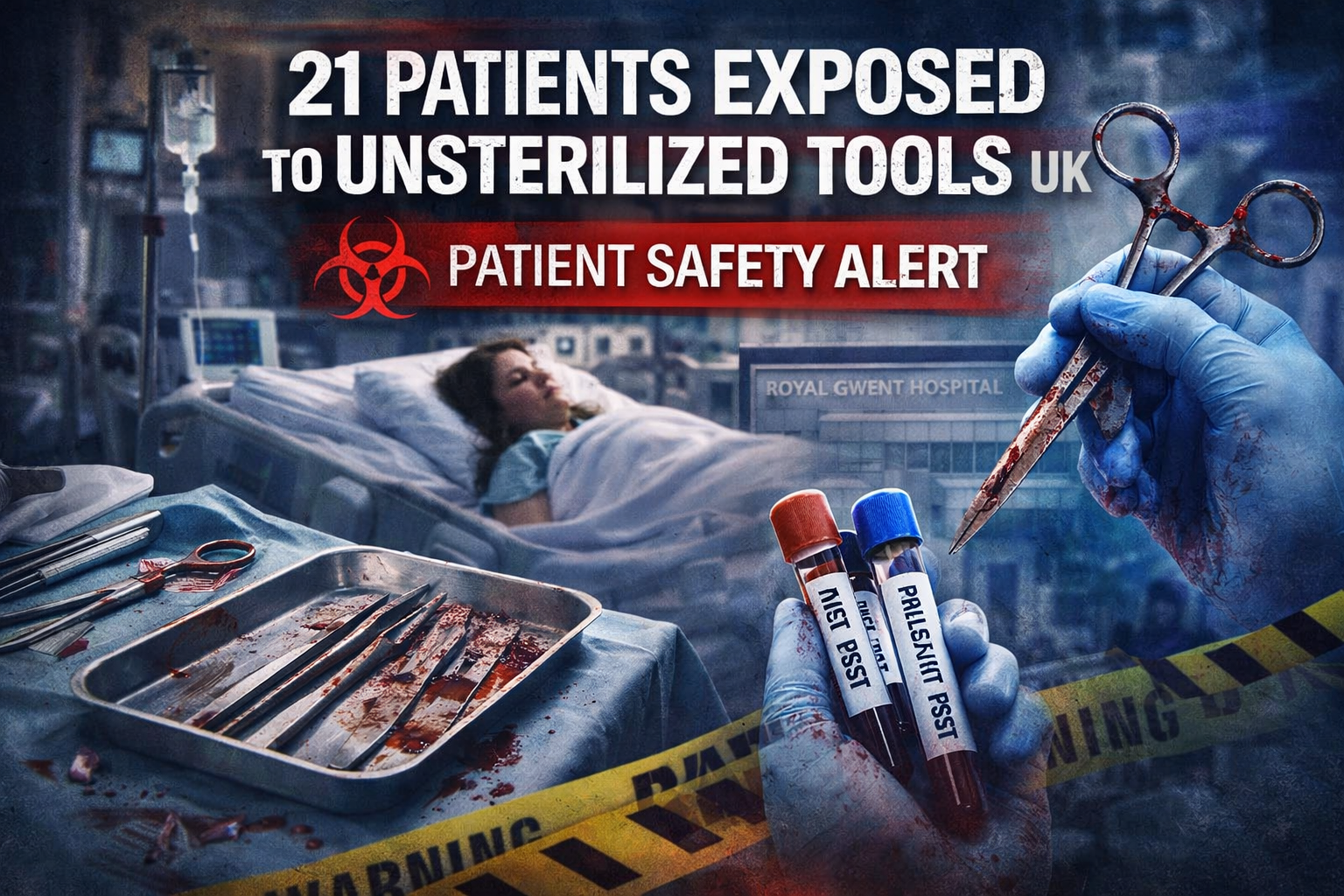
One of the largest patient safety accidents in the United Kingdom has emerged following the treatment of 21 people using poorly sterilized surgical tools in the Royal Gwent Hospital. Hospital protocols, patient safety standards and delays in communication within the health care systems have come to the fore in the case with serious concerns.
The case happened during two days in late February 2026, when medical procedures were performed on the equipment disinfected and not completely sterilized according to the standards of the necessary clinical requirements. Although disinfection minimizes contamination, sterilization is critical to prevent all microorganisms including surgical settings.
Timeline of the Incident
As it was mentioned by the publications of People, the affected operations were performed on February 25 and 26. The breakage of sterilization was revealed on February 27, only a day after the instruments were utilized by the hospital personnel. Nevertheless, patients did not learn about the incident until March 16 which is almost three weeks after.
This is one of the most disputable aspects of the case because of the delay in communication. Affected patients have raised concerns and frustrations by asking themselves why they were not informed as soon as the problem was detected.
Health Dangers and Health Issues
The issue of such cases, and in the first place, is the possibility of spreading bloodborne diseases, such as HIV and Hepatitis. Unsterilized surgical equipment may transmit the infection to other patients, and therefore, it is important not to compromise on the sterilization measures taken in hospitals.
Although the breach was of a serious nature, authorities in the Aneurin Bevan University Health Board have declared that the clinical risk posed to the patients is very minimal. All the affected individuals have been scheduled to take precautionary tests to track possible infections in the long run.
According to medical professionals, the chances of transmission can be in the range of low, but the psychological effect of the illness on patients can be tremendous. The instability that comes with waiting for test results; this may take months at a time, can lead to a lot of stress and anxiety.
Patient Reactions and Experiences
One of the affected persons will include a 15-year-old patient whose follow-up testing months will now be a requirement to ensure that they were not infected. The delay in notification has also made his parents publicly outraged with the incidence as well.
They explained that it was an emotional challenge to explain the situation to their child and that these issues should not be the burden of a young patient. The family also expressed that the time lag in notifying patients might have had a wider effect since there might be incidences of people being exposed to others in the intervening period without their knowledge.
This view has been shared by other patients, who have emphasized the need to have transparency and fast communication in medical care. To a great number, it is not just the mistake itself, but the way it was managed later.
Response and Investigation in Institutions
Aneurin Bevan University Health Board controls the hospital, and the board has released a formal apology accepting the distress that was caused to patients and their families. The organization has initiated an entire investigation process with an aim of finding out how the lapse had occurred, as well as what needs to be done to avoid occurrence of such incidents in future.
Authorities have termed the incident a limited incident and have reassured the populace that there is no wider danger besides the cases that are infected. However, the case has led to the heightened enquiry of sterilization practices and self-observatory measures in the hospital.
The findings of the investigation are also supposed to be reviewed by the healthcare regulators to determine whether further oversight or policy adjustments are needed.
Significance of Sterilization Procedures
Sterilization is one of the key measures in the medical practice, especially in surgical and invasive procedures. It is done by applying unusually high pressure of steam, chemicals or other means to kill all the bacteria, viruses and other microorganisms.
The machinery may be contaminated, resulting in severe health infections when sterilized improperly. Incentives in hospitals are usually characterized by strict rules and regular inspections to make sure that everything is done correctly, so such cases are quite uncommon but very alarming.
Specialists highlight that the loss of trust in healthcare facilities by people can be achieved even by one failure. Consequently, hospitals will have high standards of performance and will apply the multi-level checks of verification to avoid this kind of mistake.
Greater Healthcare System Implications
This case illustrates the dilemma of current healthcare systems in ensuring a high level of quality and safety. Although human error cannot be completely avoided, systems should be made in such a way that problems are identified and dealt with at the earliest.
The scope of time taken to inform patients has also elicited an argument regarding the communication practices in hospitals. It is common knowledge that transparency is a key factor in preserving the trust between healthcare providers and patients. The early revelation enables people to take the right precautions and consult a doctor in case of need.
Over the last couple of years, healthcare organizations have been paying more attention to patient-centered care, which encompasses effective communication, accountability, and responsiveness. The necessity of these principles and constant improvement is emphasized by such incidents.
Ongoing Developments
Since the investigations are ongoing, more information is likely to be presented on the events that caused the sterilization failure. Law enforcement officials will probably investigate the possibility of lapses in the processes, equipment malfunctions, or human error.
Meanwhile, precautionary testing and monitoring are being conducted on affected patients. Medical practitioners are also providing medical advice and counseling to them in an attempt to help them go through the situation and overcome any fears.
The situation is monitored rather closely, as medical experts as well as the general population are waiting to learn the results of the inquiry and further measures of the health officials.