
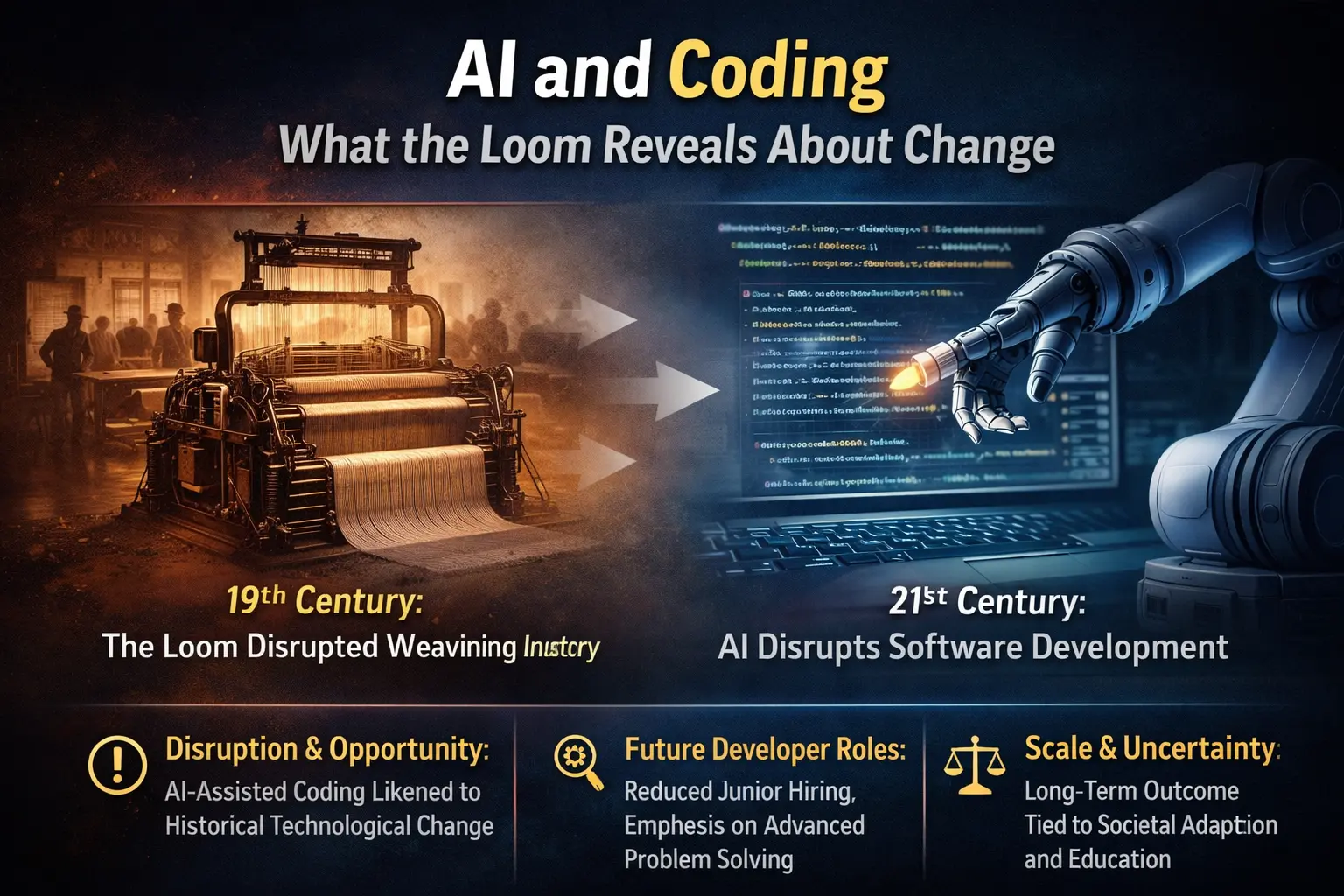
The emergence of generative artificial intelligence (AI) software development tools has become a highly divisive subject on the future of coding and the future of software engineering, in general. A recent review likens this technological transformation to the advent of the industrial loom at the beginning of the 19 th century, which transformed cloth manufacture and labour market as well as sparked off opposition among skilled weavers who feared the loss of their means of living. The analogy shows both the disruptive nature and long-term opportunity of AI in the field of coding, implying that whilst in the short term the profession might be shaken, in the long term the overall effects may be introducing new forms of innovation and work that cannot be fully predicted today.
The Loom as a Metaphor for Technological Disruption
Loom revolutionized the production of cloth since it allowed the less-skilled laborers to make cloth much more effectively than hand weavers. This mechanisation in the short run displaced artisans and lowered wages, and led to the eruption of social restlessness, which developed into the Luddites, workers who brutally fought against the new technology to protect their jobs. However, with time, the loom was used to initiate the Industrial Revolution, which contributed to economies of scale, increased access to goods, and completely new industries and occupations.
Using this historical prism to interpret AI-assisted coding, the argument is not to reduce the actual anxieties about displacement, but to point out that technological change is frequently a process that cannot be predicted. Like in 1820, when it was almost impossible to envision such occupations as telegraph operators and movie producers, the future of coding and software development professions might have such nonexistent jobs.
Current Early Signals: Hiring Trends and Developer Roles
The software employment market is already giving indications of transforming the nature of the employment and training of developers. Hiring of junior developer roles has been reported to have reduced, a move attributed by some industry commentators to the use of AI-based successors to this coding in the form of automated systems that handle mundane coding work. As the demand for senior developers is projected to persist, there exists the fear of a lack of the next generation of engineers to have practical experience in case AI continues to automate basic tasks.
These directions replicate the original effect of the loom: the change in the allocation of labour and skills. In the same way that manual weaving fell out of favor, some traditional forms of coding might lose their place to newer forms of work based on higher-level problem-solving, architectural design, integration and oversight of AI systems, and creative application design.
AI’s Productivity Gains and the Paradox of Learning
Generative AI is already having a significantly profound impact on the developer experience. Code assistants, such as GitHub Copilot, Amazon CodeWhisperer, and other LLM-based assistants, can assist developers with writing code, refactoring old systems, and even identifying security issues, with speeds capable of doing so in many cases faster than can be done by manually writing code. Such tools can be used to increase productivity by automating away boilerplate work, easing the burden on new developers, and allowing experienced developers to work on high-impact work.
But there is a contradiction to this productivity boosting: once AI writes a significant portion of the code, how are developers going to gain knowledge of the basics they need to become proficient? The traditionally accepted practice of training junior programmers involves solving real-life problems, debugging, and code inspection. The more AI performs these activities, the less one might have a chance to develop the rich hands-on experience that characterizes senior developers.
Critics of overreliance on AI tools argue that while these systems can generate code, they lack contextual understanding and can produce errors or insecure code if not carefully reviewed. Human engineers remain essential for validating outputs, understanding system goals, and making architectural decisions, tasks not be easily delegated to AI.
Uncertain Effects on Job Quality and Market Structure
Unlike earlier industrial transformations, the software domain is intertwined with rapidly evolving AI capabilities, making predictions especially difficult. Some experts warn that AI could reduce demand for certain coding skills, especially among mid-level developers performing repetitive tasks. Others suggest that AI will act not as a replacement but as a force multiplier, enabling developers to tackle more complex and creative problems.
In the broader labour market, AI may compress or eliminate some traditional roles while giving rise to new, hybrid positions such as AI prompt engineers, system designers, AI ethics specialists, and roles focused on choreography between human and machine. Just as the early industrial era created entirely novel professions, the AI age may extend beyond what we currently conceive as “coding jobs.”
Skills Shifts and the Future of Developer Education
In response to these shifts, both industry leaders and educational institutions are reevaluating how software professionals are trained. Instead of focusing exclusively on syntax and manual implementation, there’s growing emphasis on algorithmic thinking, systems architecture, and human-AI collaboration skills that leverage human insight and cannot be fully automated.
AI tools can accelerate learning by providing instant feedback and examples. Still, they also demand that developers cultivate critical evaluation skills, understanding when to trust AI outputs and when to intervene. This may elevate the importance of teaching testing, debugging, design principles, and ethics much earlier in developer education.
Broader Economic and Social Implications
The implications of AI in coding extend beyond individual careers. The combination of AI and software development is likely to influence innovation ecosystems, product cycles, and economic growth. Increased productivity could lead to faster development of digital services and products, lowering barriers to entry for software creation and expanding the scope of what’s technologically feasible.
However, this productivity surge could also exacerbate inequalities, as regions or companies with early access to powerful AI tools gain disproportionate advantages. Smaller firms and developers without access to premium AI platforms may struggle to compete, potentially widening gaps in opportunities and wealth distribution.
The Balance of Human and Machine
A central tension in the AI-coding debate is whether AI augments or replaces human creativity and skill. While tools can churn out code, they lack the intuition, context awareness, and conceptual foresight that human engineers bring to complex systems. Where AI excels at pattern recognition and text generation, humans excel at understanding goals, anticipating unintended consequences, and defining architectures before implementation.
This interplay suggests a future where AI and human developers co-evolve: machines handle routine production, while humans steer innovation, ensure quality, and embed ethical values. Such synergy mirrors historical patterns where new tools expanded human capacity without wholly displacing the skilled practitioners who learned to wield them effectively.
Preparing for an Unpredictable Future
The ultimate lesson from comparing AI to the loom is a reminder of uncertainty. The long-term effects of AI in coding will not simply be a matter of job displacement or productivity gains; they will depend on how societies adapt, how education systems evolve, and how businesses leverage AI responsibly.
Just as few in the 19th century could have forecasted careers such as software engineers or data scientists, today’s observers cannot fully predict the careers that will define the next decades. What is clear, however, is that AI will be a transformative force, inextricably woven into the fabric of software development and broader economic life.