
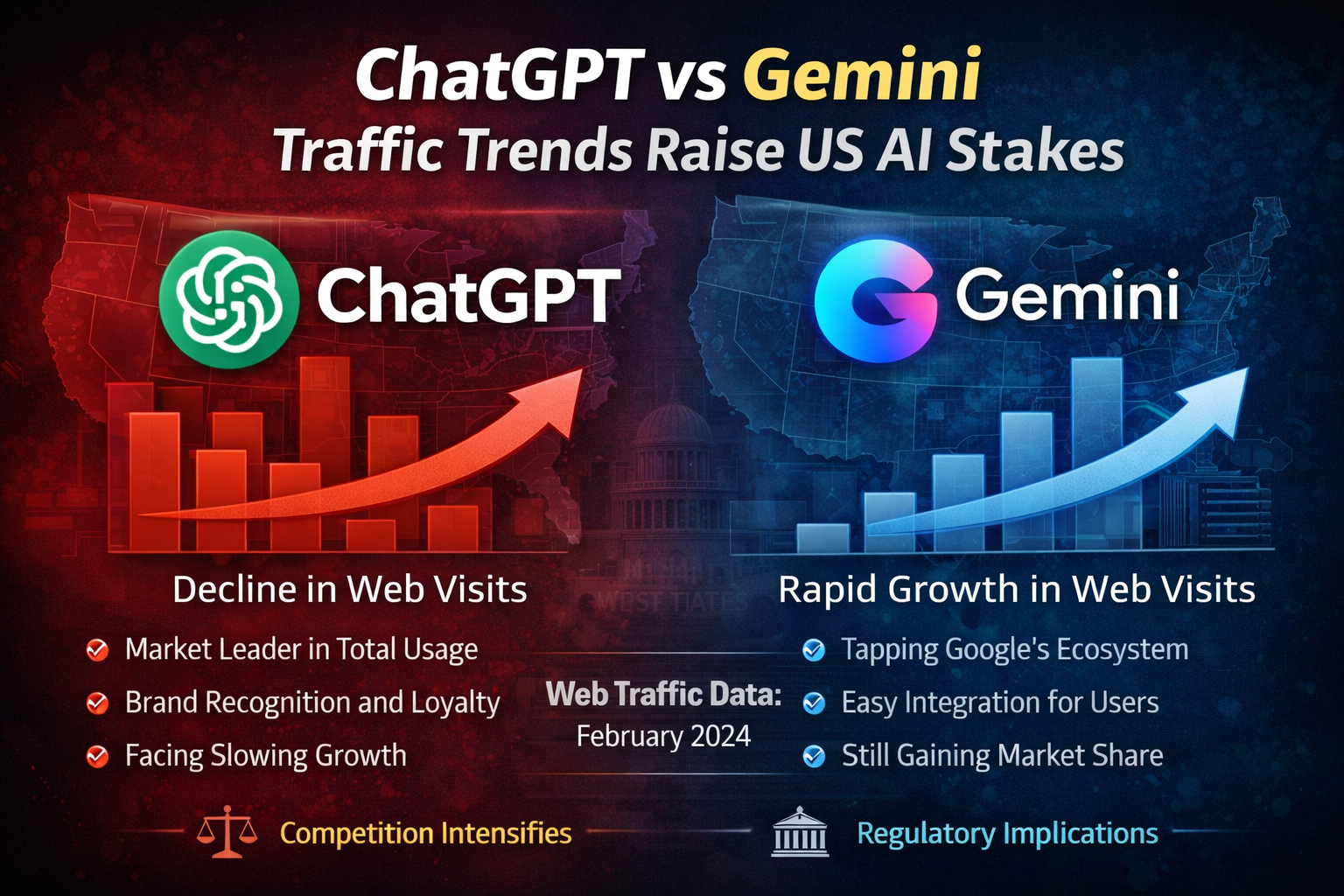
Recent data on new web traffic is also casting doubt on the balance of power in the US artificial intelligence market, with Google rapidly eating up on OpenAI ChatGPT, which had previously been the market leader in consumer-facing generative AI.
Although ChatGPT is by far the most popular AI chatbot in the US, the trends in traffic recently indicate that Google is gaining ground at a faster pace than many analysts predicted. The data also puts an emphasis on the fact that competition in AI is becoming more and more determined not only by the quality of models, but also by distribution, ecosystem integration, and user behavior on the web.
What the Web Traffic Data Shows
Web analytics estimates that are commonly shared in US technology and financial reporting show that traffic to the ChatGPT site has decreased slightly over the past few months, whereas the web traffic of Gemini has grown significantly. In the comparison, particular attention is paid to the visits to chatgpt.com and gemini.google.com, which will provide a glimpse of the direct user interaction.
ChatGPT keeps getting billions of visits monthly, and it is many times more than Gemini. Nevertheless, the growth rate is much faster in the case of Gemini, with month-on-month growth rates that imply a broader adoption with American users. According to analysts, ChatGPT traffic seems to have settled, whereas Gemini remains in the high-growth stage.
Such a deviation has raised eyebrows with some investors and industry observers who regard traffic momentum as a primary indicator of how the market may move in the future.
Why Gemini Is Gaining Ground
The massive US digital ecosystem of Google is one of the greatest opportunities for Gemini. In contrast to ChatGPT, which is mostly a standalone service, Gemini is closely built into products that are already daily used by millions of Americans, such as Google Search, Gmail, Android devices, and Google Workspace.
The barrier to entry is reduced in this integration. Gemini is met passively by many consumers using the available Google tools, and not explicitly when they visit a chatbot site. Consequently, the growth of Gemini might be due to its habit formation, but not the intentional switch, which is a strong platform success factor in the long run.
Google has gone further to invest in making Gemini an assistant that is productivity-centered and capable of managing documents, email, spreadsheets, and code classes, which are all areas that resonate well with the enterprise and professional users in the US.
ChatGPT’s Strengths and Its Challenges
ChatGPT has become the best-known AI chatbot brand in the US. It still has a lead in its total traffic, paid subscriptions, developer adoption, and API usage. To a significant number of users, ChatGPT was the first experience with generative AI, which presents OpenAI with a solid brand and loyalty position.
Nevertheless, analysts note that the natural flattening of the growth curve of ChatGPT is a consequence of the maturation of the service. The initial explosive adoption is now replaced by consistent usage, and newer competitors have the induced advantages of novelty, aggressive marketing, and leveraging an ecosystem.
Observers have indicated that the falling web traffic is not the only indication of the overall declining usage. ChatGPT is increasingly used by many users on mobile applications, enterprise platforms, or third-party integrations as opposed to the web. Nonetheless, web traffic is a significant societal indicator that affects investor behaviour and media coverage.
Distribution Is Becoming the Deciding Factor
The comparison of web traffic suggests a wider change in the US AI market: the distribution can become more important than the performance of the raw models.
The fact that Google can put Gemini directly within its core products provides it with an advantage that can not be easily reproduced by OpenAI. This is somewhat compensated for by Microsoft integrating ChatGPT-powered capabilities into Windows and Office. However, the competition is increasingly becoming more of an ecosystem contest, as opposed to a single tool.
According to industry analysts, users of AI do not often go after AI itself. Instead, they apply AI when it is integrated with workflows that they already depend on, including search, email, documents, and code sites. In this regard, the increasing traffic of Gemini might be an indication of the strategic placement of Google and not discontent with ChatGPT as such.
Implications for OpenAI
The traffic trends come at a critical moment for OpenAI, which faces growing pressure to maintain leadership amid rising competition from Google, Anthropic, Amazon, and other AI players.
In response, OpenAI has accelerated development across multiple fronts, including reasoning improvements, multimodal capabilities, developer tools, and enterprise offerings. The company has also emphasized paid subscriptions and partnerships as key growth drivers beyond consumer web traffic.
Still, analysts say OpenAI must remain vigilant. In the US tech market, shifts in consumer behavior often happen gradually and then suddenly. A sustained decline in engagement, even a small one, can signal larger changes ahead if competitors continue to improve.
What This Means for the US AI Market
For US consumers and businesses, the intensifying competition between ChatGPT and Gemini is largely positive. Rivalry encourages faster innovation, better pricing models, and more robust features.
For enterprises, the data reinforces the importance of AI diversification. Companies increasingly avoid relying on a single AI provider, instead spreading workloads across multiple platforms to reduce risk and maintain flexibility.
For regulators, the growing dominance of large tech ecosystems in AI raises familiar concerns. As Google, Microsoft, and other giants embed AI deeper into everyday tools, policymakers are closely watching for potential antitrust and competition issues, particularly in the US, where scrutiny of Big Tech remains high.
Looking Ahead
While ChatGPT remains the clear leader in absolute usage, Gemini’s accelerating web traffic highlights how quickly the competitive landscape can evolve. The US AI race is no longer about who built the first breakthrough chatbot, but about who can deliver AI most seamlessly into daily life.
If current trends continue, OpenAI may need to rely less on web-based engagement and more on partnerships, platforms, and enterprise adoption to maintain its edge. At the same time, Google’s success with Gemini underscores the power of distribution in shaping the future of AI usage in the United States.
The data does not signal the end of ChatGPT’s dominance, but it does suggest that the race is far from over. Another factor influencing US web traffic trends is how AI tools are increasingly accessed through enterprise licenses and embedded services rather than public websites. Many
American companies now use AI assistants directly inside corporate software platforms, coding environments, and cloud services, which reduces the need for employees to visit standalone chatbot pages. This shift may partially explain why ChatGPT’s direct web traffic appears softer even as overall usage remains strong, while Gemini’s visibility continues to grow through Google’s consumer-facing products that millions of US users encounter daily.