
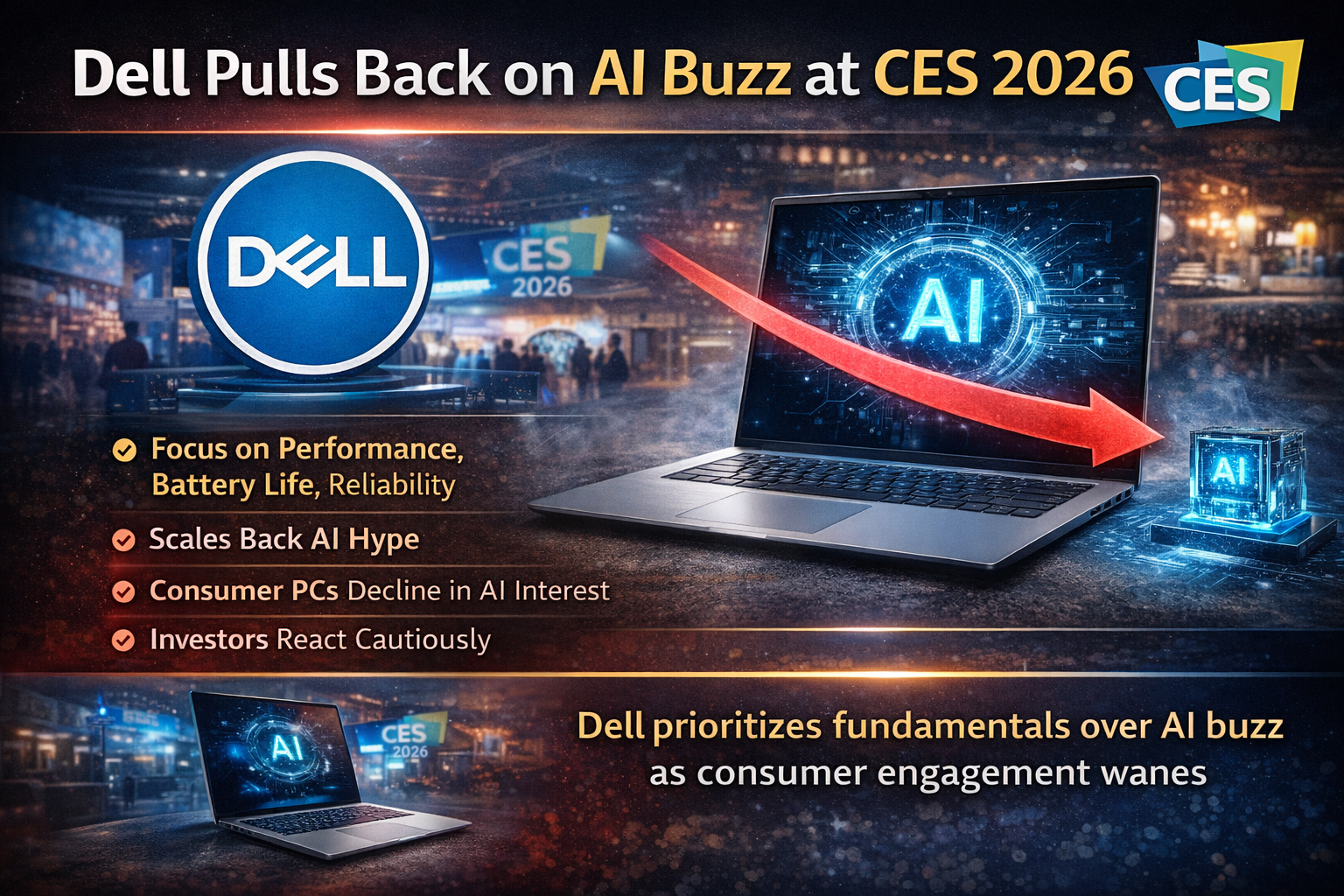
Dell Technologies is acting surprisingly meekly at a technology show that has long been dominated by future promises and buzzwords. The artificial intelligence in the marketing of consumer products became a major concern of the PC giant during CES 2026. This action, according to industry observers, could be the first indication of an early AI hype cycle decline in the consumer PC market, at least.
Whereas most hardware vendors still use the marketing terms that the newest hardware is AI-powered or AI-first, Dell messages talk about performance, battery life, thermal efficiency, design, and reliability. AI was not majorly featured in the company messages, but it remained part of the hardware, which stood in a significant contrast to the last several years.
A Quiet Shift in Strategy
It seems that Dell had planned to reduce its AI-oriented branding and not make a mistake. Company officials pointed out that despite the fact that modern Dell laptops have a neural processing unit (NPUs) that can run AI workloads, they do not influence the buying behaviors of the customers, in most cases, solely on the AI capabilities.
Dell executives say consumer reviews indicate that a large number of consumers are puzzled or unclear about AI terminologies or simply unable to explain how AI hardware enhances their daily computer use. But Dell has chosen to focus on the more physical advantages like the increased battery life, less noisy cooling, better displays and construction features that consumers always know and appreciate.
This strategy is a break of 2024 and 2025, when the AI PC branding was heavily promoted throughout the industry as the next big thing in personal computing.
The Reality of AI PCs
The idea of the AI PC was introduced along with new processors (Intel, AMD, and Qualcomm), each having its own hardware-based AI accelerators. It was an attractive promise; it was going to be faster in-device inference, better security, smarter productivity tools, and less dependent on cloud computing.
Nonetheless, the adoption of it in the market has not been uniform. Enterprise customers and developers have started to experiment with local AI workloads, but average consumers have not realized the benefits in their day-to-day lives. The most popular AI applications continue to be based on cloud-computing services, and the local AI hardware has little impact on AI devices now.
The modest message of Dell can be attributed to the fact that the firm realizes that ordinary customers do not fully realize the actual benefits of AI PCs.
Consumer Priorities Remain Unchanged
The industry analysts observe that U.S. PC purchasers are quite pragmatic. The buying choices remain flowing behind cost, functioning, portability, and durability rather than abstract artificial intelligence features.
The surveys that have been carried out in the last year show that consumers are interested in AI; however, they are not ready to spend more money on features that they cannot identify or do not use on a regular basis. To a large number of consumers, AI is more of a background feature, rather than a distinctive feature of a product.
The shift in Dell marketing is an indication of this fact, as it has focused more on clarity rather than hype, where people are more worried about expenditure on non-essential items due to economic uncertainty.
A Contrast With Industry Trends
The understated nature of Dell became particularly evident in CES 2026, when other companies were pushing to the extent of overemphasizing AI messaging. A number of competitors also displayed laptops under the brand AI development machine that focused on local execution of large-language models, gaming features with AI features, and workflows to create content.
This split accentuates the widening gap in the tech industry. Some companies worry that AI branding is critical to their survival in the market, and there are others, such as Dell, that seem to be doubting whether ongoing AI advertising is appealing to consumers or if it is a source of exhaustion.
Instead of the company giving up on AI, Dell seems to be repositioning it as a behind-the-scenes feature and not a lead.
Enterprise AI Tells a Different Story
Importantly, Dell’s skepticism toward AI marketing applies primarily to consumer PCs. In enterprise and data center markets, the company continues to invest heavily in AI infrastructure, servers, and storage solutions.
Corporate customers, cloud providers, and research institutions remain eager adopters of AI technologies, driving strong demand for high-performance hardware. For these customers, AI offers measurable efficiency gains, automation benefits, and competitive advantages.
This contrast underscores a key industry reality: AI’s value proposition is currently much clearer in enterprise environments than in consumer computing.
Is the AI Bubble Really Deflating?
Notably, the distrust of AI marketing at Dell is focused on consumer PCs. The company is still making massive investments in AI infrastructure and servers, and storage solutions in enterprise and data center markets.
Corporate clients, cloud providers, and research facilities continue to be active users of AI technologies, which is why there is a high demand for high-performance hardware. To these customers, AI is associated with quantifiable efficiency, automation, and competitive benefits.
This comparison highlights one critical industry fact: the value proposition of AI in an enterprise setting is now significantly more evident than in the consumer computer world.
Investor and Market Reaction
Dell’s muted AI messaging sparked mixed reactions among investors. While some interpreted the move as a sign of reduced growth potential in AI-driven consumer hardware, others viewed it as a responsible acknowledgment of market conditions.
Analysts generally agree that Dell’s transparency may strengthen long-term trust with customers, even if it tempers short-term enthusiasm. By avoiding exaggerated claims, Dell positions itself as a company focused on delivering value rather than chasing trends.
This strategy could prove advantageous as consumers become more discerning about technology marketing.
The Broader Implications for Tech Marketing
Dell’s CES 2026 presentation may influence how other manufacturers approach AI messaging in the coming year. As generative AI becomes increasingly normalized, constant emphasis on AI may lose its impact, forcing companies to differentiate products through usability and quality instead.
The shift suggests that AI may soon follow the path of technologies like Wi-Fi, SSDs, and GPUs, once headline innovations, now expected features that require little explanation.
If that happens, the AI era will not end, but its role in consumer marketing will quietly evolve.
A Measured Path Forward
Dell’s decision to scale back AI-centric marketing does not signal abandonment of artificial intelligence. Instead, it reflects a belief that technology should serve users without overwhelming them with jargon.
By focusing on fundamentals while quietly supporting future AI capabilities, Dell is betting that trust and clarity matter more than buzzwords. As CES 2026 demonstrates, the next phase of AI adoption may be less about spectacle and more about substance.