
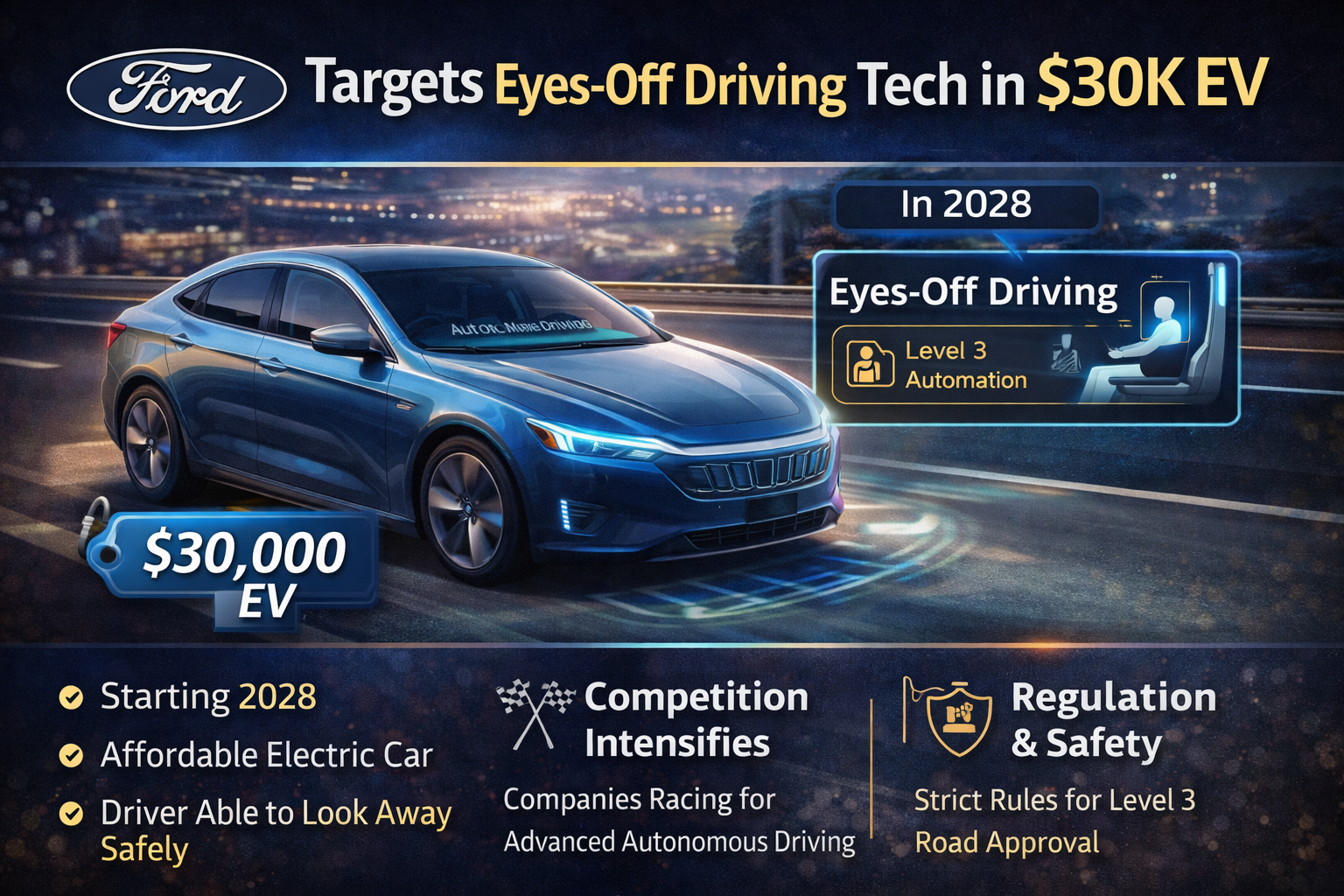
Ford Motor Company is also ready to make a significant move into the next stage of automating the vehicle, and it declared that it will roll out the eyes-off vehicle in 2028, starting with an electric car that will cost about 30 thousand dollars. The relocation puts the automaker in a small but expanding circle of corporations that are competitively vying to implement sophisticated autonomous functions for common consumers instead of restricting them to luxury models.
The release is an indicator of Ford making a fresh drive into advanced driver-assistance systems as the automotive industry tries to balance between innovation, affordability, and safety. Although complete self-driving cars are still on the horizon, the approach taken by Ford demonstrates increasing belief that Level 3 automation, in which a driver is allowed to stop paying proper attention to the road in a set of circumstances, is about to become a mainstream reality.
What Eyes-Off Driving Means
Level 3 automation, as defined by the Society of Automotive Engineers (SAE), is known as eyes-off driving. In contrast to the Level 2 systems, which are currently all over the market providing hands-free steering yet demanding the attention of the driver at all times, Level 3 systems can temporarily take up the driving chores.
The drivers may release their hands on the wheel and concentrate on other activities like watching a screen, reading messages under authorized circumstances, and the vehicle handles the steering, braking, and acceleration. Level 3 still requires drivers to be available upon request in order to take over, and therefore, it is a transition level between assisted driving and full autonomy.
According to Ford executives, the technology will be strictly restricted to specific situations, like specific highway conditions and will adhere to all the available safety and other regulatory provisions.
Building on BlueCruise
The next step in the eyes-off system will be an extension of its current BlueCruise technology that is already in place and provides hands-free driving on pre-mapped highways in the U.S. and Canada. BlueCruise has been continuously expanded and perfected, and has become popular among customers of Ford who want fewer fatigues during long trips.
Nonetheless, drivers are still needed by BlueCruise to have their eyes on the road. The proposed Level 3 upgrade is a major upgrade, which consists of more sophisticated sensors, more powerful computing systems, and improved software that is able to deal with more complicated driving situations.
Ford has signaled that this new generation system will not be provided as a standard feature, but will be offered as an optional feature to enable customers select the level of automation that they desire.
Ford has indicated that this next-generation system will be offered as an optional feature rather than standard equipment, allowing customers to choose how much automation they want.
A $30,000 EV as the Launch Platform
The most dramatic part of the plan by Ford could be its choice to launch eyes-off driving in an electric vehicle that does not fit in the premium category, but instead in the affordable one. The EV, which is scheduled to come out in 2027, and the autonomous feature will come out in 2028, will have a starting price of approximately 30,000 dollars, meaning it is affordable to a significantly larger range of customers.
The car will be constructed using the Ford electric next-generation platform that focuses on affordable pricing, modularity, and software-oriented design. Ford expects to regulate the expenses and remain flexible to add features later by developing a significant portion of the system internally.
The industry analysts believe that this strategy may transform the perceptions with regard to high-level driving technology that has always been used by vehicles priced more than 70,000 dollars.
Competition Intensifies
This announcement by Ford puts it in the same competition with other automakers who are also aiming at similar objectives. Mercedes-Benz already has some Level 3 autonomy available in selected markets, and General Motors has declared its intentions to launch eyes-off systems in luxury Cadillac vehicles later this decade.
The unique aspect of Ford is its orientation towards being affordable. As competitors tend to introduce the new autonomy capabilities in their flagships, the approach of Ford can be taken as an indication of the belief that the mass market can be offered advanced automation due to the economies of scale and better software efficiency.
Analysts believe that such a move would force competitors to reevaluate their pricing policies in order to encourage a positive consumer reaction.
Regulatory and Safety Challenges
Level 3 autonomy is also highly controlled, even with advancements in technology. The state-by-state regulations, safety certification, and transportation authority coordination are required to get their approval. Ford executives admit that the implementation will be slow and will only be confined to areas that permit the eyes-off driving regulations.
The most important issue is safety. Level 3 systems should be able to tell when conditions are right to carry on autonomously and state clear takeover requests when necessary. Failure during this handoff process would be very detrimental.
According to Ford, it is putting a lot of money into simulation, real-world testing and redundancy systems to make sure it is reliable first, before making the feature available to its customers.
Consumer Trust and Adoption
Public perception of autonomous driving remains mixed. While many drivers appreciate hands-free assistance, surveys show hesitation when it comes to relinquishing visual attention entirely.
Ford plans to address these concerns through education, transparency, and optional adoption. Customers will not be forced to use eyes-off driving, and the system will include clear indicators showing when automation is active and when human control is required.
Automakers across the industry recognize that trust will be earned gradually, as drivers gain confidence through consistent, safe performance.
AI Beyond Driving
In addition to autonomy, Ford is expanding its use of artificial intelligence across the vehicle experience. The company plans to roll out an AI-powered assistant that integrates with vehicle systems, mobile apps, and cloud services.
Unlike generic voice assistants, Ford’s system is designed to understand vehicle-specific context, such as cargo capacity, towing limits, and route conditions. It reflects a broader shift toward software-defined vehicles that rely on continuous updates and data-driven improvements.
These AI capabilities complement the company’s autonomy roadmap, reinforcing Ford’s push to become a more software-focused automaker.
Strategic Timing
The 2028 target reflects Ford’s belief that the technology, infrastructure, and regulatory environment will be sufficiently mature by the end of the decade. While fully autonomous vehicles remain years away, many experts see Level 3 systems as the most realistic next step for consumer adoption.
By setting a clear timeline, Ford is signaling confidence while allowing time for refinement and approval. The company has emphasized that it will not rush deployment at the expense of safety or reliability.
Implications for the Auto Industry
If successful, Ford’s approach could mark a turning point in how advanced automation is delivered to consumers. Making eyes-off driving available in an affordable EV challenges the assumption that autonomy must come with luxury pricing.
The move also highlights the growing convergence of software, AI, and traditional automotive engineering. Vehicles are increasingly defined by their digital capabilities, with automation playing a central role in shaping future mobility.
Looking Ahead
Ford’s plan to introduce eyes-off driving in a $30,000 electric vehicle represents one of the boldest attempts yet to democratize advanced autonomy. While obstacles remain from regulation to consumer trust, the strategy underscores how quickly the automotive landscape is evolving.
As the race toward greater automation accelerates, Ford’s 2028 vision positions the company as a serious contender in shaping how Americans experience driving in the years ahead.