
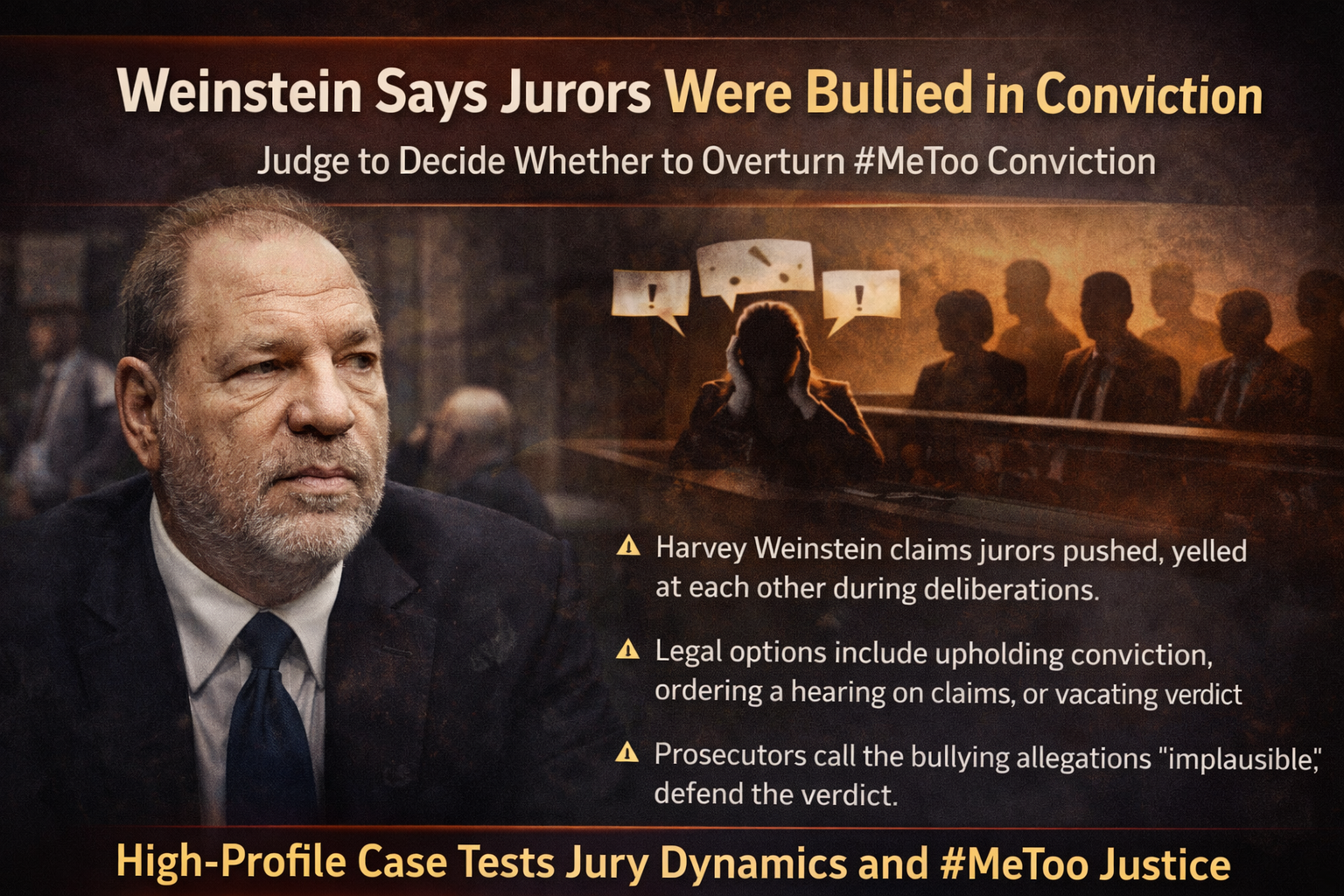
In a dramatic twist in one of the most followed legal stories of the MeToo period, Harvey Weinstein, formerly the Hollywood titan, has come back to a New York Courtroom to have his latest conviction of sex crimes thrown out, not because he truly did not do it, but by claiming that the jury in his new trial was intimidated and bullied into convicting him. The question whether that conviction shall be upheld as is, vacated altogether or further hearings given is now pending in the judgment of a judge.
It is another twist to a seven-year legal journey that has included trials across various states, reversals in the appellate courts and a focus on the dynamics of jury deliberation in big-time cases, and casts a new question on the nature of jury deliberation. This is a detailed analysis of the current events, the allegations and denials, and what it alludes to justice, due process and the long-term legacies of both Weinstein and the movement itself, the #MeToo movement.
Legal and Factual Background: A Case That Will Not Clear
The legal problems of Harvey Weinstein started in 2017 when the wave of sexual assault claims against the former-famous film producer contributed to the spread of the movement of #MeToo. After that, Weinstein has been prosecuted several times in New York and Los Angeles and convicted, reversed, and retried.
In the latest retrial in New York:
- Weinstein was found guilty of forcefully giving one of the women oral sex.
- He received a comparable criminal charge of sex with a second woman, but this time he was acquitted.
- The jury could not give a verdict on a rape allegation leveled against a third accuser, and the prosecutors promised them a second trial on the matter.
Weinstein, who is 73, has continuously denied all the non-consensual acts and argued that his encounters with his accusers were consensual and involved consensual relationships or transactions.
The New Claim: Juror Bullying and Intimidation
This week, in Manhattan criminal court, Weinstein’s defense asked a judge to throw out the conviction from the retrial, alleging that jurors did not deliberate freely and fairly. According to the filings and sworn statements:
- At least one juror complained that others pushed, yelled at, and verbally pressured them during deliberations.
- The foreperson, who presided over jury discussions, later claimed that he was intimated even threatened by other jurors, to the point that he refused to return to the deliberation room at one stage of the trial.
- One juror said they called relatives during the jury process out of fear and a sense that something was “not right about this jury deliberation process.”
The defense argues that these accounts demonstrate that some jurors did not reach their verdict based solely on evidence presented in court, but rather under pressure from fellow panel members, thus tainting the integrity of the verdict.
Judge’s Options: What Could Happen Next
The judge overseeing the case, Judge Curtis Farber, is now expected to rule on Weinstein’s motion. Under the law, a judge has several options:
- Uphold the conviction, deeming any jury disagreements or tensions as within the acceptable bounds of deliberation.
- Vacate the verdict, effectively throwing out the conviction and potentially ordering a new trial on that charge.
- Order a hearing specifically to investigate the allegations surrounding jury conduct more deeply.
All of these options are possible, and each carries implications for how this long-running case will proceed. Prosecutors have already signaled they are prepared to retry Weinstein on the unresolved rape count.
Prosecutors Push Back: Claims Called Implausible
Prosecutors have forcefully denied that the jury was improperly influenced, characterizing defense claims as “implausible” and part of a strategic legal attack to avoid accountability. In filings opposing the motion:
- Prosecutors note that jury deliberations can be tense, especially in emotionally charged cases, without crossing the line into misconduct.
- They said that the judge was informed of limited instances of contentious interactions at the time and handled them appropriately.
- According to their view, later sworn statements alleging pressure contradict other jurors who described deliberations as “just high tension.”
In short, the government maintains that there is no legal basis to overturn a conviction simply because some jurors felt social pressure during discussions, a phenomenon unfortunately not uncommon in close-knit deliberations.
The Importance of This: Due Process and Public Confidence
What is at stake in this legal case is not only the destiny of a single person but also the belief of the people in the fairness of the justice system in the United States, particularly in a high-profile, emotionally charged case.
Due Process Concerns
All defendants, regardless of how detestable they are, are entitled to a fair hearing, which includes unprejudiced and independent jury discussions. In the event a verdict was arrived at due to fear, intimidation or coercion of jurors by their counterparts, that is a grave concern for due process.
Jury Deliberation Dynamics
It is also true that the tension and disagreements between jurors are usual things during deliberations, particularly when the evidence is graphic and disturbing. Judges usually advise jurors to listen to each other and find a common ground, and they would hardly interfere in cases when it is evident that there was a lack of justice.
This renders the decision, which is about to be made by the judge, particularly consequential. He has to separate the strongly argued debate from the inappropriate coercion, and it is not easy in any courtroom and, in fact, more difficult in a courtroom that is actively covered by the media.
Historical Context: A Case Full of Twists
This is not merely a retrial; it is part of a legal journey full of twists:
- Weinstein’s original conviction in New York was overturned in 2024 by the state’s highest court, which found procedural errors had undermined the fairness of that trial.
- A retrial was ordered, leading to the mixed verdict last year.
- Simultaneously, Weinstein is appealing a separate conviction in Los Angeles, where he received a 16-year prison sentence on related charges.
That means Weinstein’s legal status is currently a patchwork: serving time on one sentence, challenging another conviction, and now appealing the process and outcome of this retrial.
Public and Cultural Impact: #MeToo, Accountability, and Justice
Weinstein’s case was one of the first and most dramatic to emerge out of the #MeToo movement, which helped empower survivors of sexual misconduct to speak out. A decision to overturn his conviction on procedural grounds could be deeply divisive:
- Supporters of Weinstein’s conviction worry it would embolden defendants in future cases to attack jury verdicts on procedural minutiae rather than substantive evidence.
- Advocates for due process argue that the system must be unwavering in ensuring that trials, even unpopular ones, are beyond reproach in fairness.
This tension reflects a broader societal debate about balancing accountability for powerful actors with protections for individual rights during prosecution.
Editorial View: Why It Is an Essential Moment
As an editorial opinion, the justice system is put to the test at this stage of the Weinstein saga:
Rule of Law Must Prevail
The system should follow the legal standards to the letter, even in situations that involve highly despicable conduct. Deliberation should not be intimidated or coerced by the jury.
Transparency is the Key to Public Trust
Judges and prosecutors must be open-minded when it comes to the process of dealing with jury-pressure accusations. Trust in jury decisions is pegged on the notion that jurors make their decisions based on evidence and the law and not emotions or fear.
High-profile Cases require high standards
In situations where the cases gain so much publicity, it is especially upon the court to take special care that, at any rate, every procedure, jury selection through deliberation, is conducted to the utmost standards of fairness. This helps to keep the legitimacy of the verdicts, both to the supporters and critics.
To put it in other words, the decision of this judge will not only be the end of the road for Weinstein on this conviction, but also reverberate in future high-profile cases where the stakes are high and the public is unsparing.