
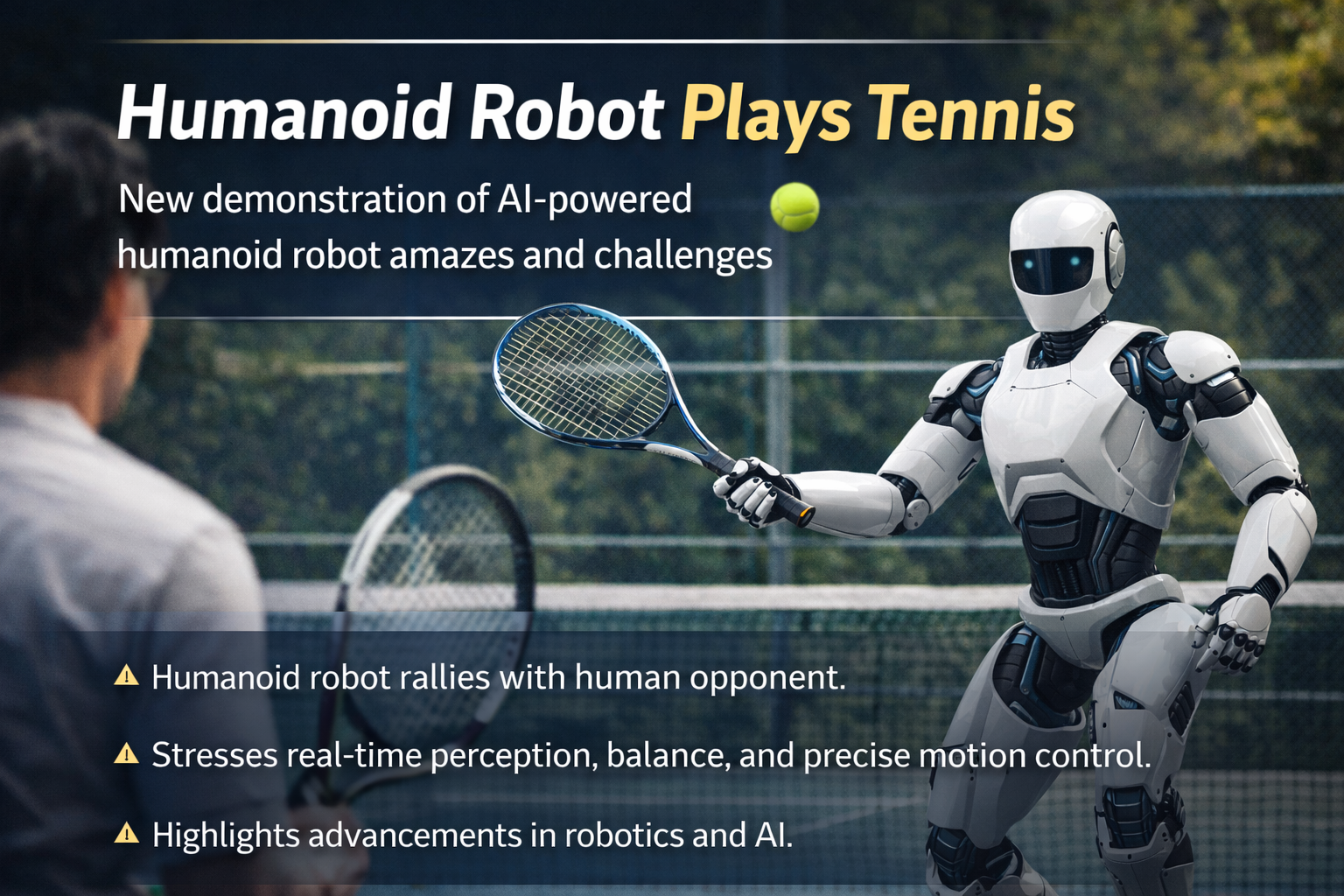
Humanoid robots are gradually leaving research laboratories and factory floors, and a recent demonstration involving a robot capable of playing tennis is attracting a lot of attention. A humanoid robot in a new video is observed to be rallying tennis balls with a human partner, following the swift shots and returning them with amazing time and coordination. Although the robot is still not in a position to compete at a professional level, the demonstration represents an important milestone in the development of robotics and artificial intelligence.
Tennis demands much more than simple mechanical strength to play. It requires real-time perception, balance, anticipation and exact control of the movement. Through a well-aware ability to unite these elements, the robot proves the success of humanoid robotics over the past few years.
Why Tennis Is a Major Challenge for Robots
Tennis is one of the most challenging sports that a robot will be able to do due to its speed and uncertainty. The ball may move at a great speed, jump in different directions, and shift direction because of the spin. To her, a humanoid robot has to process visual information continuously, forecast the ball path and move its entire body in a matter of fractions of a second.
A tennis court presents the variability that robots do not deal with easily, unlike controlled environments in factories. There is a dynamic change of lighting conditions, speed of the ball and movement of human beings. The capability of the robot to handle these variables is an indication of major developments in sensor fusion, machine vision and motion planning.
Advanced Vision and AI at Work
The most important part of the tennis-playing robot is a sophisticated vision system that follows the movement of the ball in real-time using cameras and depth sensors. The models of artificial intelligence will examine the speed, direction and projected landing point of the ball to determine how and when a robot should swing.
These AIs are required to work with very low latency. Any slight delay between the time when the ball is viewed and the time when the robot acts might lead to hitting the ball out of the field completely. According to engineers, the system is based on predictive modeling so that the robot can anticipate the path of the ball instead of merely responding to the bouncing of the ball.
Balance and Human-Like Movement
The balance of a robot is one of the most impressive in the demonstration. Having stability and stepping on the side, turning the torso, and swinging an arm is extremely challenging for humanoid machines. Human beings do these tasks without consciously thinking, and a robot has to make all the movements accurate.
Each shot is supported with the help of the legs of the robot, its hips, and its upper body. The degree of coordination signifies the significant enhancements in the whole-body regulation algorithms and in the joint actuation. Even minor advancements in balance management can greatly increase the scope of what the humanoid robots can do.
From Lab Experiments to Real-World Motion
Robots have been very efficient in repetitive work like assembling a product or transporting items within warehouses over the decades. Sports, nevertheless, are quite a different matter. They need flexibility and not monotony.
The tennis demonstration points to a more generalized research in robotics for general-purpose machines, able to cope with uncertain situations. The sports are considered by the engineers as a perfect testing field since they would push the robots to bind perception, planning and motion into one continuous process.
Public Reaction and Online Attention
Videos of the tennis-playing robot have quickly spread across social media platforms, generating a mix of excitement and skepticism. Many viewers are impressed by the robot’s ability to track and return shots, while others point out that the rallies appear carefully staged and controlled.
Robotics experts acknowledge that such demonstrations are usually optimized to highlight strengths rather than weaknesses. However, they also emphasize that even controlled success in a fast-paced sport like tennis represents real technical progress. Each demonstration builds on years of research and incremental improvement.
Applications Beyond Sports
While a tennis-playing robot may seem like a novelty, the underlying technology has practical implications. The same capabilities that allow a robot to track a tennis ball could be used to navigate crowded spaces, assist people with limited mobility, or handle objects in unpredictable environments.
In disaster response scenarios, for example, robots capable of maintaining balance and reacting quickly could navigate debris-filled areas where wheeled machines struggle. In healthcare, humanoid robots with refined motor control could help patients with physical therapy or daily tasks.
Humanoid Robots and the Future of AI
The tennis-playing robot is also indicative of a wider shift in the direction of embodied AI, with artificial intelligence combined with physical machines. Although AI has advanced rapidly in the digital realm, like language and image creation, the use of intelligence in physical movement is one of the most difficult problems in computing.
Winning sports evidences that AI systems are starting to bring the digital knowledge and physical behavior closer. This intersection has been broadly regarded as a major move to more useful and capable robots.
Challenges Still Ahead
Though it is a spectacular display, there are still major challenges to overcome to have humanoid robots as a common occurrence. A significant problem is power efficiency because sophisticated movement and real-time calculation require a high level of energy. It is also expensive in terms of hardware.
Safety is another concern. The fast and forceful movement of robots should be well designed in order to not damage human beings around. Developers also insist on the significance of rigid safety measures such as force limits and emergency shutdown systems.
Global Competition in Robotics
The tennis robot is one among several other attempts globally to develop humanoid robots. Businesses and universities across the globe are competing to have machines that will be efficient to use in the human environment. Academic researchers have been working with the private companies, which has expedited the advancement, as the competition gets tighter.
Governments and industries are keeping a close eye because it has realized that the leadership in robotics might have a great economic and strategic implication in the next few decades.
What This Demonstration Represents
It is not a technological frivolity, but rather a technological wonder to see a humanoid robot throwing back tennis balls. It is a manifestation of decades of gradual advances in AI, sensing, and mechanical engineering converging in a familiar and understandable form.
But it is still far away before robots can really compete with professionals; such demonstrations give an indication of how machines are increasingly becoming capable of perceiving, moving, and reacting in physical environments that are more complex. More enhancements of these capabilities will probably make humanoid robots have a significant part in daily life.