
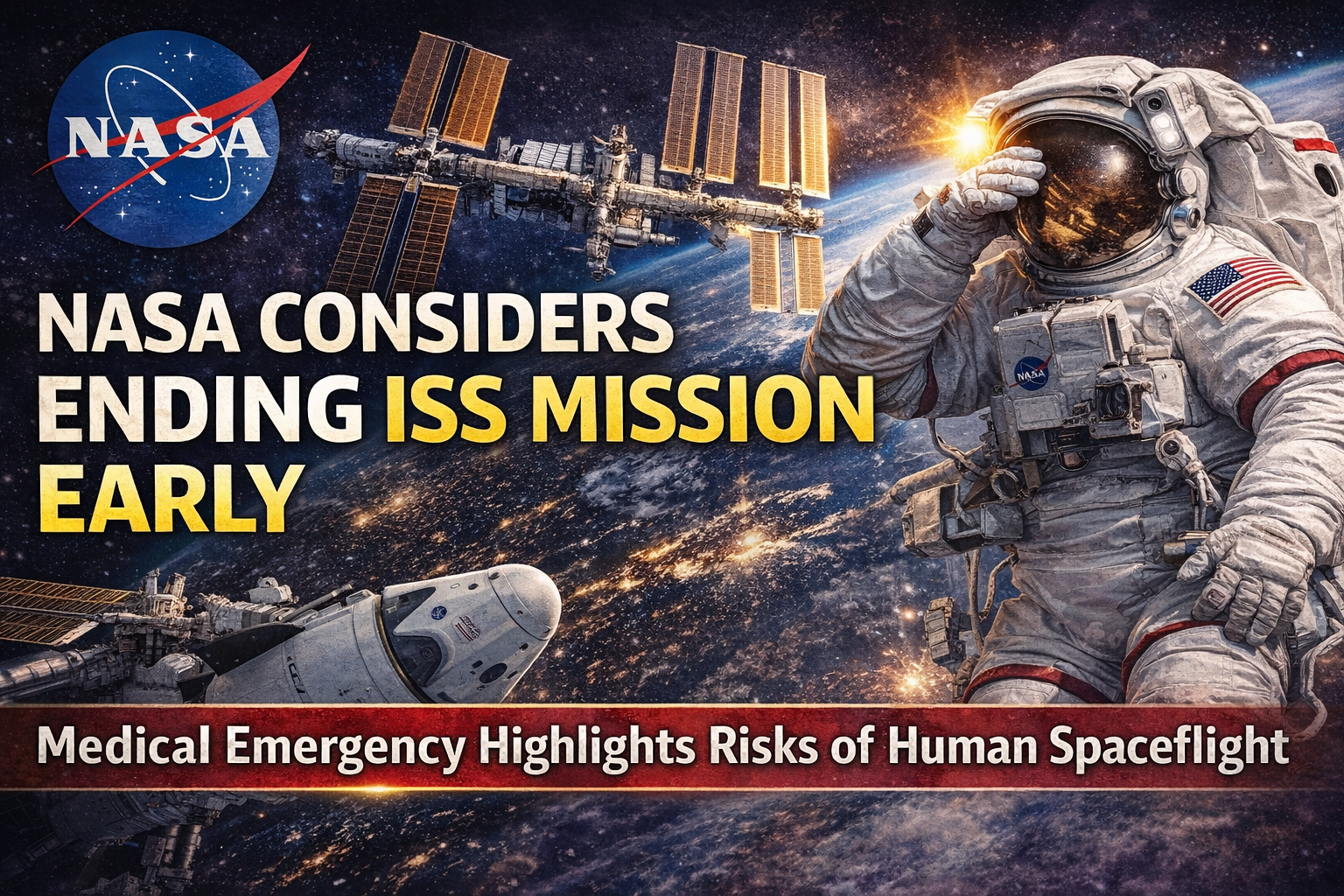
NASA is weighing an early end to an ISS mission after a medical emergency, highlighting the risks and realities of human spaceflight.
The NASA agency is considering the option of ending the SpaceX Crew-11 mission before completion after a medical emergency on board the International Space Station (ISS) triggered the cancellation of a scheduled spacewalk, and this decision demonstrates the vagaries of the human spaceflight, as well as the initial concern of the agency: crew health and safety.
In a unique twist, NASA officials on Wednesday said they were looking to send the four-person Crew-11 crew home early. The step follows the cancellation of a spacewalk planned for January 8, following a medical concern of one of the crewmembers which resulted in urgent assessment of flight surgeons and mission control back on Earth.
The agency said in a statement that this is the scenario that NASA and its partners train and prepare to execute safely. The safety of our missions is our utmost priority and we are considering all the alternatives, and one of them may involve earlier termination of the mission of Crew-11.
A Postponed Spacewalk Signals Urgency
The delayed spacewalk was an Extravehicular Activity (EVA) that NASA astronauts Mike Fincke and Zena Cardman were to perform, to perform additional exterior repairs on the ISS, including work to receive hardware additions like new solar arrays. The fact that such a carefully organized operation was postponed highlighted the weight of the issue of the health problem that NASA is taking, despite the fact that the condition of the affected astronaut has been reported to be stable. NASA has not kept the identity of the involved astronaut and the nature of the medical issue in question without reporting in accordance with standard medical privacy policies. The agency repeated itself in its public messages that further information would be issued in the next 24 hours.
Who Is on Crew-11?
Crew-11, launched to the ISS aboard a SpaceX Crew Dragon spacecraft on August 2, 2025, is comprised of:
- Commander Zena Cardman (NASA) — mission specialist and geobiologist
- Pilot Mike Fincke (NASA) — veteran astronaut with multiple long-duration missions
- Mission Specialist Kimiya Yui (JAXA) — representing the Japan Aerospace Exploration Agency
- Cosmonaut Oleg Platonov (Roscosmos) — Russian space agency representative
The mission was originally planned for a six-month duration, with a scheduled return to Earth in May 2026. If NASA opts for an earlier undocking and splashdown, the mission would still be close to its intended length, but this deviation is notable given the infrequency of early exits due to health concerns.
Astronaut Health in Space: A Persistent Challenge
Space agencies anticipate a range of health issues on orbital missions, from minor illnesses like colds and sinus infections to more complex conditions related to microgravity’s effects on bone density, muscle strength, and cardiovascular function. Onboard medical kits and telemedicine links help astronauts and ground-based doctors manage many problems — but severe or uncertain cases require careful assessment.
What makes this case exceptional is not merely the medical issue itself — details of which have not been made public — but the consideration of ending a mission early in response. While astronauts have returned ahead of schedule for personal or medical reasons in the past, such moves are uncommon and only taken when deemed necessary for crew health or mission objectives.
Strategic Timing and Operational Impacts
The Crew-11 team is nearing the latter stages of its planned stay aboard the ISS. A potential early departure would likely take place aboard their docked SpaceX Crew Dragon spacecraft, provided it remains in safe, ready condition for re-entry to Earth. SpaceX’s Crew Dragon vehicles are routinely used for crew rotation and emergency return scenarios thanks to their reliability and robust design.
In addition to the operational intricacies of an early return — including coordinating ground support teams and splashdown windows — NASA must balance this decision with the ongoing rotation of other missions. Crew-12, the next scheduled ISS crew rotation, is currently planned for February 15, meaning there is limited margin for schedule disruption.
International and Collaborative Considerations
The multinational crew of ISS and the joint management of the mission are two of its peculiarities. The fact that NASA communicates with other partner agencies, Japan JAXA, Russia Roscosmos, and others, including ESA and CSA, implies that a decision made by one crewmember or spacecraft can spill over to international research policies and operational strategies.
Regarding Crew-11, it is clear to have representatives of NASA, JAXA, and Roscosmos, which serves as a reminder of the globality of the ISS program. Any modification in the returning plans would be accompanied by consultations in various ground networks and mission control centers.
Historical Context: ISS Health Scenarios
Since the beginning of November 2000, the ISS has been continuously staffed, and in the course of it, astronauts have encountered both mild and complex cases of health complications. There are previous examples of this in the past, such as tooth emergencies, skin infections, or sudden ailments that have been treated in orbit with direct advice of Earth-based doctors and medical equipment on board. But complete confidentiality concerning certain medical information is a rule.
In comparison, mission abortions have been uncommon because of health reasons. The main concern of NASA is that every astronaut is provided with proper care in orbit, and only in extreme cases, early returns are performed. This philosophy is based on decades of experience in risk management and gives the priorities to life by overcoming the schedule.
Editorial Insight: Balancing Transparency and Privacy
This development is a bitter pill because, as an editor, this is what I have witnessed over decades of spaceflight: the human component of the rockets, science experiments, and political cooperation. The space agencies have been dealing with a field where extremities are the order of the day. Still, the men performing these missions are susceptible to much the same as people on the earth, but distance and remote locations only amplify the susceptibility.
NASA’s communication strategy — sharing the implications of the situation while withholding personal health details — strikes a careful balance. It maintains operational transparency without compromising the dignity and privacy of individual astronauts. This approach is consistent with both ethical journalism and responsible public communication in science and spaceflight.
Looking Ahead
As NASA continues evaluating the situation, updates are expected within the next 24 hours. In the meantime, the spaceflight community — both inside and outside NASA — is closely watching. The outcome of this decision will not only affect Crew-11’s return timeline, but may also influence future policies regarding medical response and crew management aboard the ISS.
Ultimately, what matters most is the health and well-being of the astronauts who make the extraordinary leap from Earth to orbit in the service of science and exploration. This latest development, while unsettling for some, underscores the reality that even seasoned spacefarers and sophisticated agencies must adapt to the unpredictable conditions of life beyond our planet.