
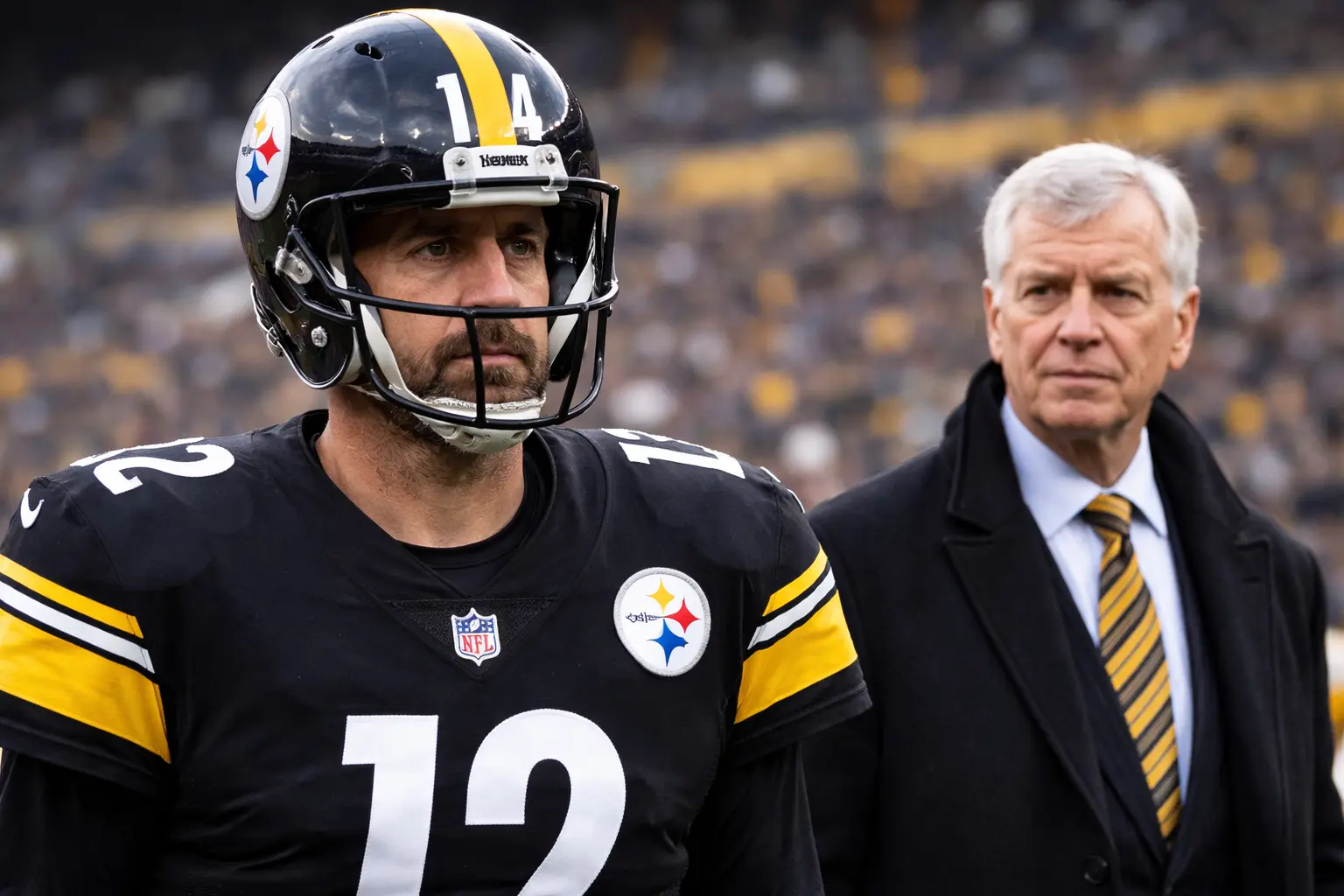
Pittsburgh Steelers owner Art Rooney II delivered a stark and very straightforward message this week about the uncertain future of veteran quarterback Aaron Rodgers with the franchise a future now clouded in doubt following the departure of longtime head coach Mike Tomlin.
In a candid remark that captured the attention of football fans everywhere, Rooney acknowledged that Rodgers’ decision about whether to continue playing and specifically whether he will return to the Steelers likely hinges on Tomlin’s exit. “Aaron came here to play for Mike,” Rooney said in a brief but revealing comment to reporters, suggesting that Tomlin’s departure will influence Rodgers’ next steps.
Rodgers, 42, signed with Pittsburgh last year on a one‑year deal that reunited him with Tomlin after an accomplished career with the Green Bay Packers and a stint with the New York Jets. His relationship with Tomlin widely respected as one of the most consistent and successful coaches in recent NFL history — was a major factor in his decision to join the Steelers.
A Year of High Hopes and Harsh Realities
The 2025 season was one of both optimism and disappointment for Pittsburgh. Rodgers led the Steelers to a 10‑7 record and an AFC North title, rekindling expectations of a deep playoff run. But a crushing 30‑6 loss to the Houston Texans in the wild‑card round ended those dreams abruptly and raised questions about the team’s direction.
Even before the playoff exit, Rodgers had hinted that this might be the final season of his illustrious career. In media appearances last summer, he acknowledged that retirement was a possibility, though he stopped short of a firm commitment.
With Tomlin now stepping down after 19 seasons as head coach, the season’s turbulent end and the coaching change have left Rodgers and the franchise at a crossroads.
Rodgers’ Uncertain Decision: Retirement or Return?
Rodgers hasn’t publicly announced a decision on retirement or his future with the Steelers, but his options now feel more open — and more complicated than ever.
Some Steelers players have publicly supported the idea of Rodgers returning for another season. Veteran defensive lineman Cameron Heyward, for instance, said he’d welcome Rodgers back if he decides to continue playing, emphasizing both respect and admiration for the quarterback.
Yet outside voices have offered a harsher perspective. Former NFL great Troy Aikman recently suggested that Rodgers may have played his last game, noting that age and performance trends often weigh heavily on quarterbacks in their early forties.
The key question looming over Rodgers now and one that fans, analysts, and teammates alike are waiting to see answered — is whether he truly wants to keep playing after the 2025 season. His affinity for Tomlin appeared strong all year, and now that the coach is gone, that emotional connection could be a deciding factor in Rodgers’ next chapter.
The Rooney Angle: Leadership, Loyalty, and Transition
Art Rooney II’s comments about Rodgers weren’t just brief remarks — they offer a candid view into the franchise’s mindset during a transitional period. Rooney made clear that Tomlin was a central piece in the team’s strategy and that Rodgers’ presence was tied to that leadership.
Rooney also confirmed that the Steelers have begun a search for a new head coach, the first time they have done so since 2007. That search is expected to be thorough, with ownership considering candidates who can both rebuild the team’s culture and compete at a high level.
Whether the next coach will be someone who influences Rodgers’ decision or someone who arrives with a fresh vision that sidelines veteran priorities — remains to be seen.
What Rodgers’ Future Means for the Steelers
Rodgers’ future is not just a storyline about one player; it has significant implications for the Steelers’ identity moving forward.
With the franchise already navigating major change — a new coach, an aging core of veterans, and a recent playoff disappointment — the uncertainty around Rodgers’ status adds another layer of complexity.
If Rodgers chooses to retire, Pittsburgh will almost certainly enter a rebuilding phase that could affect draft strategy, salary cap planning, and the team’s direction for years. If he chooses to play on — whether in Pittsburgh or elsewhere — it could reshape how the team approaches offensive strategy and player development.
Fans, Legacy, and the End of an Era?
For many Steelers fans, Rodgers’ arrival brought excitement and hope. His decision to sign with Pittsburgh after long tenures in Green Bay and New York was seen as a bold statement of ambition — a statement that the storied franchise still had championship dreams.
Now, with Tomlin gone, that chapter feels like it might be closing. If Rodgers retires, his tenure in Pittsburgh will be remembered as short but impactful — a veteran leader trying to spark a resurgence in one of the NFL’s most tradition‑rich organizations.
If he returns, it will be seen as a vote of confidence in the franchise’s next phase, regardless of who is at the helm.
Either way, this offseason promises to be one of the most defining in recent Pittsburgh history.
Editorial Perspective: What This Says About NFL Careers
From an experienced editor’s point of view, Rodgers’ situation is a microcosm of how the NFL handles aging stars, loyalty, and transition.
Quarterbacks rarely face a clearer crossroads than this: the choice between stepping away at the top of their legacy or grinding through another season to chase unfinished business. Rodgers is in both categories.
His decision will not only affect the Steelers’ roster, coach search, and fan expectations but it will also rekindle broader conversations about how the league values veteran leadership versus long‑term team building.
We are reminded that even in a sport driven by youth, passion, and constant change, the human element, loyalty to a coach, love for competition, and fear of goodbye still resonate deeply with fans.