
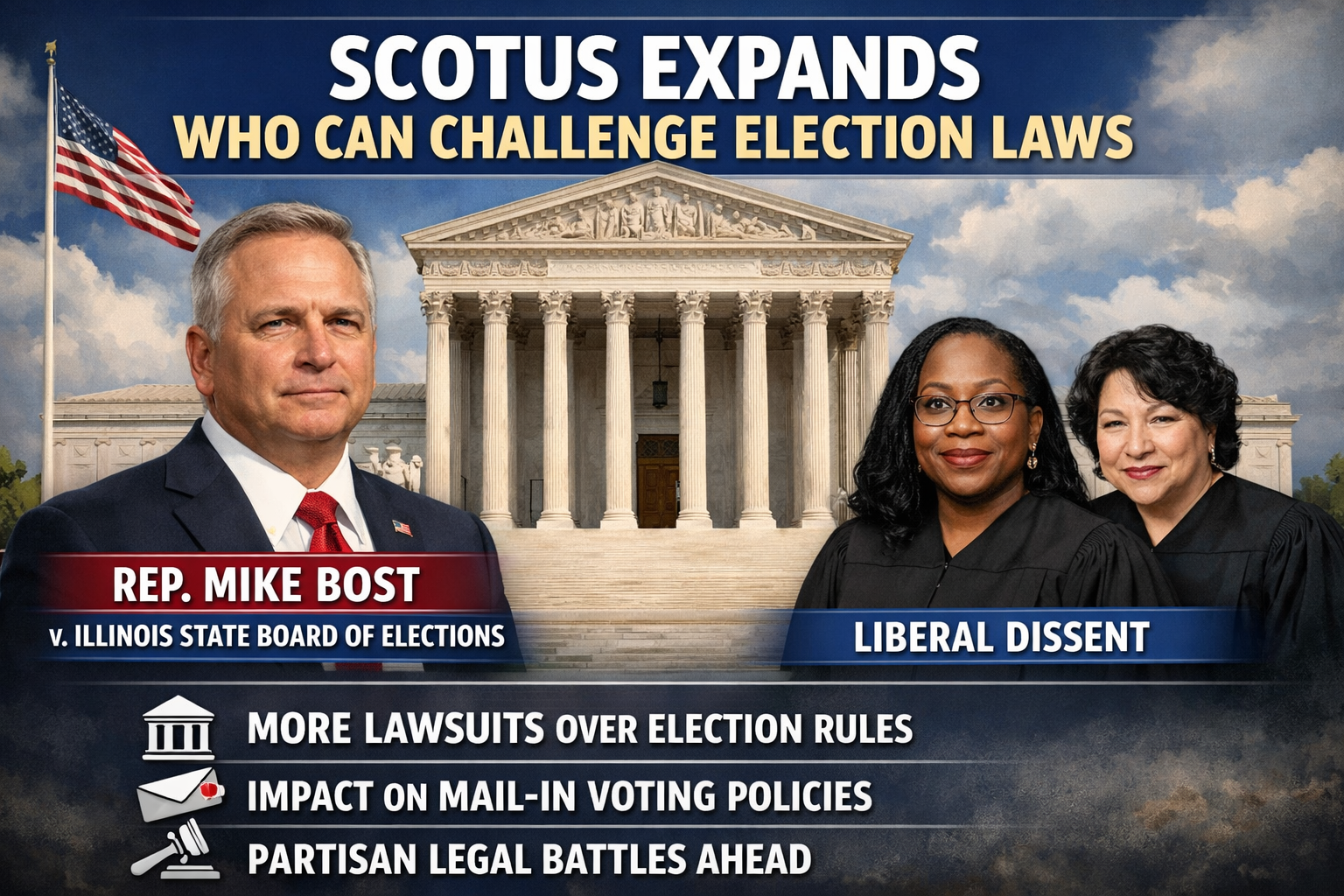
WASHINGTON, D.C. — January 14, 2026 — In a 7‑2 decision on Wednesday, the U.S. Supreme Court issued a landmark ruling that significantly alters how election law disputes can be brought in federal court, a development Republicans are hailing as the most important election law ruling in a generation.
The case—Bost v. Illinois State Board of Elections—centered on whether federal candidates have the legal standing to challenge state election procedures, even if they cannot yet demonstrate direct, provable harm from a particular law. The court held that candidates do have such standing, making it easier for them to sue over election rules before or during an election season.
The decision clears the way for a challenge by Republican U.S. Rep. Mike Bost of Illinois, who sued under federal law to contest Illinois’ practice of counting mail‑in ballots that are postmarked by Election Day but arrive up to two weeks later. Lower courts had dismissed Bost’s case on standing grounds, saying he lacked a personal injury necessary to bring a federal lawsuit. The Supreme Court reversed, holding that candidates can show a “concrete and particularized” interest in how election rules are applied to their races.
Chief Justice John Roberts, writing for the majority, explained that candidates seeking public office “suffer when the process departs from the law,” and that such an injury does not depend solely on whether they win or lose an election or can quantify a precise loss of votes. His opinion emphasized that litigation over election law is often more useful before votes are cast and counted, rather than afterward.
What the Ruling Means
1. Broader Access to Election Law Challenges
By lowering the bar for when a lawsuit can be filed, the Supreme Court’s ruling opens the door for more candidates, especially challengers, to seek judicial review of voting procedures, ballot rules, voter ID laws, mail‑in ballot deadlines, and other election‑related policies. Legal experts say this could substantially increase litigation in the months leading up to elections.
2. Implications for States With Mail‑In Voting Rules
The case itself does not strike down Illinois’s ballot‑receipt law. Instead, it allows Bost and similar plaintiffs to pursue their arguments in lower courts that such laws conflict with federal election statutes. Separate cases already before the Supreme Court including challenges out of Mississippi put the constitutionality of these grace periods directly at issue and could shape how ballots are counted nationwide.
3. Mixed Judicial Views
Justice Amy Coney Barrett, joined by Justice Elena Kagan, concurred in part with the ruling, suggesting they would base standing on a traditional financial harm, such as campaign expenditures, rather than on candidate status alone. Meanwhile, Justices Ketanji Brown Jackson and Sonia Sotomayor dissented, warning that the ruling could unleash a wave of “politically motivated lawsuits” that distract from election administration and destabilize public confidence in electoral outcomes.
Reactions From Both Sides
The decision was quickly celebrated on the right. Republican lawmakers and conservative legal groups hailed it as a tool to ensure federal election rules are interpreted consistently and transparently before ballots are cast.
However, Democrats and advocates for voting rights issued a cautionary note. They argue that giving candidates easier access to courts could fuel lawsuits aimed more at contesting election results than improving fairness or transparency. Critics also worry about an uneven playing field, where well‑funded campaigns use litigation as a campaign tactic rather than a legal redress.
Legal scholars offered mixed perspectives. Some argue that resolving election law disputes before crises arise after voting is beneficial. Others worry that the decision could inundate courts with cases of marginal legal merit, thereby complicating election administration and potentially delaying results or confounding voters.
Editor’s Perspective
As a seasoned news editor, I perceive this ruling as a complex issue, encompassing ramifications that extend far beyond the current dispute over mail-in ballots. On the one hand, clarifying legal standing for election law cases can prevent last‑minute challenges that disrupt elections,, a problem that plagued courts and legislatures in the 2020 cycle. On the other hand, giving broader standing to candidates without demonstrable harm threatens to shift election administration from legislatures and secretaries of state to federal courts, increasing partisanship in what should be neutral legal processes.
Moreover, this decision arrives at a moment of intense national debate over voting rights, including ongoing Supreme Court review of major portions of the Voting Rights Act and other federal protections. The election law landscape is already highly contested, and this ruling could supercharge legal battles in the 2026 midterms and beyond. Democrats and Republicans alike may seek strategic advantages through litigation rather than legislative compromise.
Critically, ease of access to courts doesn’t guarantee fair outcomes; it may simply extend the battleground of elections into judicial arenas. These battles will consume time, money, and attention,, potentially eroding public confidence in elections at a time when trust in democratic institutions remains fragile.