
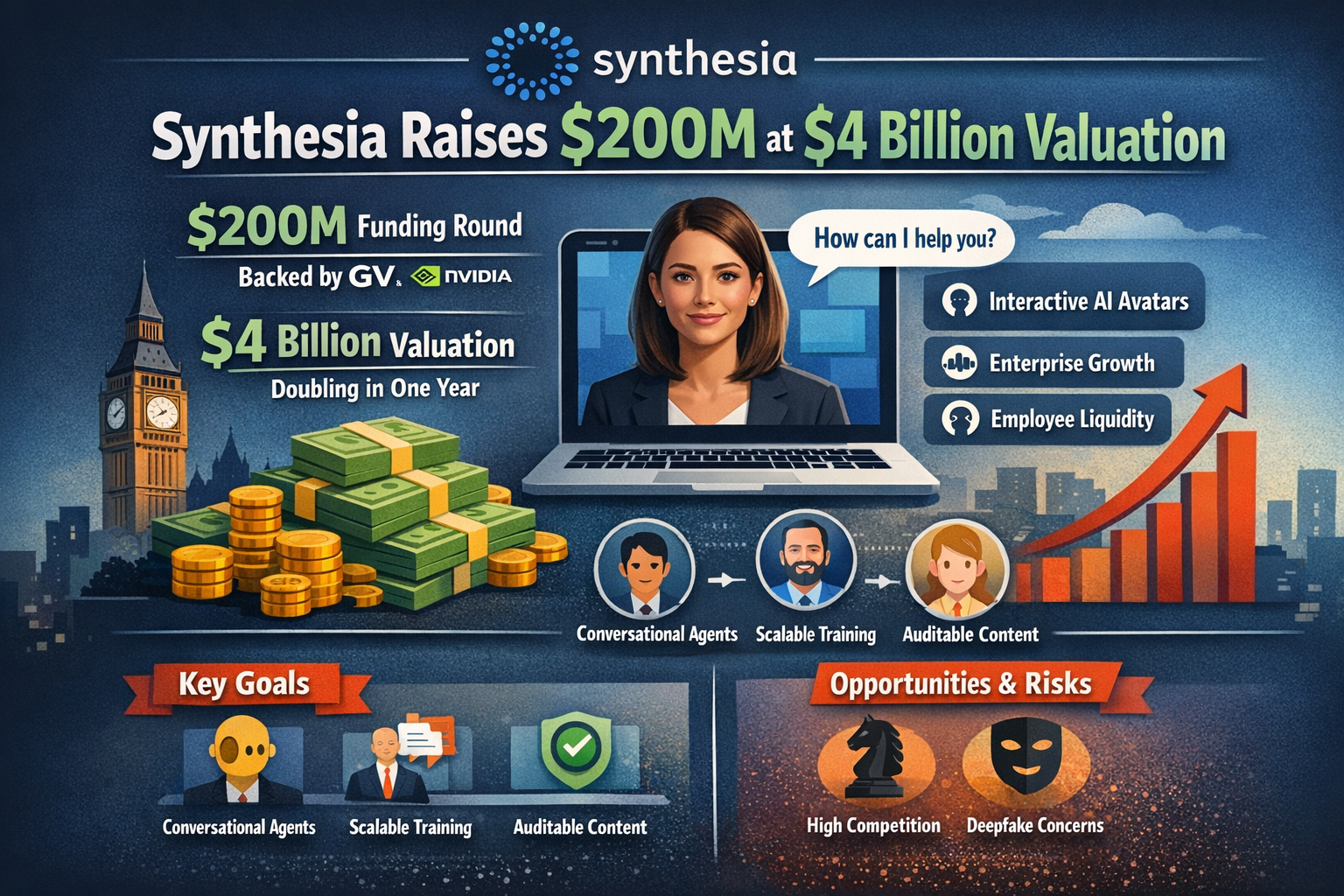
The London-based maker of AI-generated video fragments, Synthesia, has raised a $200 million funding round, valuing the company at 4 billion — about twice the valuation a year ago — as it further extends beyond text-to-video tools, into interactive and conversational avatar agents to train corporates, consult with HR and sales.
Established in 2017, Synthesia gained an initial momentum by allowing businesses to produce high-end training and marketing videos with an artificial presenter generated by AI. The new round, organized by GV, the venture fund of Alphabet, and consisting of a number of existing investors (with Nvidia as the supporting player), will fund the next stage of the company: how to introduce natural-language interactivity to its digital presenters that would be able to respond to questions, role-play and provide personalised coaching at scale.
Why the round matters
The fact that the infusion cost was 200 million dollars and, as a result, the valuation has hit 4 billion is a good indication that investors are still ready to support specialized, business-focused generative-AI plays when larger AI markets are swings. The history of Synthesia, as a video-generation company and then as a platform to facilitate agents interacting, accesses a big business market: learning and development, onboarding, compliance training, customer support, and local marketing. Analysts and coverage report that the company boasts of meaningful enterprise traction and recurring revenue growth, which puts the new capital as a source of growth and a defensive moat in a progressively competitive area.
Investor confidence and business performance
What is reported to the market and interviewed near the raise point is of mixed and improving fundamentals. Coverage Synthesia reported mid -single digit millions of revenue over the last few years and has reported that annual recurring revenue has increased significantly (ARR is reported above 100 million), despite the company spending heavily on product and personnel and operating at a loss on a GAAP basis. The perception of end-user concentration in enterprise accounts and strong product roadmap to monetize conversational avatars seems to be a relief to investors.
Employees and liquidity
The round also featured an element in its design which is said to have enabled some of the employees to access secondary liquidity to a limited extent, an interesting act in a market where startups usually closely guard cash-outs. That decision is an indication of management and investor interest in retaining and rewarding employees and continue to inject a large amount of new capital on the cap table.
Product roadmap: talking back avatars
The product objective soon to be achieved, as stated by Synthesia with the new funding is to transform passive video into interactive experiences: imagine a sales-trainer avatar, which reacts to a learning question spoken by a learner, or a compliance agent, which plays a role of a negotiation, depending on the inputs of a user. Examples of how this has been framed by company executives include applying the same efficiency benefits achieved by content creation to scalable, conversational coaching and that the value is captured by human-like, on-demand, conversation, and tailored to region, language and role. Some of the outlets claim to expand these features at a large scale later in the year.
Market environment and rivalry
Synthesia is in a line with an expanding group of generative-AI startups – voice experts to generalist multimodal model constructors. Its niche is practical: it sells software that enterprises can implement to achieve quantifiable internal applications, instead of pursue virality among consumers. Such a positioning justifies the interest of investors in the face of deep-pocketed players and the risks of the platform. These strategic partners and backers (such as Nvidia and GV) do not just offer access to go-to-market channels and compute ecosystems but also capital.
Risks and headwinds
Synthesia has real problems in spite of the encouraging numbers. Synthetic media increases concerns of authenticity and misuse – deepfake regulation, customer trust and platform content policies are shifting targets that may limit some product plays. Strict auditability and provenance provisions will be needed in regulated industries (finance, healthcare, government). Also, there will be high valuations that come with fast growth and profitability break-even points; the company will be required to drive enterprise experiments into high-end SaaS revenue bases.
What investors are buying into
They seem to be selling three items to investors, namely (1) proven enterprise demand and repeat growth in revenues, (2) a product roadmap (to make avatars interactive) that is differentiated to increase the cost of switching vendors to the company, and (3) a team that demonstrated capital efficiency and the capacity to commercial deployments on a large scale. To GV and Nvidia aligned investors, a European success story having defined commercial applications is also a strategic bet in the global AI supply chain.
Bottom line
The series of $200 million and the valuation of Synthesia at $4 billion are representative of a larger trend: the investing community is willing to put money in small-scope AI businesses that address a quantifiable enterprise issue, rather than model playbooks. The company is currently faced with the following challenge: delivery of trusted, auditable conversational avatars, growth of ARR and reduction of unit economics, as well as reputational and regulatory fallout that is bound to follow advances in the synthetic media domain.
Editor’s view (brief)
This increase highlights two facts about the existing AI market. First, specialization prevails: sell what the CFOs and L&D heads can measure, and the investors will follow. Second, the technical novelty of the avatars of AI is not the only half of the story, the long game is trust, integration and ROI. The decision of Synthesia to allow some of its employees to cash out is worth noting; this is an indicator of a mature mentality of the founder that balances retention with actual human motivations. Once the company can convert competent pilots into adhesive enterprise workflow, and imbue provenance and control into its product, saying that it might be a unicorn of European AI companies that develops profitably and responsibly would be a rarity. Otherwise, the valuation will be more and more pegged on future product milestones and not past sales growth.