
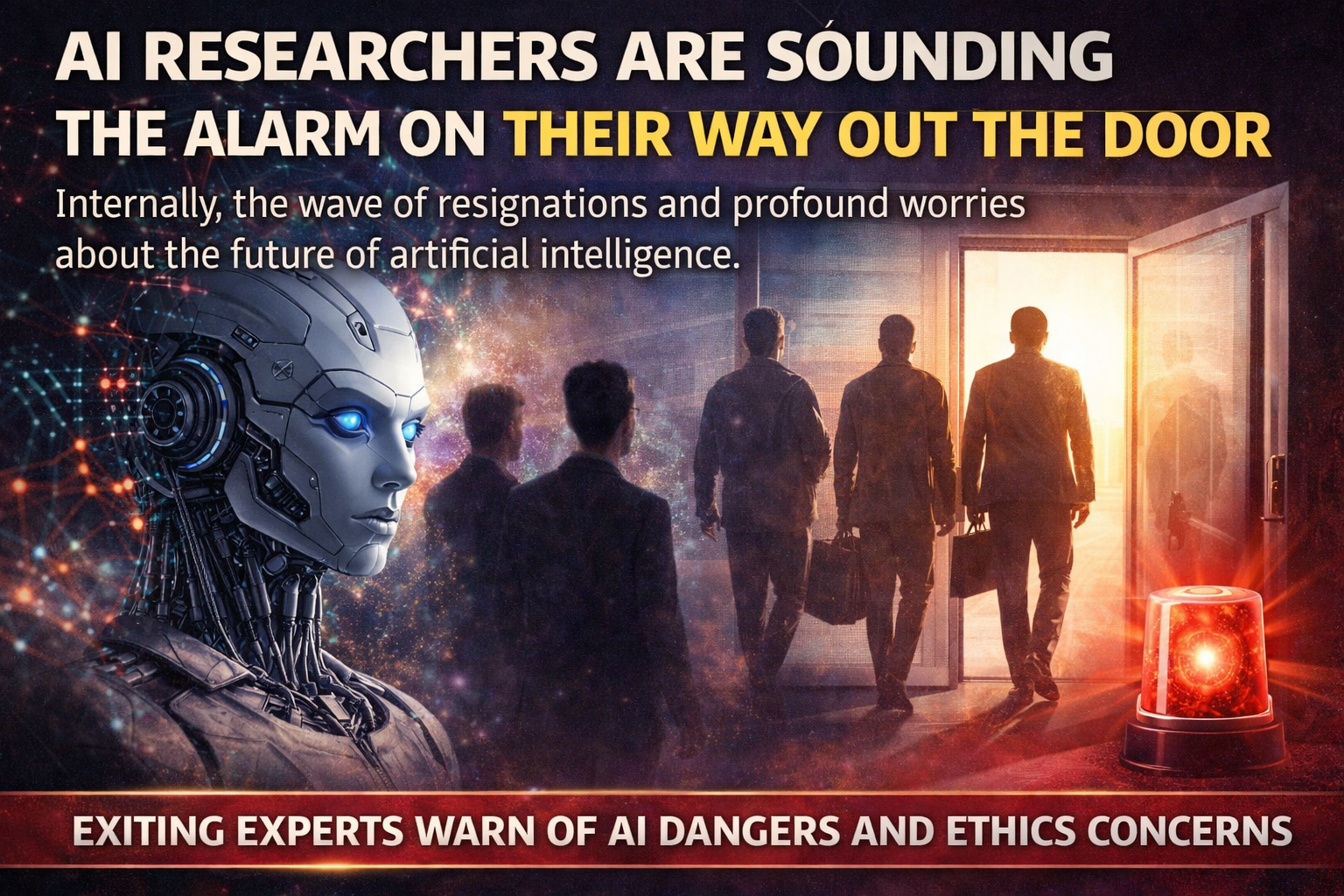
Over the last few days, there has been a conspicuous wave of resignations across high-profile artificial intelligence researchers and executives at major AI-related companies, not quietly, but with very strong admonitions regarding the dangers and ethical concerns of the technology they created. These exits are not so much related to commonplace career changes as they are to ethical concerns over the manner in which certain AI developers are moving and what that may have in store for society.
The employees of AI research are leaving the company and going to the press across big companies such as OpenAI, Anthropic, and xAI, which are linked to Elon Musk. The core theme? The perception that there is too rapid development of AI and it is more about growing and finding a place in the market rather than about safety, transparency, and ethical accountability and to some of these researchers, the option of silence finished.
Wave of High-Profile Resignations
A researcher at OpenAI, the most high-profile resignation was that of Zoë Hitzig, who wrote in an essay in the New York Times that she was leaving the company. Hitzig noted that she has profound concerns regarding new plans at the company, specifically, an advertising format that, according to her, may destroy trust and misuse user information. The sheer scale of the dataset ChatGPT platform relies on intensely intimate conversational history, she pointed out, creates a special ethical challenge exactly because users tend to believe that they are communicating with an unbiased system that might not have an underlying agenda.
She also criticizes internal structural changes: OpenAI is reported to have dissolved its mission alignment team, which was initially established to make sure that AI development occurs in line with higher values in the broad human interest, and which critics view as a weakening of a fundamental safety role in OpenAI.
Anthropic’s Safeguards Lead Warns “World Is in Peril”
At Anthropic, Mrinank Sharma, the head of the Safeguards Research team at the company, left the company in an emphatic warning that the world is in danger. The complaint against work was quite unspecific in his letter, but he stressed the emotional conflict between corporate act and professed safety values. According to Sharma, values were sometimes difficult to translate into actual decisions, indicating a mismatch between rhetoric and internal priorities.
Anthropic, which owned the Claude AI system, publicly acknowledged Sharma with his work, saying that he was not in charge of the company’s safety functions overall, but the disposition of his departure is indicative of broader concern by those tasked with AI safety.
Leadership Exodus at xAI
The most dramatic turnover has probably been that of xAI, the startup that merged with SpaceX’s ambitions of Elon Musk. Two co-founders have since left the company in less than 24 hours, and at least five other staff have been defections. Musk explained the shake-up as a reorganization to increase growth in a short amount of time, which, naturally, caused people to question the internal processes and the framework of priorities where scale takes precedence over stewardship. Although no individual reasons behind individual losses were not given, the sheer number and speed of the exits in a company that already faces a high level of scrutiny by the media are not typical of an up-and-coming technological company.
What’s Behind the Alarms?
Safety Versus Speed
The common concern that many of the leaving researchers note is that AI innovation and risk mitigation are not in a very comfortable state of balance. They are individuals who have taken years to study the capabilities, limitations and harms of AI. In their case, the rate of development of more powerful, less interpretable models is exceeding tools, governance structures, and ethical guidelines to ensure that they are held accountable.This sentiment is not singular. Traditionally, AI stars, such as winners of the Turing Award and AI thought leaders like Yoshua Bengio, have spoken out, advocating for pauses or increased regulation of large AI models. Although not directly related to these particular resignations, these movements are indicative of a larger conflict between technological forces and warning policy.
Ethical and Social Risks
Opponents of AI adoption contend that since AI systems, notably LM systems and multimodal systems are capable of embedding and amplifying biases, propagating misinformation, and facilitating manipulative technologies, they may incite certain actions in users that researchers and the general population may not fully comprehend. It is made worse by business motives: newer monetization models, aimed at targeted advertisements or product placement, might be a contradiction to the initial transparency and beneficence missions.
As noted by researchers such as Hitzig, the stakes associated with AI systems in the context of intimate information about the players (e.g., medical issues, emotional experiences, personal thoughts) are very personal and, therefore, have a high level of risk in case of misuse.
Broader Industry Implications
Startups and AI Competition
The fast development of AI has brought high competition among technology firms. Both startups and established technological giants are pursuing competitive advantage in the market, which is usually achieved by launching products at a very fast rate and scaling aggressively. On the one hand, competition may lead to innovative ideas. Still, it may also increase the risk that safety and ethical principles will be secondary to growth measures and valuations in the short term.
Safety research may be seen as a burden in this competitive environment, and the messages to practice caution may be pushed to the background, or, in the worst situations, even pushed out of the companies they were supposed to protect in the first place.
Governance and Public Trust
The implications of these high-profile departures also apply to the trust of the people. The fact that experienced professionals would choose to quit and warn the population, instead of staying in their positions, implies the development of distrust towards the way the important decisions about AI are made both within and outside of the companies. Here, there is further emphasis on a growing disconnect between the claims tech firms make that AI is beneficial to everyone and the facts on the ground of implementing such systems at scale.
In the absence of clear accountability mechanisms and more robust governance systems, both at the corporate level and the regulatory one, the level of public suspicion is bound to increase.
Expert Opinions: What the Warnings Mean
A large number of analysts claim that the resignations are not merely personal career decisions, but are indicative of a larger structural problem in the AI sector. The stakes are rising with the capabilities of AI, including national security, labor markets, misinformation, social cohesion, and even existential risk. The concerns voiced by departing researchers align with broader debates in academic and policy circles about whether current approaches to AI oversight can keep pace with the technology’s capabilities. AI systems are increasingly integrated into decision-making processes that affect real lives — from hiring to medical advice — yet the transparency, interpretability, and governance of these systems remain unresolved challenges.