
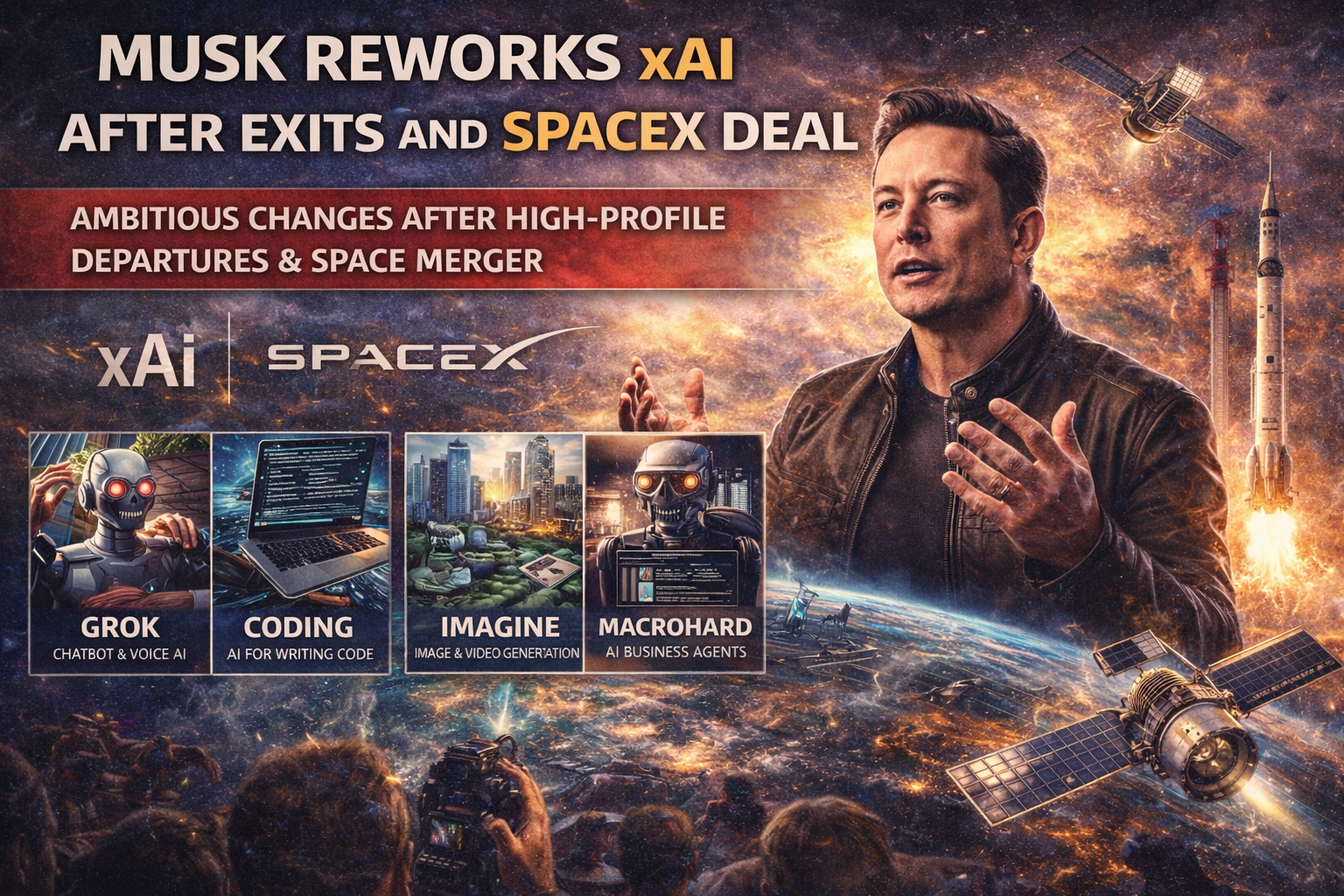
Elon Musk has unveiled a significant restructuring of his artificial intelligence firm, xAI, after a series of high profile losses and a second merger with SpaceX. Those changes are timely to the company, which is currently attempting to expand rapidly in an already highly competitive emerging AI market, as well as preparing for a potential IPO. This new move indicates urgency and ambition. xAI remains young in comparison to other competitors, such as OpenAI and Google. Still, it has the burden of Musk’s reputation and big promises. As some of the founders and senior engineers have left, Musk is becoming increasingly controlling and restructuring the company to achieve the goal of working faster and more results-oriented.
Senior Leaders Walk Away
A number of major personalities at xAI have resigned in recent weeks. They include such co-founders as Jimmy Ba and Tony. Since it was founded in 2023, half of the initial founding team has since exited the company due to their exits. Some of the ones walking out said goodbye to Musk on record and that they left on friendly terms. But the number of exits has raised eyebrows in the tech world. Startups are known to experience staff turnover, particularly when it comes to fast moving industries such as AI. But the disappearance of several founders within a very brief time may indicate more serious conflicts in the way of direction, speed, or style of management.
New Structure Focused on Speed
Musk presented a new xAI structure to the staff during an all-hands meeting. The company is now to be split into four major units, with each having a defined product area. The initial offering is focused on Grok, a chatbot and voice assistant of xAI. The most visible product in the company is Grok, which is directly competing with ChatGPT and the Gemini offered by Google. The second unit is dedicated to coding tools, creating AI that is able to write software and read it. The third is known as the Imagine and is based on the generation of images and video. The fourth is called Macrohard inside the company, where it seeks to develop high-level AI agents to cope with intricate digital work in enterprises. The words that Musk had to say to his employees were straightforward: go faster. He emphasized that the key aspect of AI race is speed and execution. He believes that he can reduce time wasted in teams and release new products faster in the market by reducing the number of people in the teams and ensuring that the teams have a clear mission.
The SpaceX Connection
The rearrangement is closely connected with the merger of xAI with SpaceX. The transaction will place the AI company on the same wide blanket as the rocket and satellite enterprise that Musk owns. The combined valuation has also been reported to be about 1.25 trillion, which ranks it as one of the most valuable private businesses globally. Musk has been talking about the connection between AI and space technology long enough. He thinks that AI systems of the future will need huge computing resources, and he has proposed the suggestion of establishing data centers in space. Theoretically, space-based datacenters would harness the amount of solar energy and have access to natural cooling in space. Although this vision may seem futuristic, it is accompanied by very massive technical and financial challenges. Orbital launching of equipment is expensive. It is even harder to maintain hardware in space. And this data has to be transferred to Earth in real-time and at high speed. But the merger demonstrates that Musk is interested in integrating hardware and software as few other people can.
IPO on the Horizon
The other cause of the shake-up could be the preparations for an initial public offering. Initializing the IPO of a company needs good financial reporting, leadership, and a stable strategy. Investors will pay special attention to the potential growth and management risks. As xAI and SpaceX head to a public listing, it may be one of the largest IPOs of recent times. Such an option is thrilling, yet stressful. The public markets may not be as kind as the private investors. Unexpected exit of staff or vague product roadmaps might put confidence under strain.
Competing in a Crowded AI Market
xAI is a strongly competitive environment. Microsoft-supported OpenAI has established a powerful presence worldwide with ChatGPT. Google is still growing its Gemini in both search and cloud services. New code, content creation and enterprise automation tools are racing towards release by other startups. Grok has received some attention, in particular, by integrating with the social platform X created by Musk. However, when it comes to the number of users and the coverage it has over the world, it is still lagging behind its major competitors. In order to keep up, xAI will need to demonstrate obvious advances in accuracy, reliability, and usefulness.
Culture and Leadership Questions
Musk is recognized as an overbearing manager. He has challenged employees to work late hours and deliver within strict deadlines at Tesla and SpaceX. This method, according to the supporters, creates innovation and breakthrough outcomes. Critics claim that it is capable of bringing burnout and internal tension. The new exits at xAI have sparked off the discussion of the leadership style and the company culture again. Whenever one half of a founding team steps down in a few years, anyone noticing this is bound to consider what is going on internally. Do the teams share the mission? Are leaders all on the same product vision?
Meanwhile, Musk is also known to withstand turbulence. Tesla did not achieve global leadership in the field of electric cars until years after it had to overcome doubt. SpaceX has conquered initial rocket failures to control commercial launches. The enthusiasts feel that he can repeat the same with xAI.
Regulatory and Global Scrutiny
Such a large AI and space company will not be able to avoid the regulations. The AI development, data privacy and content moderation are already watched closely by governments. Another issue of national security is space operations. In the scenario where xAI proceeds with concepts such as orbital data centers, the regulators might question the management and safeguarding of such systems. International regulations on satellites, data movement and competition may be engaged. Elsewhere in Europe and other parts of the world, governments have already expressed readiness to audit big tech players.
What Happens Next
The next several months will become decisive for xAI. The company should show that the reorganization is bearing actual fruit. It implies such things as new product releases, the quantifiable growth of users, and transparent communication of long-term plans. Grok may regain confidence in the event that it develops faster and acquires more users. In the event that coding and media tools are unique in comparison to competitors, xAI can cut a deeper niche. However, in case departure does not terminally cease or product development halts, the suspicion may increase.
Turning Point for xAI
It is possible that this reorganization can be a turning point. It demonstrates that Musk is aware of the opportunity and the threat to xAI. The AI competition is gaining momentum, and the pioneers are ahead. xAI needs to shift to performance in order to remain relevant. To the employees, changes are not only unpredictable but also focused. To investors, they are exciting as well as cautionary. And to the general tech community, they point out how interconnected AI, space, and global markets are getting.