
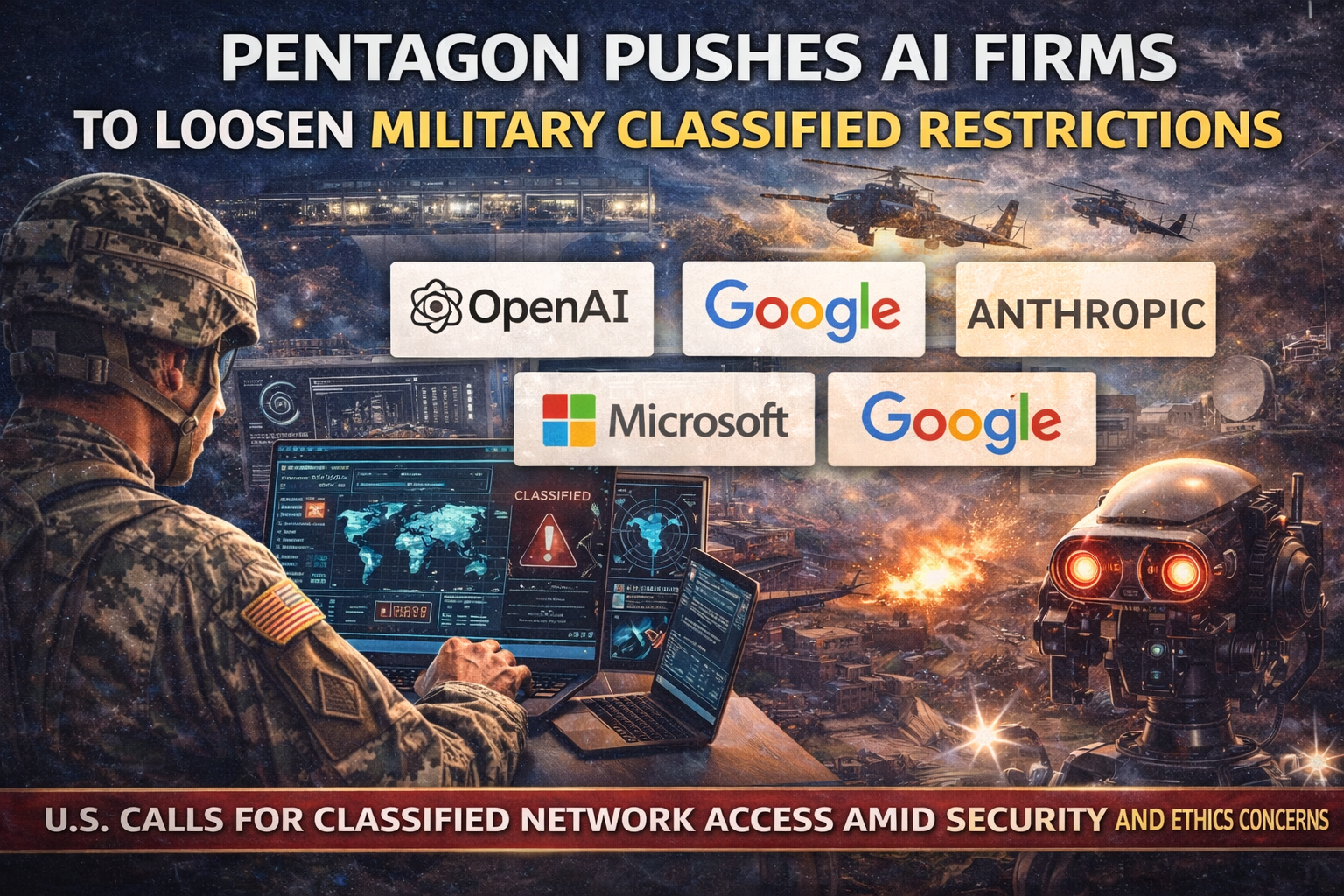
According to the defence and industry sources of the U.S., it is being encouraged by the Pentagon that the leading artificial intelligence firms, including OpenAI, Anthropic, Google, and others, should make their AI tools accessible on classified military networks with fewer restrictions on their use. The project signifies a significant change in the way the U.S. military will apply the commercial AI technology in sensitive state security missions despite the questions of safety, morality and operational risk.
This week, at an event at the White House, Pentagon Chief Technology Officer Emil Michael informed the executives of the leading AI companies that the U.S. was interested in deploying modern generative AI models, not only on unclassified systems, but on all levels of the classified defence networks, according to people privy to the discussion.
The relocation not only reflects the growing ambition of Washington to leverage the most innovative AI applications to mission-critical operations between real-time intelligence synthesis and multi-level operational planning, but also reflects the gap between the military leadership and AI companies on the issue of control, safeguarding, and the extent to which commercial applications should be integrated into the defence operations.
What the Pentagon Is Asking For
Until recently, the majority of AI implementations in the Pentagon were restricted to unclassified networks and administrative work, data analysis, and non-secret cooperation. An example is that OpenAI has accepted a customised version of ChatGPT to operate on an unclassified defence platform deployed to over 3 million members of the U.S. Department of Defense, and most of its normal restrictions have been lifted to make it more military-friendly.
Pentagon officials are now wishing to go the extra mile by requesting AI firms to open their models to networks containing classified intelligence, such as mission planning and even decisions involving weapons. This would imply a reduced number of guardrails compared to those that most companies tend to impose on their tools.
Not only data analysis, the military desires frontier AI capabilities at all levels of classification, according to a Pentagon official who remained anonymous to speak to Reuters. The push is also an element of the wider Pentagon policy to absorb advanced AI into war planning and war fighting in the face of the growing global competition and the accelerated change in technology.
Industry Concerns and Safeguards
AI companies have historically built safety layers and restrictions into their products to prevent misuse and protect sensitive information. These include content filters, rules about how data can be processed, and guardrails against certain actions that may be harmful or unlawful.
For commercial customers, especially in civilian sectors, these safeguards help prevent problems like hallucinations and misuse of personal or sensitive data. However, many military leaders argue that such restrictions could limit AI’s usefulness in high-stakes scenarios where speed, precision and full access to capabilities matter. They contend that as long as AI systems operate within U.S. law, they should be deployable without extra restrictions even in classified environments.
This stance has created friction. While some companies, like Google and OpenAI, have reached agreements with the Pentagon on unclassified use, expanding into classified zones would require new contracts and modified terms. OpenAI has said its current arrangement is specific to unclassified use and that broader deployment would require fresh negotiations.
Anthropic’s Resistance and Ethical Debate
One firm that has pushed back is Anthropic, which makes the AI model called Claude. According to previous reporting, the Pentagon and Anthropic have been in talks under a contract worth up to $200 million, but negotiations hit a standstill over demands to remove safety precautions that prevent its AI from being used for things like autonomous weapon targeting or domestic surveillance.
Anthropic executives have made clear they are willing to support U.S. national security goals, but they do not want their technology used in ways they believe could escalate conflict or erode civil liberties. Their position highlights a broader ethical divide: whether tech firms should cede control over how their innovations are deployed once they enter the defence arena.
In response, Pentagon officials have expressed frustration, arguing that once AI tools are cleared for lawful military use, companies should not impose extra limits. This clash illustrates how difficult it is to balance innovation, ethics and national security when cutting-edge technologies move from civilian to military applications.
Risks and the Danger of Errors
The professionals caution that the deployment of AI in classified networks is a dangerous reality. As opposed to civilian data emails, documents and web content, military systems might involve life-and-death decisions: coordination of targets, strategies and identification of threats. Even minor errors or errors created might have life-threatening consequences on the battlefield.
Artificial intelligence models are effective but not flawless. They are capable of hallucinating or generating something that is plausible but not true, which is a known weakness of generative AI, which can be mitigated but not completely addressed.
In an unclassified or administrative context, an error may result in confusion or a necessity of a human correction. The same mistake may endanger lives in some classified or combat situations, warns analysts. That is why the importance of human supervision and multi-level validation systems in the implementation of AI in defence settings is highlighted by industry and research communities.
Military Strategy and Future Warfare
The Pentagon’s move comes as the U.S. military reorients itself toward what many officials describe as AI-driven warfare, where machine learning, autonomous systems, real-time data synthesis and autonomous agents become key tools in decision-making and battlefield advantage.
AI integration is no longer an experiment but a strategic priority. Officials believe that having access to the best generative AI tools, even those developed in Silicon Valley will help streamline analysis, improve logistics, aid threat assessment and support complex planning tasks at a speed humans cannot match alone. This vision is part of a trend seen across global militaries, where AI support systems are increasingly linked with drones, cyber operations, communications and intelligence to create interlinked, rapid-response networks.
Balancing Innovation, Security and Ethics
This push by the Pentagon shows a fundamental conflict in modern technology policy: to strike a balance between innovation and safety, and to what degree foster a balance between innovation and safety when civilian uses are presented by the same company that is, in other cases, used by the military.
On the one hand, the national defence advanced with the best AI opportunities may improve the U.S. strategic robustness, as well as prevent the aggressors. Conversely, the transfer of sensitive classified systems to models that are open-ended causes concerns of abuse, vulnerability and responsibility. The controversy crosses legal, ethical and operational boundaries. It includes the policymakers, defence contractors, civil liberties lobbying groups and the researchers of AI who came up with the tools in the first place.
What Comes Next
The next few months will probably define the extent of this initiative. The AI companies will have to make choices whether to expand their relationships with the Pentagon, update the safety measures, or be better integrated into the classified networks.
To the Congress and to the populace, the push will be a fresh start on the topic of AI regulation, Congressional control over defence AI strategies, and accountability on how the military applies commercial technology.
To industry leaders, the argument serves as a reminder that as soon as technologies attain a point of capability and strategic value, they will inevitably touch national security issues in a manner that has been inconceivable only a few years ago.
Editor’s Perspective
From a newsroom perspective, this is not merely a news piece about the use of technology; it is about the struggles of societies to adjust to the overwhelming development of potent technology that extends beyond current regulations and principles. The drive behind the Pentagon is actually a strategic imperative, but the ethical concerns of safety, control and accountability are too much to ignore.
The guardrails of AI companies have taken years to establish to ensure that AI is not abused. It is natural to request them to draw those back in a defence environment, but this is only possible when overseeing, error reduction and responsibility are given the same focus. As this narrative progresses, it will not only be technologists who should be made to understand how AI functions, what dangers it presents to the mainstream audiences, but also who should bear the blame when machine intelligence commits a fateful error.