
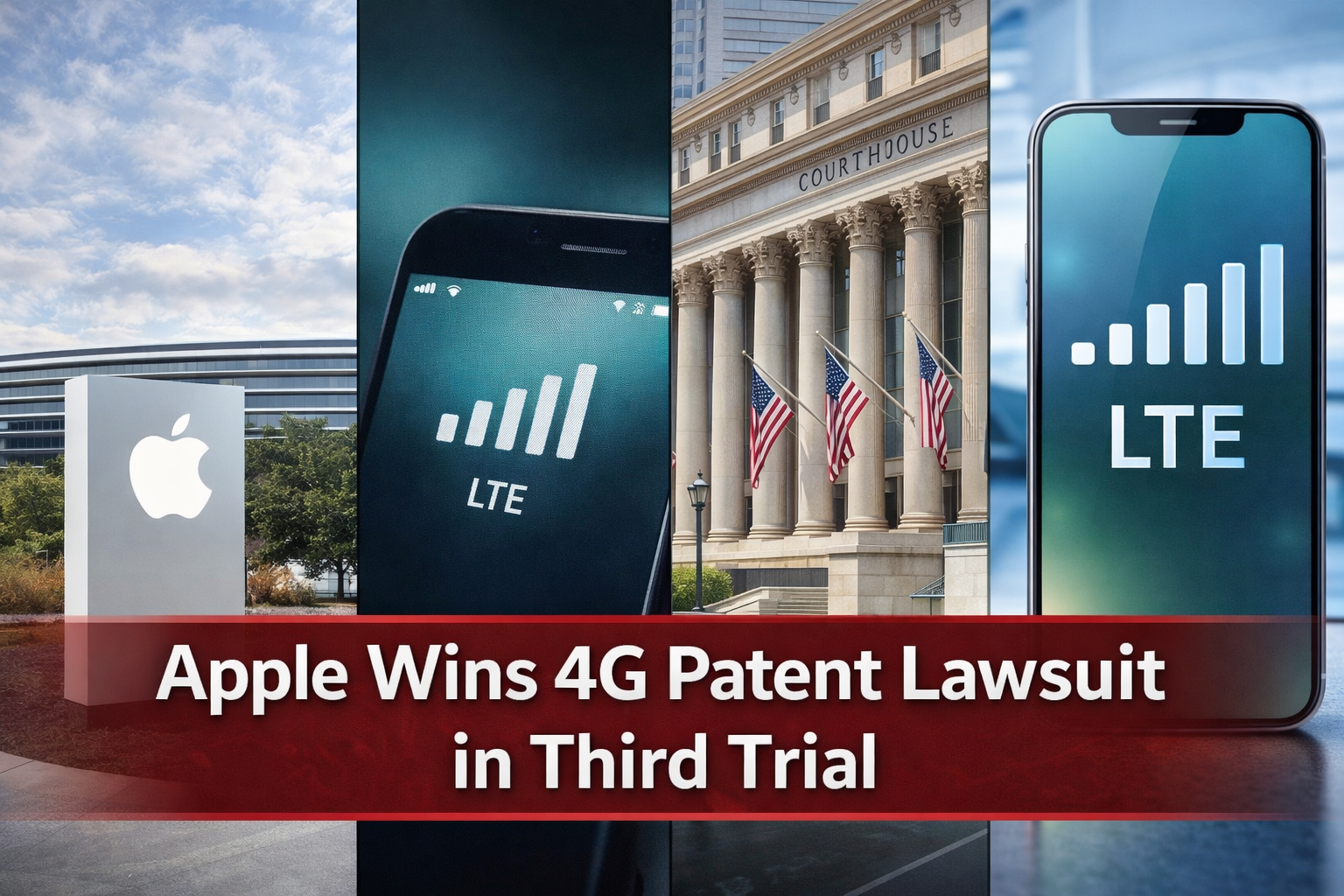
Apple Inc. has managed to counter a lawsuit concerning patent infringement over 4G wireless with a major courtroom victory, filed by Optis Wireless Technology LLC. The ruling, as reported by Reuters, is the third judgment in a protracted legal action that has spanned many years and several hundred million dollars in damages. Findings of a federal jury in Texas declared that Apple did not violate patents claimed by Optis, which brought a big victory to the iPhone maker, who had previously lost their appeal in two verdicts.
The case revolved around patents of 4G LTE wireless communication technology, which also underlies the connectivity of contemporary smartphone devices. Optis alleged that Apple had violated its patented technology by utilizing it in its devices, such as the iPhones and the iPad, without authorization or remuneration. Apple, in its turn, has held that it had not violated the patents and appealed to their validity during the course of litigation.
Background of the Legal Dispute
In 2019, the conflict between Apple and Optis started when Optis alleged that Apple was violating a number of patents, which it believed to be fundamental to the 4G LTE standard. These were termed as standard-essential patents; they are patents required to adapt a given industry standard. The companies with such patents usually undertake to license them on fair, reasonable, and non-discriminative (FRAND) conditions so that they are accessible to everyone in the industry.
In 2020, a jury awarded Optis damages in the amount of 506 million dollars as a result of a ruling that Apple had infringed its rights. That judgment was, however, subsequently overturned by a judge who declared that the damages award was to be reconsidered. In 2021, a second trial gave a verdict of 300 million against Apple. Once again, the decision was not upheld. The second verdict was reversed by the U.S. Court of Appeals for the Federal Circuit on grounds of jury instructions, which might have unduly affected the judgment-making process. These reversals paved the way towards a third trial where jurors had to take a closer look at every patent claim as they appeared. This time around, the jury found that Apple had not violated any of the patents under consideration, and the company was therefore innocent in the United States case.
The Importance of 4G LTE Technology
The patents refer to the fundamental components of 4G LTE wireless communication systems. LTE technology enables the use of smartphones and other mobile gadgets in transmitting data at high speeds via cellular networks. It is compatible with video streaming, internet browsing, online gaming and video conferencing.
The category of standard-essential patents is especially sensitive as it forms the basis of technologies that many people use in the world. telecommunications industry. Any company that adopts such standards should be able to license the necessary patents to make sure that they comply and work. The legal battles that surround what should be considered as fair and reasonable licensing charges are the source of arguments and disputes, which are accompanied by detailed litigation, which includes the technical and economic analysis.
In this instance, Optis claimed that its patents covered major procedures in the transmission and reception of signals in the LTE networks. Apple responded by saying that it was not using the patented techniques or that the patents were invalid. The jury ended up supporting Apple.
Apple’s Legal Strategy
Apple’s defense strategy focused on both non-infringement and patent invalidity arguments. The company maintained that it had not violated Optis’ intellectual property rights and that the claims made against it were unfounded. Apple also highlighted Optis’ business model as a non-practicing entity, meaning the company does not manufacture products but instead acquires and licenses patents.
Patent assertion entities, sometimes labeled “patent trolls” by critics, often face scrutiny for aggressively pursuing litigation against large corporations. Apple has previously argued in various cases that such lawsuits impose unnecessary costs and stifle innovation. In the third trial, Apple’s legal team successfully persuaded jurors that the evidence did not support Optis’ claims of infringement. Following the verdict, Apple expressed satisfaction with the outcome, stating that the jury’s decision confirmed its position that it did not infringe the patents.
Broader Implications for Patent Law
The Apple-Optis case reflects broader tensions within patent law, especially concerning standard-essential patents and FRAND commitments. Courts must balance protecting intellectual property rights with preventing excessive licensing demands that could harm competition and innovation.
Repeated reversals in this litigation demonstrate how carefully appellate courts scrutinize jury instructions and procedural fairness in complex patent cases. Technical disputes involving telecommunications standards require jurors to understand intricate engineering concepts, making precise legal guidance essential. Errors in instructions can significantly affect verdicts, as seen in the previous trials. The outcome of this third trial may influence how future disputes involving standard-essential patents are handled, particularly regarding how juries are instructed and how damages are calculated.
International Dimensions of the Dispute
Although Apple secured a win in the United States, the legal battle is not entirely over. Optis previously achieved a favorable ruling against Apple in the United Kingdom, where a court ordered Apple to pay substantial damages for infringing related patents. Apple has appealed that decision, and further proceedings are expected in the UK legal system.
International patent litigation often involves overlapping claims across jurisdictions, creating a complex web of legal challenges for multinational corporations. Outcomes in one country do not necessarily determine results elsewhere. As global companies operate across borders, they must navigate differing patent laws, enforcement mechanisms, and judicial standards. The Apple-Optis case illustrates how technology disputes increasingly play out on an international stage, with significant financial and strategic consequences.
Financial and Industry Impact
In the case of Apple, a damages award could be in the hundreds of millions of dollars, which is why it is worth avoiding. Although Apple possesses a large amount of financial resources, constant high-sum verdicts may influence investor confidence and planning. Litigation over patents also swallows a lot of legal costs and managerial time.
In a broader sense, the technology industry is paying close attention to such cases since they have the potential of establishing precedents on licensing negotiations. In the event that courts award severe damages on a standard-essential patent, other companies would experience higher costs of licensing on a broad basis. On the other hand, when defendants often win, patent holders will potentially have a difficult time protecting their rights.
Collaborative processes of setting standards rely especially on the telecommunications sector. The companies submit patented technologies to the common standards as they are assured of fair compensation. The question of what fairness is has been a common occurrence in the world of technology litigation.
The Ongoing Evolution of Intellectual Property Battles
The case of Apple-Optis illuminates the dynamic aspect of intellectual property litigation nowadays. The smartphones and connected devices are becoming more advanced, incorporating thousands of patented technologies. The correct choice of patent essentials, the mode of implementation and the appropriate licensing fees are not arrived at without intricate technical and economic assessment.
The legal fight against wireless standards would probably go on as industries upgrade to 5G networks and ultimately to the next generation of network standards. With every new standard, there are new possibilities of innovations and new platforms of ownership and compensation controversy.
The decision made by the American court in the third case against Apple forms a great part of this continuing story. Although the case might proceed in other places or by appeal, the recent case highlights the hardships that patent owners go through in establishing infringement and also receiving damages in a highly technical case.