
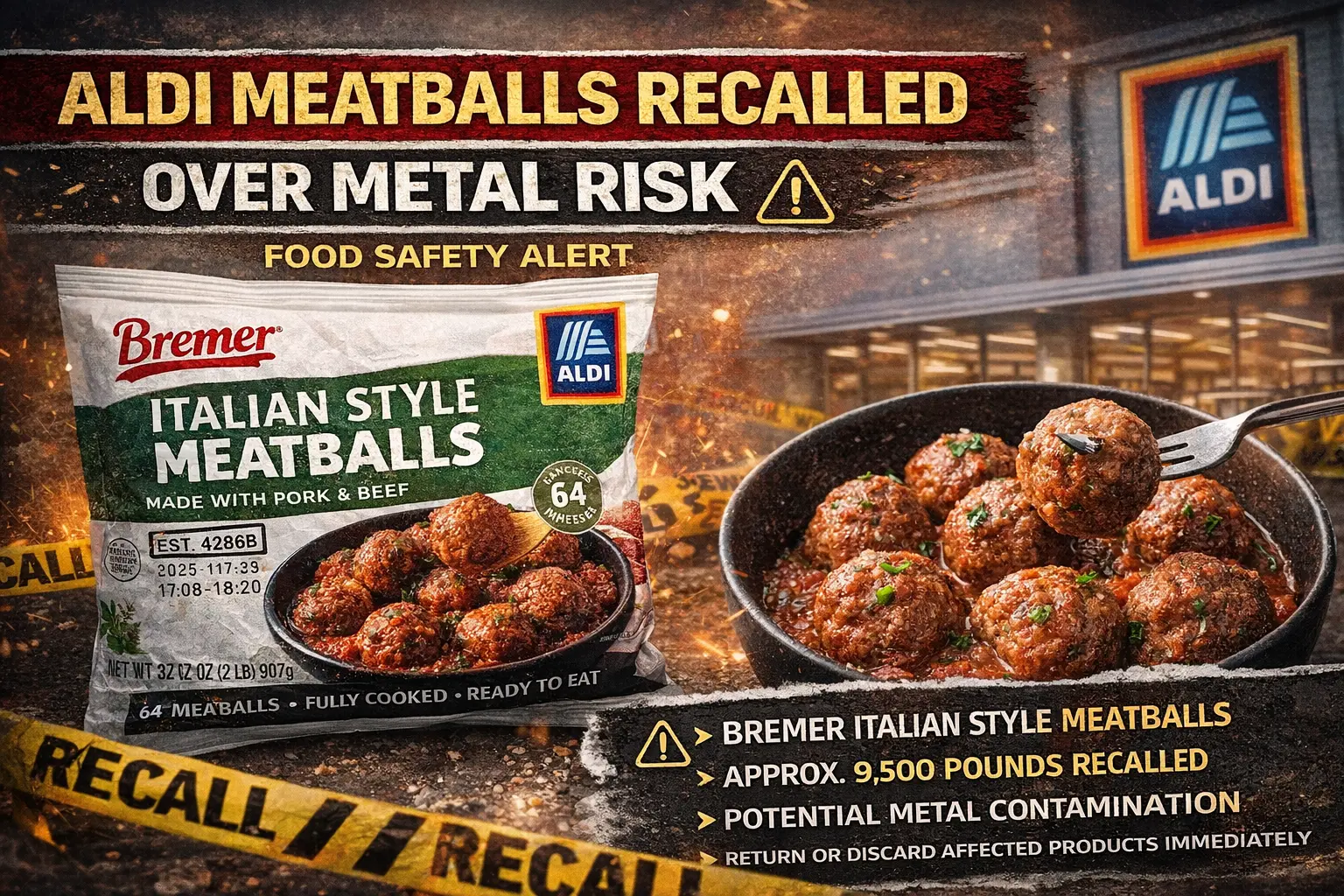
There has been a recall of thousands of pounds of frozen meatball products that are distributed to Aldi stores all over the United States, resulting in a nationwide food safety alert. The Food Safety and Inspection Service (FSIS), an agency of the U.S. Department of Agriculture, declared the recall after one of the consumers had raised an alarm over the possibility of metal contamination in a frozen meatball product that was ready to eat.
The tainted goods were sold under Aldi’s own-label brand and sold across the country, and it was feared that consumers in various states could have purchased and frozen the products at home.
Product Recall Information
This recall is of about 9462 pounds of fully cooked and ready-to-eat frozen meatballs manufactured by Rosina Food Products Inc. The name of the product is Bremer Family Size Italian Style Meatballs, and the product is packaged in 32-ounce bags with approximately 64 meatballs in each package.
Federal officials declare that the products in question had been manufactured on July 30, 2025, with the date 10/30/26 inscribed on them. The recalled items can also be identified by the consumer checking the packaging of the item to establish if it has the mark of identification, which is the establishment number “EST. 4286B” printed inside. Timestamps of production between 17: 08 and 18: 20 are also linked to the batched lot.
The goods were transported to Aldi retail distribution centers around the country and then sold in the stores around the country.
The discovery of the Contamination
This problem was revealed when a consumer alleged that he had discovered metal particles in the product consisting of meatballs. After the complaint, FSIS started an investigation, which resulted in the announcement of the recall.
Even though there were no verified cases of injuries caused by the product consumption, the officials of the federal authorities mentioned that the recall was issued due to an excess of caution. Foreign contents like metal in food products may be quite hazardous to health, like a cut to the mouth or the throat, choking or even internal trauma in case of an internal ingestion.
FSIS categorized the case as a health risk that requires immediate intervention to avoid potential damage.
Some of the health risks associated with metal contamination are as follows.
The presence of metal in foodstuffs is said to be a great safety issue. Even tiny pieces can be destructive to the teeth, or can cut or otherwise harm the digestive tract, or can injure other body parts internally. In extreme situations, medical assistance might be needed after taking hard metal fragments.
Since the product is ready to eat, having been cooked, people can boil the meatballs and can serve them without paying much attention to each one of them. This heightens the need to make sure that contaminated products are withdrawn from circulation in the quickest time possible.
Authorities have recommended that everyone who thinks they have had the product and is reporting abdominal pain, difficulty swallowing, or some unusual pain seek immediate medical attention.
Consumer Direction and Next
Consumers are highly discouraged from eating the meatballs that were bought. Rather, they are supposed to dispose of the product in a friendly manner or repurchase the item in the store that they bought it.
FSIS also cautioned consumers to be cautious in the inspection of the labels on the products, including the date of production and establishment numbers, as they review the recall notice. Due to the nature of frozen goods that might be stored in home freezers for a long time, the authorities stressed the importance of consumers checking whether they are holding the affected batch.
The recall questions can be placed in the customer service department of the manufacturer, and the consumers can also contact the USDA Meat and Poultry Hotline to get more information on food safety.
Distribution and Nationwide Impact
The effect of the recall is national since the meatballs were delivered to Aldi outlets throughout the country. Aldi has hundreds of stores across several states, which have a high probability of having acquired the products that might have been affected.
Since frozen foods have a long shelf life, even products that will be produced in the middle of 2025 could still be in the freezer of consumers in 2026. The federal representatives are carrying out checks on the effectiveness of the recall to make sure that retailers take the product off the store shelves and inform customers accordingly.
To notify customers in a timely manner, retailers usually display the recall notices in the stores and update the customers on their websites.
Response and Quality Control Evaluations in a Company
Rosina Food Products Inc. is an old manufacturer of frozen and ready-to-eat meat products, which has undertaken rectifying actions in response to the incident. Although the firm has not provided the source of the metal contamination, such occurrences are usually a result of the failure of equipment, wear and tear of the machines or failure of the processing parts during the manufacturing process.
The food processing plants are currently equipped with metal detectors and other quality assurance technologies that seek to detect foreign objects before they are discharged from the processing plant. Nevertheless, even these precautions do not exclude instances of isolated incidents.
The recall shows that continuous monitoring of equipment, preventive maintenance, and observance of food safety measures are essential in the large-scale production of food products.
The Federal Oversight
As indicated in the recall process, the intervention of the federal oversight in the food safety of the entire country cannot be underestimated. FSIS, which is a department of the United States Department of Agriculture, is charged with the responsibility of regulating meat, poultry, and processed egg products to make sure they are safe, wholesome, and labeling them accordingly.
In the event of identifying potential dangers, FSIS collaborates with manufacturers to recall the impacted products in the marketplace in a short period of time. The effectiveness of the recall is also observed by the agency to ensure that the corrective measures are put in place.
Although disruptive, food recalls are deemed to be one of the key elements of the protection of the general health. Regulators will reduce the harm that could be caused to consumers by responding rapidly to contamination dangers.
Greater Food Recall Background
Food recalls concerning foreign material contamination are a common instance in the food industry on a periodic basis. Recall of different packaged products has happened in recent years because of the presence of plastic, rubber or metal fragments.
These recalls highlight the sophistication of the contemporary food supply chains. By having centralized production sites that deliver the products to various states in the country, one problem in a production line is capable of impacting thousands of packages in different states.
Even though these types of recalls may temporarily inconveniencing to consumers, there is an underlying purpose of having such types of recalls in place, which is to show that food safety surveillance mechanisms are at work and any issues are being identified and solved.