
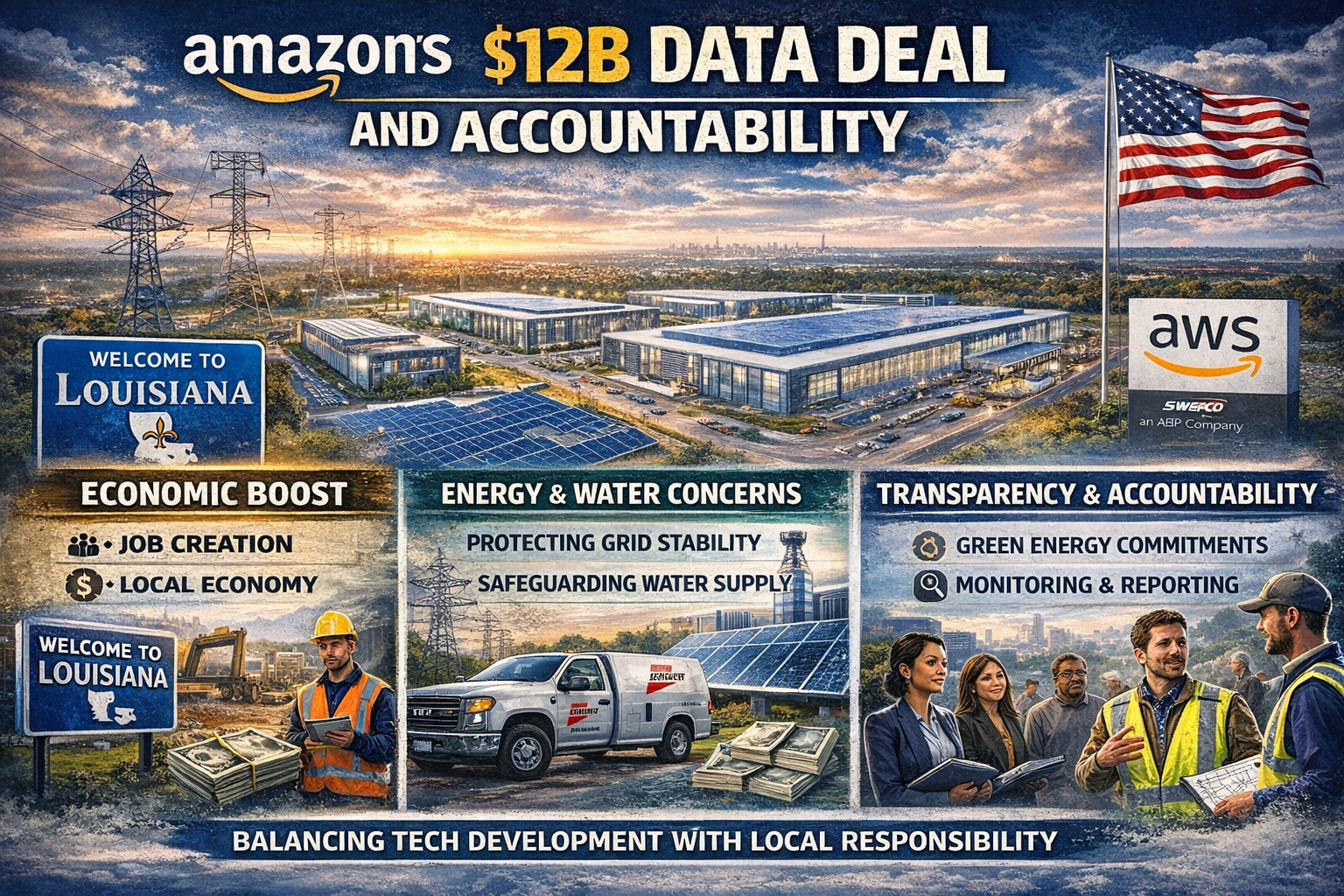
One of the biggest infrastructure expansions by the company in the United States is the 12-billion-dollar investment announced by Amazon to build large-scale data center campuses in northwest Louisiana. The project will enable the rising needs of Amazon Web Services (AWS) that drives cloud computing and artificial intelligence-based technologies that are utilised by companies, governments and consumers all around the globe. Since the adoption of AI is on the rise, the data center has turned out to be a significant infrastructure that stores and processes data. The choice of Louisiana is an indicator of the increased visibility of the state as a location where high-tech investment and development of digital infrastructure can occur.
The campuses will be found in Caddo and Bossier Parishes and are likely to generate hundreds of permanent jobs, as well as thousands of temporary construction jobs during the development. Local leaders have received the news positively, as it will help boost the economy of the region as well as diversify employment. In addition to direct hiring, the project will trigger an overall economic activity in the supply chains, utilities, and service industries.
Energy Infrastructure and Grid Responsibility
Electricity consumption is a major issue for large data centers. These systems demand a lot of power that is heavy and constant to run servers, cooling, and networking systems. In most areas, it has been pointed out within communities that the networks of data centers may overload the local power networks or hike electricity charges for the locals. Amazon, in its turn, has promised to pay the expenses of the needed grid upgrades instead of imposing such costs on ratepayers.
The firm is in consultation with Southwestern Electric Power Company so that the grid can be able to take the extra load. Amazon has also committed to incorporating renewable energy in the project, such as making investments in solar power generation,n which will supply electricity that is free of carbon in the regional grid. These actions are also to prove that economic growth and grid stability can co-exist, and local households cannot be disadvantaged.
Water Usage and Environmental Safeguards
Water consumption is another area of concern with data centers, particularly in regions where resources may be limited. Cooling systems often require substantial water usage to prevent servers from overheating. Amazon has stated that its Louisiana facilities will rely primarily on air-cooling technologies, using water-based cooling only during limited periods of the year. The company has further pledged to source water from verified surplus supplies to avoid disrupting essential community needs.
In addition, Amazon has committed hundreds of millions of dollars toward improvements in local water infrastructure. These investments are meant to strengthen system resilience and ensure that municipal water services remain stable as demand increases. Environmental accountability has become a central expectation for major technology projects, and Amazon’s commitments reflect growing public scrutiny over the ecological footprint of digital infrastructure.
Transparency and Public Accountability
The Louisiana deal represents more than an economic investment; it signals a broader shift toward transparency in large-scale technology development. Policymakers and community leaders across the United States are increasingly demanding detailed disclosures regarding projected energy consumption, water usage, and sustainability metrics before approving new projects. As AI-driven computing expands rapidly, so too does the need for oversight.
By publicly outlining its infrastructure payments, renewable energy plans, and water commitments, Amazon is positioning itself within what many observers describe as a new era of corporate accountability. Other tech firms, including Microsoft, have introduced similar pledges emphasizing responsible development and community partnership. These initiatives suggest that the industry recognizes the importance of maintaining public trust as digital infrastructure becomes more visible and impactful.
Economic Opportunity and Community Investment
Beyond environmental safeguards, Amazon has pledged to invest directly in the surrounding community. Funds have been allocated to support workforce training, STEM education initiatives, and local development programs. These measures aim to ensure that residents benefit from long-term skill-building opportunities linked to the high-tech sector. By combining infrastructure development with educational outreach, the company seeks to create sustainable economic growth rather than temporary gains.
The construction phase alone is expected to generate substantial employment, while long-term operations will require specialized technicians, engineers, and security personnel. Local officials view the project as a transformative opportunity for the region, potentially attracting additional technology-related investments in the future.
Industry-Wide Implications
With the high growth of AI and cloud computing, data centers have become more demanded across the country. It is estimated that digital infrastructure will contribute to the electricity demand expansion of a sizeable portion in the next decade, according to analysts. This influx has brought about arguments among policymakers, environmentalists and industrialists concerning the issue of innovation and sustainability. Other legislators have proposed more stringent rules or a moratorium on new data center permits until more sensible environmental criteria are developed.
The Louisiana contract signed by Amazon can also be used as an example of a strategy in the future that could help firms step forward in order to explain issues regarding water consumption, grid overload, and cost to the population. The actual accountability, however, will be seen in the consistency of reporting and quantifiable results when the facilities are up and running. Transparency should not be one-sided conduct but should be a continuum that involves constant monitoring and data accessibility to the community stakeholders.
Editorial Perspective on the New Era of Accountability
Editorially speaking, the Amazon data center project, which costs the company 12 billion dollars, is a representation of the optimism and the conflict of the AI-driven economy. On the one hand, these investments create employment, enhance the growth of the region, and enhance national digital capabilities. Conversely, they exert great pressure on the natural resources and the infrastructure in society. The declaration in Louisiana is an indication that technology firms should shoulder some of these effects instead of passing the liability.
The wider ideology is evident: extensive digital infrastructure can no longer act without interference on the part of the population. Transparency, environmental stewardship, and financial fairness are the new expectations of the communities. In case Amazon sticks with its promises to upgrade the grid, cut down on water, and make renewable energy investments, it would establish a precedent of responsible expansion. Otherwise, distrust toward technological growth is bound to grow.
The infrastructure behind artificial intelligence and cloud computing will have to be modified in the same vein as global economies transform under the same high accountability demands. The Louisiana project is a good example of how the corporate strategy and the interests of the audience are becoming more and more connected, and it may well come to represent one of the turning points in the way the technology companies deal with large-scale development.