
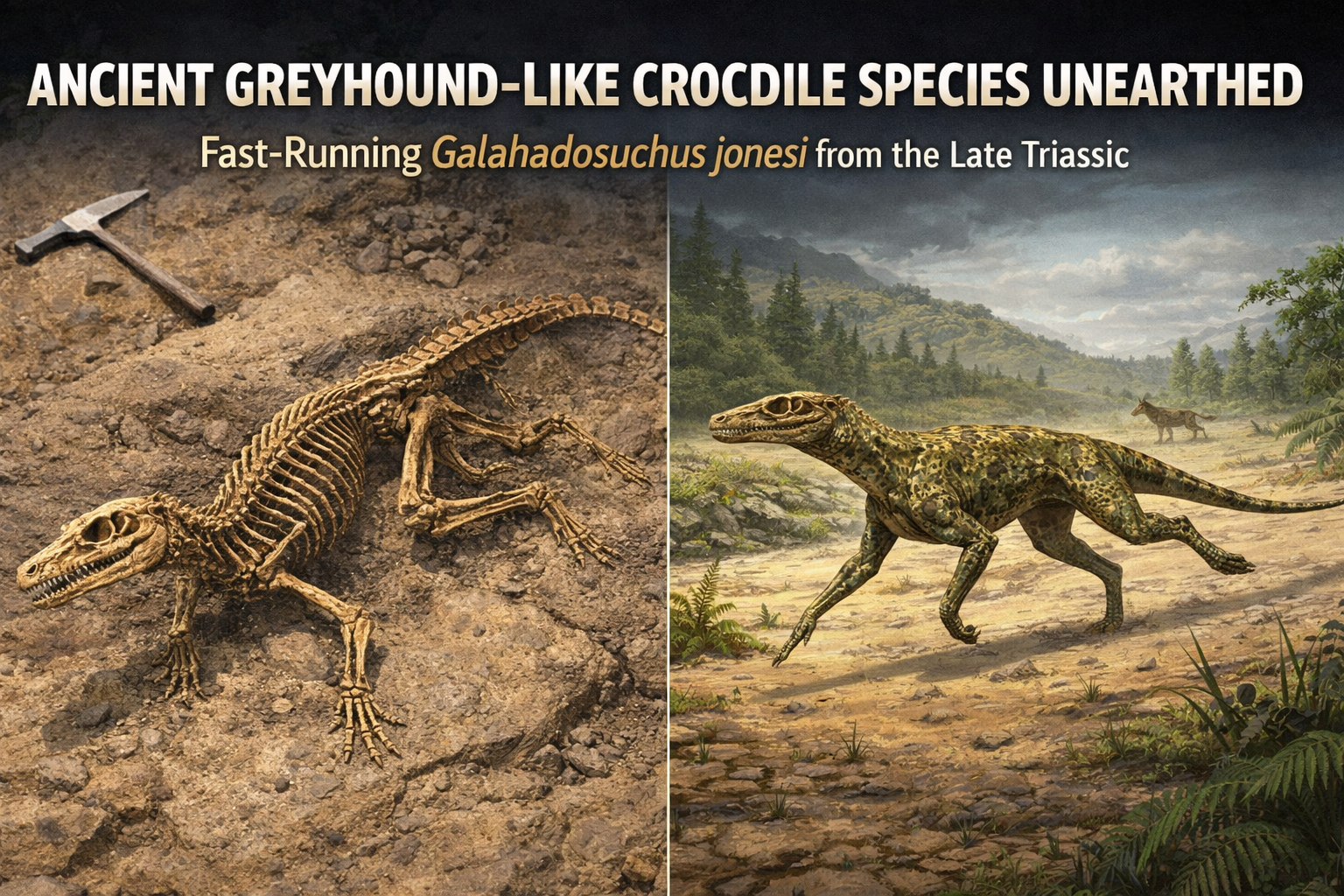
Today’s paleontology spotlight shines on a remarkable scientific finding: researchers have identified a previously unrecognized species of ancient crocodile relative with long, slender limbs and a body plan unlike modern crocodilians. Unearthed from fossils more than half a century after their initial discovery, this new species rewrites part of our understanding of crocodylomorph evolution and terrestrial ecosystems during the Late Triassic period.
Discovery Overview
In a fascinating twist of scientific detective work, researchers studying fossil specimens from the United Kingdom have identified a species of crocodylomorph whose anatomy resembles that of a reptilian greyhound more than the sprawling semi-aquatic reptiles we recognize today. Dubbed Galahadosuchus jonesi, this animal lived approximately 215 million years ago in what is now southern England and Wales.
Although the fossil remains were first uncovered in 1969 at a site in southwestern England, the specimen languished in museum collections for decades before its significance was realized. Only through modern examination techniques and renewed paleontological interest were scientists able to detect key anatomical differences that warranted naming it as a new species.
What is Galahadosuchus jonesi?
Galahadosuchus jonesi belongs to the broader group Crocodylomorpha, which includes all prehistoric relatives of modern crocodiles and alligators. However, unlike today’s crocodilians that spend much of their lives in water and move with a sprawling gait, this ancient species shows clear adaptations for life on land.
Here’s what makes it stand out:
- Long, slender limbs: The proportions of its legs suggest it was adapted for running, perhaps more like a greyhound than a traditional crocodile. Its elongated and lightweight limbs gave it agility and speed on land.
- Upright stance: Unlike most modern crocodylomorphs, which have splayed limbs, Galahadosuchus appears to have had a somewhat more upright posture, aiding terrestrial locomotion.
- Distinct skeletal features: Scientists identified 13 anatomical differences—especially in wrist and limb bone structure—compared with related species such as Terrestrisuchus, justifying its classification as a new species.
In essence, this wasn’t a slow, swamp-dwelling crocodile relative—it was an agile, land-based predator capable of chasing down small animals, amphibians, and early mammals in the undergrowth.
Ancient Habitat and Lifestyle
During the Late Triassic, the region that would one day become southern England and Wales was vastly different from today. Dominated by arid plains, upland scrub, and karst landscapes (limestone terrains with caves and fissures), the environment supported a diverse array of reptiles, early dinosaurs, amphibians, and small mammals.
Fossils from this period often turn up in geological formations known as fissure fills—natural sinkholes and cracks where animals that died on the surface were washed into deeper sediment. Over millions of years, these deposits preserved a rich assemblage of creatures from this ancient ecosystem.
Within these fissures, paleontologists have found early dinosaur specimens like Thecodontosaurus and agile reptiles such as Kuehneosaurus, alongside rarer animals like Galahadosuchus. These finds offer critical windows into an ecosystem that existed before the Triassic–Jurassic mass extinction event, a major transition in Earth’s biological history.
Naming and Scientific Recognition
The systematic classification of Galahadosuchus jonesi was published in the peer-reviewed scientific journal The Anatomical Record. The name itself reflects both physical characteristics and scientific homage:
- Galahado: Inspired by Sir Galahad, a figure from Arthurian legend associated with uprightness and chivalry, reflecting the creature’s upright stance. -suchus: Derived from Greek, meaning “crocodile.”
- Jonesi: A tribute to David Rhys Jones, a high-school physics teacher whose mentorship inspired the lead author, PhD student Ewan Bodenham.
This naming honors both the paleontological discovery and the human stories behind scientific exploration.
Why This Discovery Matters
Uncovering a species like Galahadosuchus jonesi is important for several reasons:
1. It expands our understanding of crocodile evolution
Modern crocodilians are mostly semi-aquatic predators with sprawling gaits adapted for ambush predation in water. Discoveries like this show that their early relatives were far more diverse in form and lifestyle, occupying niches similar to those of fast-moving terrestrial predators. This challenges simplistic views of ancient reptiles and highlights the remarkable adaptability of crocodylomorphs across geological time.
2. It highlights the value of museum collections
Many fossil discoveries are made not in the field, but in museum drawers and archives where specimens sit unnoticed for decades. It took a fresh look at long-collected fossils to reveal this treasure hidden in plain sight—underscoring the importance of systematically re-examining existing collections with modern tools and perspectives.
3. It offers insights into prehistoric ecosystems
By situating Galahadosuchus within its broader ecological context, paleontologists can better understand how species interacted with each other and responded to environmental pressures in the Late Triassic. This, in turn, informs how extinctions and subsequent recoveries shaped the trajectory of life on Earth.
What We Still Don’t Know
- Despite the excitement, this discovery also raises new questions. For example:
- How widespread were agile, terrestrial crocodylomorphs like Galahadosuchus?
- What were their exact behavioral strategies for hunting and survival?
- Did similar species exist on other continents during the same time period?
Future discoveries—both in existing collections and fresh fieldwork—may help answer these questions and piece together a richer picture of ancient reptilian evolution.
The unearthing of Galahadosuchus jonesi is more than a paleontological curiosity. It is a testament to the complexity of life on Earth hundreds of millions of years ago and a reminder that even the most familiar groups of animals—like crocodile relatives—can hold deep evolutionary secrets still awaiting discovery. The story of this greyhound-like reptile enriches our broader understanding of how animals adapt, thrive, and evolve across geological epochs. As paleontologists continue to explore museum collections and new fossil sites around the world, we can expect more revelations that will reshape our understanding of prehistoric life.