
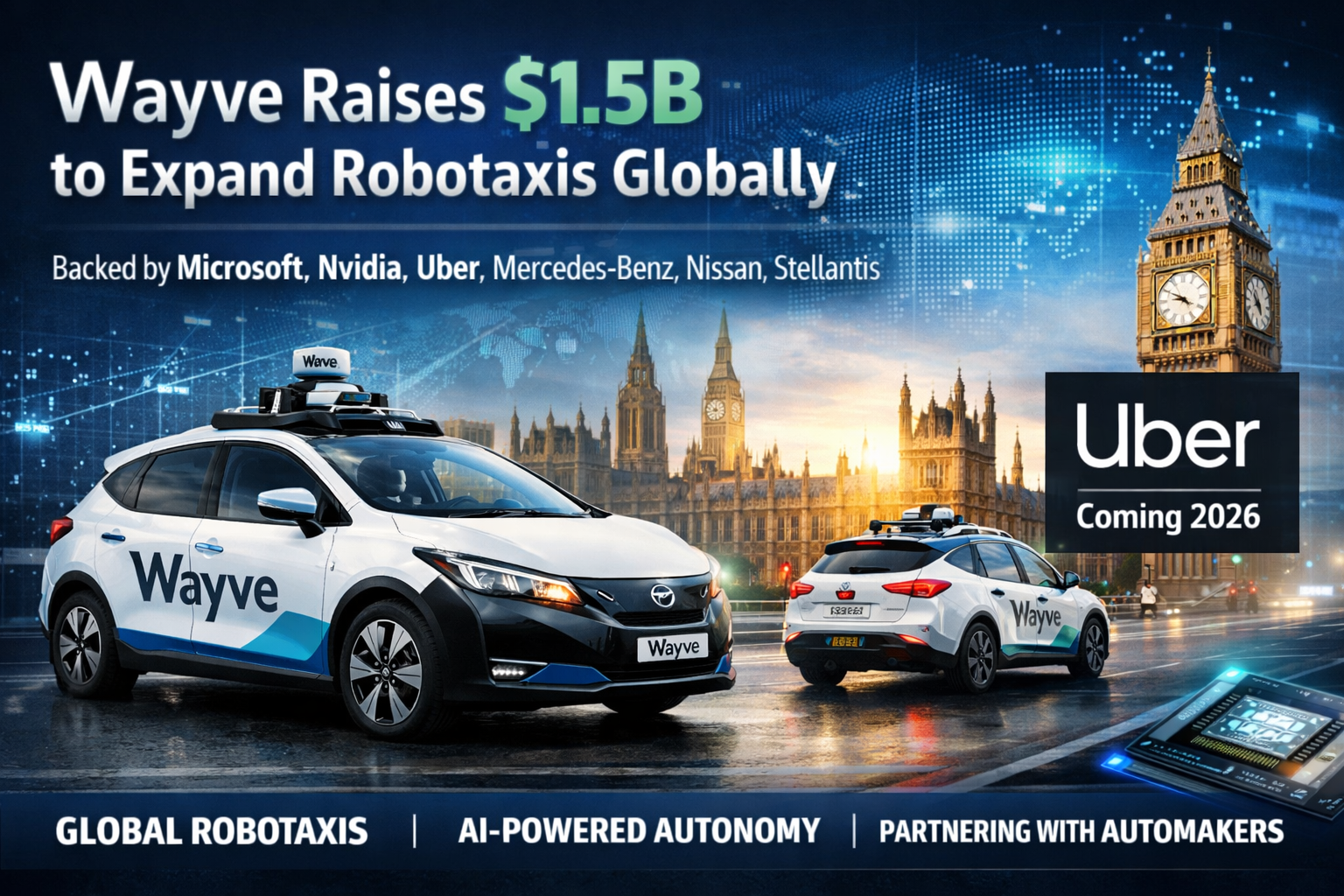
Wayve, a UK-based autonomous vehicle startup, has announced a huge new round of funding, worth 1.5 billion, to speed the implementation of its AI-driven self-driving technology across the world. It is also one of the biggest investments a British artificial intelligence firm has ever acquired and makes Wayve a serious competitor in the rapidly developing robotaxi market.
The round consists of the support of the large international players like Microsoft, Nvidia, Uber, Mercedes-Benz, Nissan and Stellantis. The most recent capital inflow has seen Wayve reportedly worth up to 8.6 billion, which indicates that the company is well-liked by investors regarding its AI-first strategy to autonomy. This is not just a funding event, but it is a symbol of the autonomous vehicle industry getting its mojo back, years after being cautious with investments and following lagging commercial deployments.
What Makes Wayve Different?
Wayve, an autonomous driving company founded in 2017, has a radically different approach to autonomous driving. Most of the competitors are dependent on high-definition maps and rule-based programming, whereas Wayve is based on deep learning models, which enable vehicles to learn driving behavior similar to humans. Its system can be mentioned as an embodied AI drive,r, the one that perceives the environment using cameras and sensors and makes decisions based on it in a dynamic fashion, instead of depending on pre-charted roads.
This is meant to remove the necessity of customizing city by city. Company statements reveal that Wayve AI has been piloted in hundreds of cities without the need to map them out. The possibility of it being reliable in large-scale commercial implementations could make scalability grow into the largest competitive advantage it has.
Uber Partnership and Global Robotaxi Plans
One of the biggest aspects of the Wayve expansion plan is based on the collaboration with Uber. In 2026, the two companies will roll out Wayve-powered robotaxis in London, and hope to continue to international markets of over 10 countries.
In the case of Uber, the joint venture, instead of developing its own autonomous system, will minimize the risk of development and be capital-intensive. In the case of Wayve, Uber is the instant access to a ride-hailing network and millions of customers worldwide. It is a win-win strategic fit.
Competition will, however, be stiff. Alphabet-based Waymo has already extended its robotaxi fleet to several cities in the United States and is planning to extend its service to other countries. The self-driving car market is not a hypothetical idea anymore; it is turning into a fighting field.
Beyond Robotaxis: Consumer Vehicles
Wayve is not restricting itself to ride-hailing fleets. The company has also created partnerships with car manufacturers, such as Nissan, to incorporate its AI technology in the next-generation driver assistant system. This ushers in the entry of consumer vehicles that have high autonomy features.
Wayve is also not a company that would develop the entire vehicle based on proprietary systems; it specializes in developing the AI-based brain that can be plugged into other vehicles by their makers. This is a software-based model that resembles operating systems driving a variety of hardware brands, and this may enable Wayve to scale faster than companies that have to operate fleets or manufacturing lines. Should the strategy become successful, this model may enable Wayve to be a foundational layer of the global automotive ecosystem.
Regulatory and Commercial Challenges
There are still barriers to overcome in spite of high financial allocations and technical potential. The self-driving cars are tightly regulated in the international markets. The methods of approval also differ depending on the country and may need a lot of safety verification. The trust of the people is also shaky, particularly following high profile incidences of self-driving systems across the world.
Another question mark is the commercial viability. Long-term low operating costs are guaranteed by robotaxis, but fleet management, insurance, maintenance and infrastructure investment are high. The robotaxi industry is yet to show scalability to profitability. Besides, the autonomous system’s acceptability to the consumer is determined not solely by the statistics of safety but also by the perception. It will take time to convince ordinary users to have faith in AI drivers.
Industry Impact: Why This Funding Matters
The $1.5 billion raise by Wayve is not just capital alone, but a belief. Large tech and car manufacturers are indicating that AI-controlled autonomy has stopped being a side project of experimental scope and is now a cornerstone of the mobility of the future.
The support of such companies as Microsoft and Nvidia indicates the increasing overlapping between artificial intelligence, cloud computing, and car innovation. Fully autonomous vehicles have ceased to be merely cars and have become data-driven AI-based applications made in real-time. To the UK technology sector, this investment also highlights the increasing role of Britain in the development and commercialization of advanced AI.
Editor’s Perspective: A Calculated but Bold Bet
From an experienced news editor’s standpoint, this funding round is both ambitious and cautious at the same time. Ambitious because $1.5 billion is a powerful vote of confidence in a company that has yet to fully commercialize at global scale. Cautious because Wayve’s software-focused model avoids the enormous capital burden of manufacturing vehicles or owning fleets outright. That strategy may prove to be its smartest move. Instead of competing directly with automakers, Wayve is positioning itself as a partner. Instead of operating fleets like Waymo, it is leveraging platforms like Uber.
However, history reminds us that autonomous driving timelines have repeatedly been pushed back. The technology is incredibly complex, and real-world driving conditions are unpredictable. Investors are betting that AI advancements, particularly large-scale neural networks, can finally overcome those barriers. If Wayve succeeds, it could redefine how autonomy is delivered globally. If it struggles, it will serve as another lesson in the long and difficult evolution of self-driving vehicles.
The Road Ahead: Vision vs Reality
Looking ahead, the real test for Wayve will not just be technological performance, but execution speed. Raising $1.5 billion creates expectation from investors, regulators, partners, and the public. The company must now translate AI research breakthroughs into safe, reliable, and commercially scalable deployments. As competition from players like Waymo intensifies and traditional automakers accelerate their own autonomy programs, Wayve’s ability to move quickly without compromising safety will define its success. In the end, autonomy is not a race won by headlines or funding rounds, but by consistent real-world performance.