
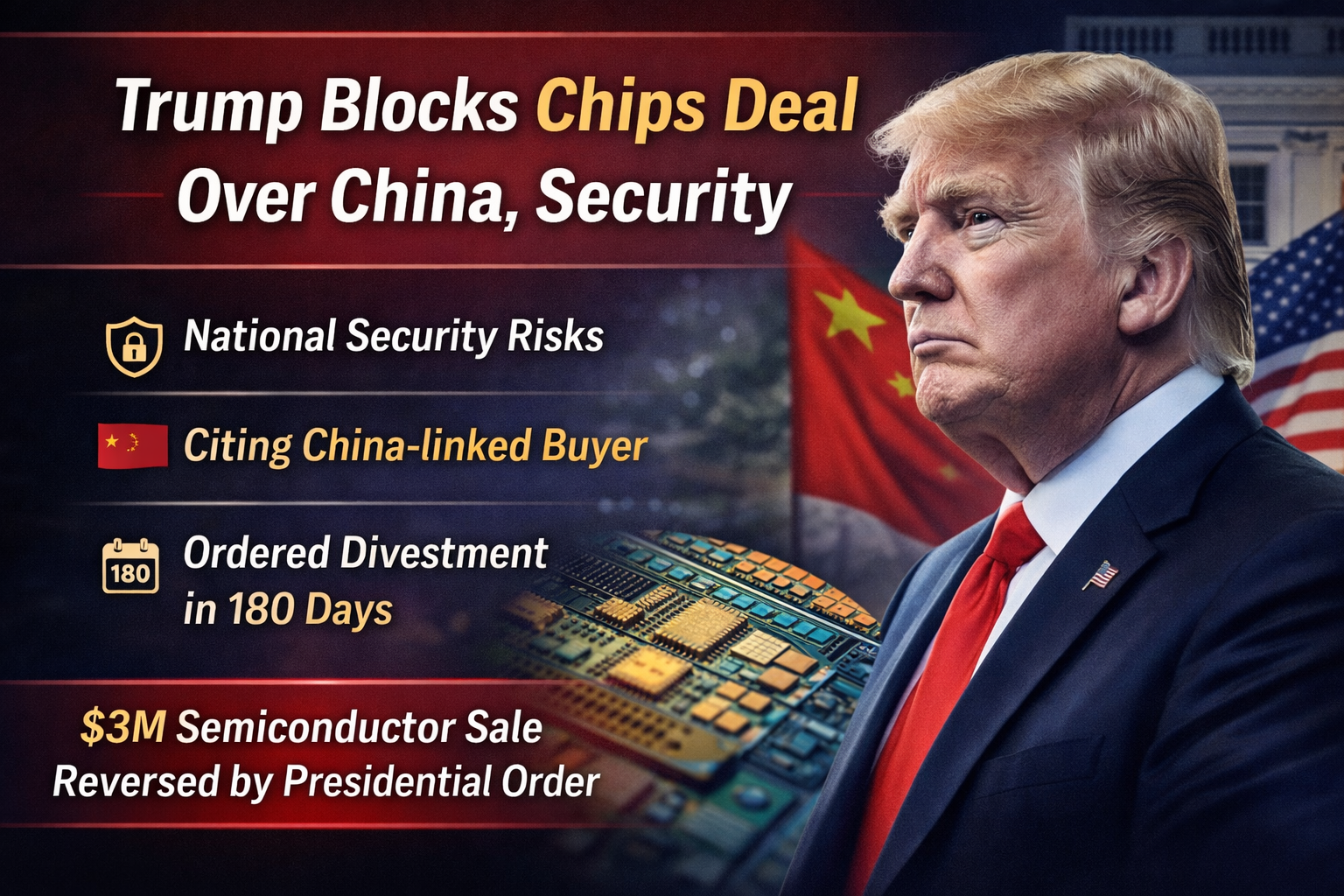
On Friday, President Donald Trump took the first step to prevent a minor yet symbolically important semiconductor deal, citing reasons of national security and issues related to China, in a move that highlights the growing intensity of scrutiny of foreign investment in U.S. technology holdings and the increasingly tenseU.S. relationship with China. In a January 3, 2026, White House order, Trump ordered the assets of photonic technology firm HieFo Corp. of the aerospace and defense specialist Emcore to be reversed as he claimed that the purchase may pose a security threat to the United States. These assets are the chip business and indium-phosphide wafer-fabrication businesses of Emcore, which were acquired by HieFo in 2024 at approximately 2.92 million and eventually privatized.
According to the order issued by Trump, HieFo is owned by a citizen of the People’s Republic of China, and the foreign ownership created an area of concern that the company could do something that would endanger the national security of the United States. Nevertheless, this order did not specify the person or specify certain vulnerabilities that provoked the measure.
HieFo should sell all interests and rights in the Emcore assets, and the order requires that he do so within 180 days. The White House has not given additional details regarding what the threat to national security was, and neither HieFo nor Emcore came out publicly to give comments after the announcement.
Background of the Blocked Deal
Emcore is a company that was located in New Jersey and was formerly a publicly traded corporation known to work in aerospace, defense technologies, and photonics technologies, including semiconductor wafer fabrication. When it was sold to HieFo in 2024, it did not initially attract much attention when it was conducted under the previous administration.
HieFo, an American photonics company that also engages in semiconductor business, was established by Genzo Zhang, who used to be an Emcore vice president of engineering and Harry Moore, who was once an Emcore senior sales director. During the time the transaction occurred, the company declared in its plans of operating within most of the same employees in California. The relatively low cost of the deal of about three million dollars, compared with the bigger headline-making foreign acquisitions of U.S. technology property over the last few years. However, the national security review of the transaction under the Trump administration has turned the table around since the Biden-era approval of the transaction.
CFIUS Review and National Security Concerns
This is after the Committee on Foreign Investment in the United States (CFIUS) had to investigate the matter and then decided to block the transaction. This is an interagency organization that audits possible security risks in foreign investments. The Treasury Department established that it had found a national security issue in its assessment of the HieFo-Emcore transaction. But it did not publicly expound on the details of such a risk.
Amid a growing strategic competition with China, CFIUS reviews have targeted more deals involving key technology industries, such as semiconductors, artificial intelligence systems and aerospace technologies. Over the past few years, the U.S. policy has become more restrictive of most such transactions, especially when companies with Chinese affiliations in foreign countries want to gain access to advanced technologies that are advanced and can be used in defense or dual-use purposes. According to the observers, the move by the Trump administration is a bigger move to curb the influence of China and its access to the high-technological and critical supply chains in America. The investigation of the committee took into account the character of the technologies under question and the possible consequences in the case when they are held by the entities related to the Chinese interests.
Wider Context: U.S.–China Tech Tensions
The aborted deal follows an extended history of tension between the United States and China over access to technology and national security. In the last few years, the U.S. exportation controls have become more stringent, particularly for high-end semiconductors and advanced computing technology that may serve military purposes. The U.S. policymakers are keen on semiconductors due to their critical role in the state of the art computing, aerospace systems, and defense capabilities. Washington has already prohibited or limited the supply of sophisticated chips and other related technologies to Beijing, claiming that such powers would serve to strengthen the military or strategic capabilities of the Chinese.
By late 2025, say, when the Trump administration indicated it would not permit the sale of Nvidia’s most advanced AI chip to China, other exports of high-performance semiconductors have been controlled.
These actions can be seen as a part of the wider effort to remain at the forefront of critical technology development in the U.S. and to restrict Chinese access to the best technologies that might form the backbone of military modernization or domination in artificial intelligence and other areas of strategic purpose.
Political and Strategic Implications
By blocking the HieFo acquisition, the administration is sending a wider message about its approach to foreign investment and national security. Trump has repeatedly emphasized economic and security competition with China throughout his presidency, and technology transfers have been a central concern.
Some analysts argue that the broader geopolitical competition between the U.S. and China has now extended deep into commercial and technological arenas. The review and rejection of deals like the Emcore transaction indicate that even comparatively small deals are not exempt from scrutiny if they involve sensitive technologies or potential national security implications.
The move also arrives amid other U.S. political dynamics, including ongoing debates in Congress over export controls on major chipmakers like Nvidia and AMD, as well as bipartisan efforts to sharpen restrictions on technology transfers. These legislative pressures complement the executive branch’s use of CFIUS and other tools to police foreign involvement in key sectors.
Industry Response and Market Impact
While HieFo and Emcore have offered no public response following the president’s order, industry watchers have noted that the decision could have ripple effects in how foreign investments are approached in the technology and defense sectors. Smaller firms, like HieFo, may find it more challenging to attract foreign capital if national security reviews become more stringent and unpredictable.
From a market perspective, the decision is unlikely to have a direct financial impact—the assets were acquired for a relatively small amount. Still, it may influence investor sentiment around cross-border deals in strategic industries. Potential investors might reassess risks associated with acquisitions involving sensitive technologies, particularly if they involve entities with ties to China or other strategic competitors.
Next Steps for Divestment and Enforcement
The White House order mandates that HieFo divest all interests in the Emcore assets within six months, setting a clear timeline for enforcement. How this divestment process unfolds and what entities may step in to acquire the assets remains unclear.
Enforcement of the divestment order will likely involve CFIUS monitoring and may require coordination with the Treasury Department to ensure compliance. U.S. officials could face pressure to provide greater transparency around specific security concerns linked to the deal, though such information is often shielded under national security protocols.
The Biden administration’s earlier approval of the HieFo deal underscores the shifting priorities between successive U.S. presidencies when it comes to foreign investment in strategic sectors. With Trump’s directive, the U.S. is signaling a more cautious, security-first framework that could shape future reviews of technology deals and foreign investment across industries critical to national defense and economic competitiveness.