
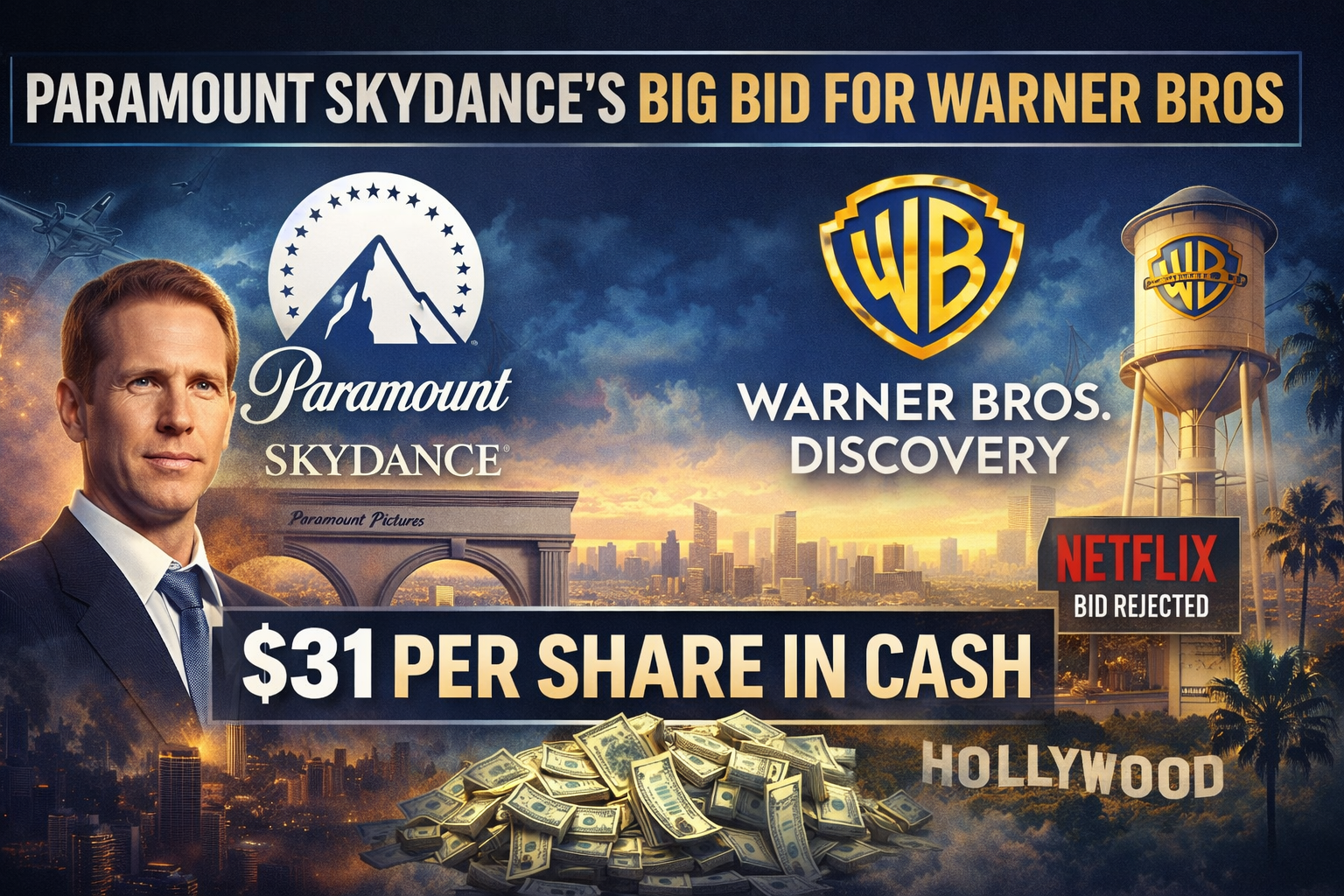
Paramount Skydance has become the center of one of the largest takeover fights in the history of Hollywood, and it is proceeding with a visionary idea to purchase Warner Bros. Discovery. Paramount Skydance, the new firm headed by CEO David Ellison, is trying to acquire the entire ownership of WBD at a price of $31 per share in cash. It is a step into a time when the global media business is being radically transformed, legacy television revenues are dying off, and streaming platforms increasingly struggle to meet their financial obligations. The acquisition would, should it be undertaken, bring together two of the most powerful entertainment collections in the entertainment sector across the world and change the competitive landscape in Hollywood considerably.
Board Declares Paramount’s Offer Superior
In a stalemate move, the board of Warner Bros. Discovery found that a revised offer by Paramount Skydance would be a Company Superior Proposal to a previous competitive offer by Netflix. In contrast to the offer by Netflix, which allegedly concentrated on buying only a few streaming and studio properties, the one made by Paramount aims at buying the whole of Warner Bros. Discovery. It has the iconic film and television studios, its premium networks like HBO, its cable brands like CNN and TNT, and its streaming platforms.
The arrangement of the offer by Paramount has the effect of reassuring the shareholders. It also contains a significant regulatory breakup cost in case the antitrust consent is not achieved, and clauses on breakup costs that Netflix owes in case Paramount accepts the bid by Warner. Moreover, a ticking fee would also pay off shareholders in case the deal is characterized by extended delays. Such financial guarantees must have been a major contributor to the decision by the board to consider the offer by Paramount to be better.
Q4 Earnings Reveal Industry Pressures
The acquisition comes at the same time as Paramount Skydance has released its fourth-quarter earnings, which showed a mixed state of the financial condition of the company. Streaming and direct-to-consumer segments were experiencing some growth, but the traditional television revenue was still declining because of the declining advertising markets and cord-cutting behavior. The firm also recorded an increase in losses, a fact that highlights how challenging the economics of the entertainment business are nowadays.
In its communications to staff, David Ellison highlighted that the future strategy of the company will focus on technological breakthroughs and the expansion of streaming. He made it plain: large size and new technologies are the keys to survival in the modern competitive world of media. The so-called Warner acquisition is not just an opportunity situation; it is a strategic one. The mixture of such large content libraries and subscriber bases will enable Paramount to increase its bargaining power, decrease content costs per subscriber, and increase global coverage.
Netflix Steps Aside
The fact that Netflix did not hike its previous bid meant that the course of the deal changed considerably. Netflix did not want to get into a long bidding war, and this is after analyzing the upgraded bid of Paramount. Such a choice demonstrates the tight financial strategy of Netflix and its unwillingness to spend huge sums on acquisitions and instead rely on organic growth.
The streaming company has, in the past, used internal production, international growth, and data-driven content strategies compared to the acquisition of entire conglomerates. The act of leaving would enable Netflix to clear the way for Paramount Skydance, although the ultimate decision would be determined by shareholders and regulation.
Regulatory and Shareholder Hurdles Ahead
Despite the board’s endorsement, the transaction is far from finalized. Shareholders of Warner Bros. Discovery must still approve the deal, and regulators in the United States and potentially abroad will examine the merger’s competitive implications. Media consolidation of this magnitude inevitably draws scrutiny, especially given concerns about reduced competition, media concentration, and consumer choice.
Antitrust authorities will likely assess whether the combined entity could exert excessive influence over content distribution, advertising markets, or streaming pricing. While Paramount’s inclusion of a sizable regulatory termination fee demonstrates confidence, it also acknowledges the genuine risks of governmental resistance.
A New Media Titan in the Making
If successful, the merger would create a formidable entertainment powerhouse. Warner Bros.’ legendary film studio, DC franchises, and HBO’s prestige programming would join Paramount’s existing assets and Skydance’s production capabilities. The combined entity would possess one of the largest content libraries in the world, spanning blockbuster films, scripted dramas, reality programming, and global streaming platforms.
In an era defined by intellectual property dominance and global distribution wars, scale increasingly determines survival. Rising production budgets, subscriber churn, and advertising volatility have pressured companies to seek consolidation as a solution. The Paramount-WBD combination would reflect this broader industry trend toward fewer but larger players capable of competing with technology-driven giants.
Editorial View: Bold, Risky, and Transformational
From an editorial perspective, this bid represents both opportunity and risk. On one hand, David Ellison’s aggressive approach signals ambition at a time when many legacy media companies appear defensive. His willingness to invest heavily suggests confidence in the enduring value of premium storytelling and established franchises. If executed effectively, the merger could produce operational efficiencies, stronger streaming economics, and enhanced global competitiveness.
On the other hand, the integration of two massive media organizations is never simple. Cultural clashes, overlapping assets, and restructuring costs could create turbulence. Moreover, the streaming market remains unpredictable. Subscriber growth has slowed industry-wide, and profitability remains fragile. A larger company does not automatically guarantee sustainable margins. Ultimately, this moment underscores a broader truth about modern media: standing still is no longer viable. As traditional television declines and streaming matures, companies must either scale up, specialize sharply, or risk marginalization. Paramount Skydance has chosen scale boldly and publicly.
Whether this acquisition becomes a transformative success or a cautionary tale will depend on execution, regulatory approval, and the evolving tastes of global audiences. For now, Hollywood watches closely as one of its most consequential corporate dramas unfolds.
Impact on Employees and Creative Talent
Beyond shareholders and regulators, the proposed merger carries significant implications for employees, producers, and creative talent across both companies. Large-scale consolidations often result in restructuring, overlapping divisions, and cost-cutting measures. While leadership may promise operational efficiency and growth opportunities, there is usually uncertainty regarding layoffs and departmental integration. At the same time, creatives could benefit from expanded resources, larger production budgets, and cross-platform storytelling opportunities. The success of the merger may ultimately depend on how effectively leadership balances financial discipline with creative freedom, an equation that has historically determined whether media megamergers flourish or falter.