
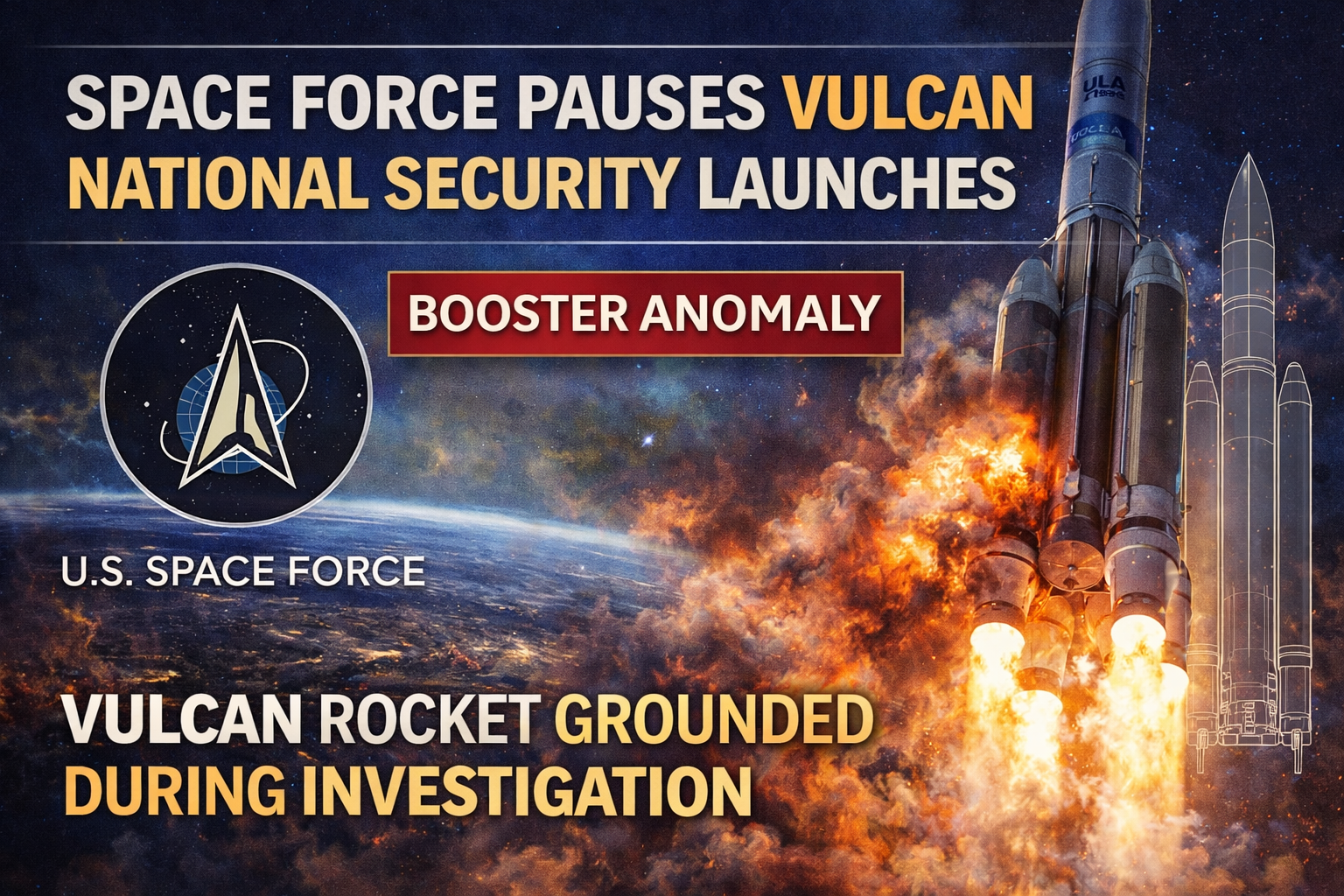
As a major step toward national security space operations, the U.S Space Force has declared that it will suspend all scheduled national security launches on the Vulcan Centaur rocket of the United Launch Alliance (ULA) until a repeat booster problem has been completely comprehended and solved. The decision stems from an anomaly observed during the February 12, 2026 USSF-87 mission, raising concerns about the reliability of Vulcan’s solid rocket boosters and prompting a cautious response from military space officials.
The Vulcan Centaur vehicle, which debuted in January 2024 and had completed four flights, was carrying two satellites for the Geosynchronous Space Situational Awareness Program (GSSAP) when one of its four Northrop Grumman–built GEM-63XL solid rocket motors (SRMs) exhibited an anomalous plume just after liftoff. Although the rocket’s main engines compensated and delivered the satellites successfully into orbit, the recurrence of this issue—similar to one observed in October 2024—prompted the Space Force to halt future missions until a thorough investigation is completed.
In announcing the pause, Space Force Col. Eric Zarybnisky, portfolio acquisition executive for assured access to space, explained that the technical anomaly could take many months to diagnose and correct. “Until this anomaly is solved we will not be launching Vulcan missions,” he told reporters during the Air & Space Forces Association’s Warfare Symposium on February 25.
The USSF-87 Anomaly and Its Significance
The USSF-87 mission, launched from Cape Canaveral Space Force Station, Florida, was intended to be a routine national security flight. It carried two GSSAP satellites—designed to monitor other spacecraft in geosynchronous orbit—and an experimental technology demonstration payload intended for training purposes. Early in flight, less than 30 seconds after liftoff, ground cameras recorded an unusual irregular flame pattern from one of the solid rocket boosters, indicating a potential burn-through or nozzle problem. Despite this, the vehicle continued its ascent nominally and deployed its payload into the targeted geostationary transfer orbit.
This is the second known occurrence of a solid rocket motor anomaly on a Vulcan launch. During one of the vehicle’s earlier flights in October 2024, a nozzle separated from an SRM, resulting in a deviation from the expected flight path. ULA and the Space Force responded with an extensive review and test program to address the issue. Despite that effort, a similar problem occurred again in February, suggesting deeper or unresolved technical challenges.
In response to the latest incident, Space Systems Command—the branch of the Space Force overseeing launch acquisitions—is conducting a comprehensive investigation into the performance of the SRMs and the conditions that may have contributed to the anomaly. Officials have been tight-lipped about specific causes, emphasizing that data collection and analysis are ongoing and that concrete findings have yet to emerge.
Vulcan’s Role in National Security Space Launches
The Vulcan Centaur rocket is the creation of the ULA, which is a joint venture formed between the Boeing and the Lockheed Martin to outmoded launch vehicles like Atlas V and Delta IV. Driven by two Blue Origin BE-4 engines that are powered by methane fuel and as many as four Northup Grumman solid rocket boosters, Vulcan was planned to fulfill both commercial and National Security Space Launch (NSSL) tasks.
After years of development delays, Vulcan attained certification from the Space Force in March 2025, qualifying it to carry critical U.S. military and reconnaissance payloads. The rocket’s first NSSL mission—USSF-106—flew successfully in August 2025, delivering technology demonstration satellites for geosynchronous operations. Its certification was seen as a milestone, ending reliance on Russian RD-180 engines that powered the Atlas V for decades.
At the time of the recent anomaly, Vulcan had been scheduled to carry several additional national security payloads in 2026, including GPS navigation satellites and advanced missile-warning spacecraft. The pause in launches disrupts this manifest, potentially forcing the Space Force to shift critical missions onto alternative launch vehicles or adjust timelines.
Broader Implications for ULA and the Launch Industry
The stoppage is an adverse time to ULA. It has been experiencing a rotation of leaders, with a veteran CEO, Tory Bruno, who has been serving the company, retiring at the end of 2025 to join a national security position at rival Blue Origin. Vulcan has also had repeated technical problems, which place strain on a program already plagued by delays and the danger of substitutes, especially SpaceX Falcon 9 which has proven to be an effective workhorse on numerous missions of national security concern.
According to industry analysts, recurring anomalies, although they need not be mission-threatening, will rattle the confidence of government customers, who require reliability and predictability that is not seasonal. The national security payloads, particularly those associated with missile warning, reconnaissance, and navigation are deemed to be too important to gamble their existence on cars whose performance uncertainties have not been resolved. Such environment may hasten the transfer of additional missions to longer track record launch providers or providers that have dual qualifications.
The Space Force already can offload missions to other providers on demand. The Falcon 9, having already won many GPS and other space defense missions, can be utilized more regularly in the event that the grounding of Vulcan is even longer. This is a procurement flexibility indicating a strategic move not to have single-point dependency in accessing national security spaces.
Technical Complexities and Safety Priorities
Solid rocket motors like the GEM-63XLs used on Vulcan are engineered to burn consistently and deliver predictable thrust. An anomaly such as a burn-through or nozzle malfunction can affect thrust distribution and vehicle orientation, necessitating rapid compensation from main engines to keep the rocket on its intended trajectory. In the USSF-87 flight, the Vulcan’s two BE-4 core engines adjusted performance in real time, allowing the mission to continue successfully even as booster issues persisted.
While redundancy and engine compensation help ensure mission success despite isolated component issues, repeated occurrences point to potential manufacturing or design concerns that must be resolved before national security missions resume. Given the high stakes of launching classified payloads and billion-dollar satellites, the Space Force’s pause reflects a broader culture of caution and risk mitigation that is essential when human and strategic assets are on the line.
Space launch systems like Vulcan represent cutting-edge engineering, yet even mature designs face challenges that only become apparent after several flights. The Space Force’s decision to halt launches underscores the complexity of space hardware and the imperative of ensuring mission assurance over schedule pressure.
The recurring solid rocket booster anomalies serve as a reminder that aerospace manufacturing is an exacting discipline where minor flaws can cascade into major risks. While Vulcan has demonstrated capable performance in delivering payloads despite these issues, the Space Force’s cautious stance is both understandable and necessary given the strategic importance of national security space infrastructure.
Challenges like these also offer an opportunity for the industry to refine quality control, improve design margins, and build deeper confidence in next-generation launch vehicles. Solving such technical puzzles ultimately strengthens the overall ecosystem, benefiting both military and commercial space endeavors.