
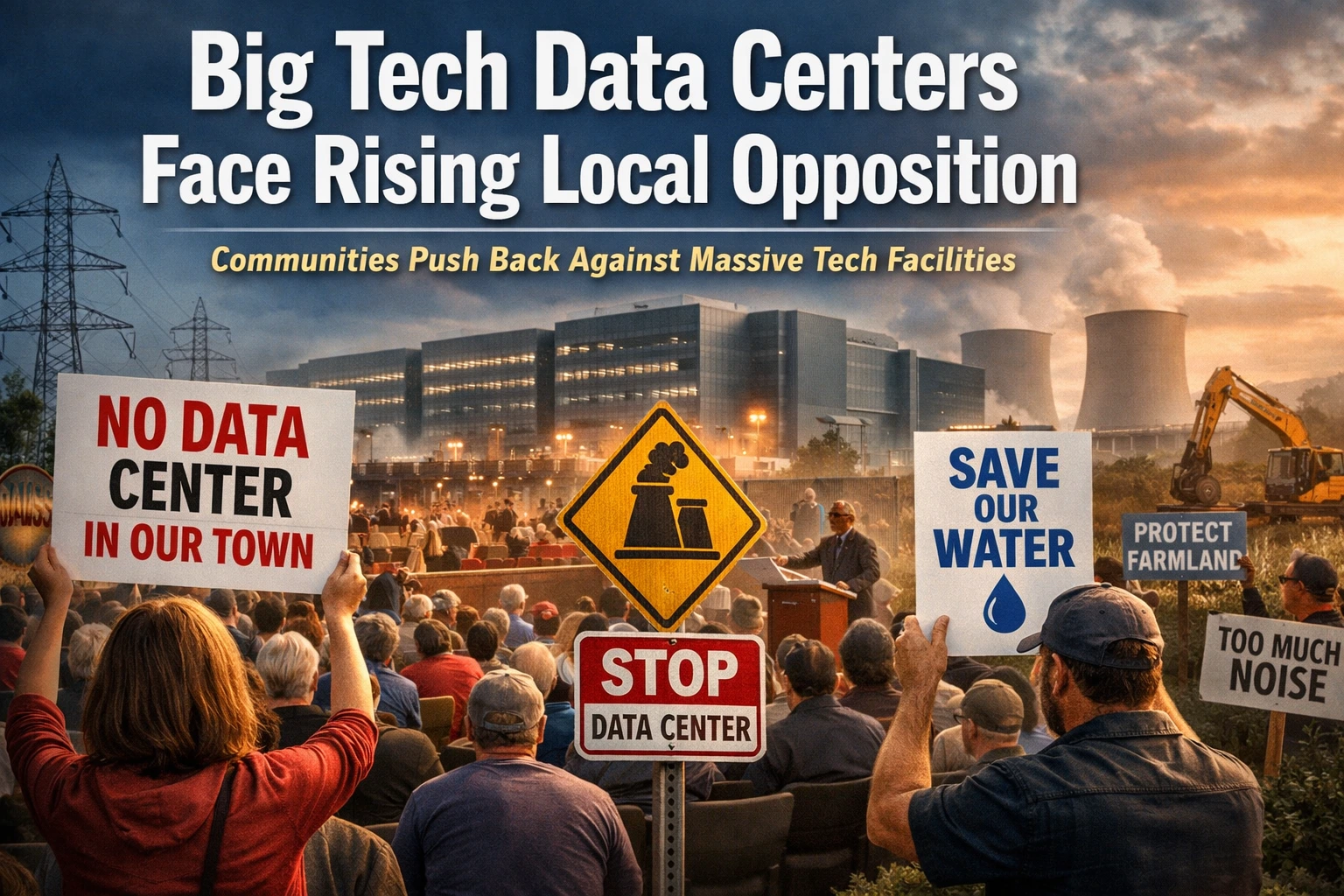
January 3, 2026 — Across the United States, once-quiet rural towns and suburban communities are emerging as unlikely flashpoints in a growing clash between Big Tech and local residents over the rapid expansion of data centers — the massive facilities that power cloud computing and artificial intelligence (AI). What tech giants such as Microsoft, Google, Amazon, and Meta once pitched as economic development and future-proof infrastructure is increasingly being seen by residents as unwelcome, environmentally taxing, and socially disruptive.
In Spring City, Pennsylvania, township meetings that traditionally drew a handful of citizens now attract overflowing crowds as residents pack municipal halls to voice opposition to a proposed data center on the historic grounds of the former Pennhurst State Hospital. “Would you want this built in your backyard? Because that’s where it’s literally going,” one resident told supervisors, capturing the growing sentiment at the grassroots level.
Across Indiana, Minnesota, North Carolina, and other states, similar scenes have unfolded: public hearings extend well past midnight, opponents wear shirts, distribute flyers, and place protest signs in yards. Data Center Watch, a project that tracks data center proposals, reports that a majority of projects tracked between April and June 2025 were delayed or blocked due to local resistance.
Community Meetings Turn Contentious
At a recent township meeting in East Vincent Township, Pennsylvania, local resident Larry Shank captured the sentiment of many when he asked township supervisors, “Would you want this built in your backyard? Because that’s where it’s literally going, is in my backyard.” His concern reflects a broader national mood of skepticism — and often outright resistance — toward what many see as intrusive, energy-hungry developments.
In communities that once welcomed economic development projects with relative silence, people are now crowding public hearings in droves. Meetings once dominated by routine agenda items are now filled with vehement objections, passionate testimony and urgent public pleas. Developers report opponents going door to door, handing out T-shirts and organizing expansive grassroots campaigns.
Environmental and Quality-of-Life Concerns
At the heart of the opposition are concerns over environmental impact, local infrastructure strain, and quality of life. Critics point to several recurring issues:
- Water usage: Data centers often consume vast quantities of water for cooling, raising fears of groundwater depletion in rural areas.
- Energy demand: Locals worry that increased electricity consumption could drive up utility costs for residents and place additional stress on regional grids.
- Noise and pollution: Backup diesel generators and ongoing operational noise are seen by residents as nuisances and potential health hazards.
- Land use: Many object to the loss of open space, farmland and forests, particularly when data centers replace agricultural land or scenic rural terrain.
- Transparency: In some cases — such as a proposed facility near Duluth, Minnesota — residents were distressed to learn that local officials and utilities had been discussing projects for months before the public became aware.
Projects Delayed, Blocked, or Withdrawn
The impact of these objections is measurable. A report by Data Center Watch, a monitoring project of the AI security consultancy 10a Labs found that approximately two-thirds of tracked data center projects valued at nearly $100 billion were either blocked or delayed due to community resistance between April and June 2025.
This backlash has led developers to reconsider site selection tactics, with some even contemplating selling properties once they secure a power connection, a scarce and valuable commodity — simply because community resistance makes zoning approvals increasingly uncertain.
In North Carolina’s Matthews, a proposed data center that would have funded nearly half the city’s annual budget was pulled from the town council’s agenda amid overwhelming public opposition. Mayor John Higdon noted that the adults in his community made it clear they would not support the development, describing public sentiment as “999 to one against.”
Industry Response: Engagement Over Expansion?
Industry voices acknowledge the challenge. Microsoft, in public filings, has identified community opposition and local moratoriums as operational risks that could delay or derail infrastructure projects permanently. Trade groups and developers admit that more robust community engagement is needed. Dan Diorio of the Data Center Coalition, an industry group said companies are increasingly discussing strategies to involve residents earlier in the planning process, highlight economic benefits, and promote water and energy conservation initiatives designed to reassure locals.
Legal Battles and Political Fallout
The data center wars are not confined to public hearings. Lawsuits on both sides have proliferated, with opponents suing local governments for alleged procedural failures and developers pursuing legal avenues to overcome zoning and environmental review obstacles.
In some communities, the issue has escalated into broader political discourse. Local elections and zoning votes are now influenced by data center proposals, with candidates’ positions on the developments becoming defining campaign issues. Politicians and activists have called for moratoriums until clearer national or regional policies are established to govern the rapid buildout of AI infrastructure.
A Broader Context: National Resource Challenges
This grassroots resistance coincides with broader debates about the future of technology infrastructure in America. Critics argue that data center expansion exemplifies how large corporations can impose significant environmental and social costs on small communities that see few long-term economic benefits from these installations.
Moreover, studies highlight that data centers contribute disproportionately to local energy demands and can affect air quality, particularly due to backup generators and cooling systems concerns that echo many community complaints.
Editorial Insight: A Tipping Point in Infrastructure Planning
As an experienced news editor observing this trend, what’s unfolding is more than a series of isolated zoning battles; it’s a transformative moment in how America grapples with the consequences of technological progress.
For years, data centers were largely invisible to the public. Their haunts were industrial parks and peripheral zones places few residents visited. But as the AI boom intensifies, the infrastructure needed to sustain it is moving closer to the heartland. And with global demand for cloud and AI services sky-high, tech giants are racing to build capacity wherever power and connectivity are available.
Yet this rush has collided with a public that is increasingly informed, organized, and emboldened. Whether justified or rooted in misinformation, the fear of losing control over local land use, environmental integrity and long-term costs has energized resistance movements nationwide. It signals a growing distrust between communities and corporate decision-makers.
Importantly, data centers do produce economic benefits they create construction jobs, can increase tax revenue, and boost local utility sales. But these benefits are often perceived as unequal and insufficient compared to the impacts residents fear particularly when promised jobs are few and specialized, and the facilities themselves require minimal onsite workforce once built.
Community opposition is a reminder that infrastructure is not just engineering it’s social contract. Developers and tech firms must earn public trust, not assume it. That means transparency, early engagement, equitable benefit sharing, and genuine responsiveness to environmental and lifestyle concerns.
As AI and digital infrastructure become ever more central to economic life, the path forward must include inclusive planning, clear regulatory frameworks, and attention to environmental sustainability. Without these, every future project could face the same intense backlash — turning progress into a battleground instead of a bridge.