
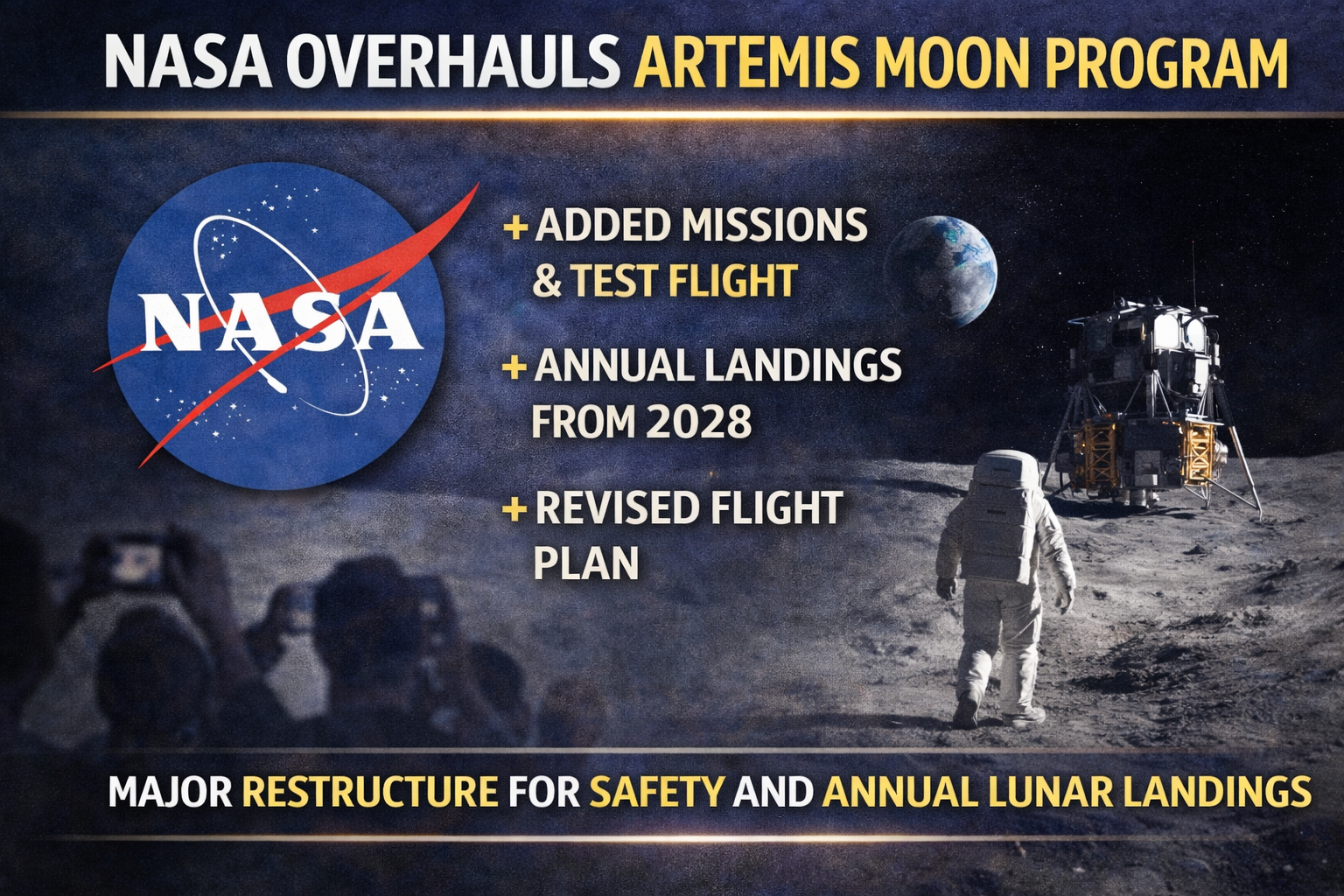
In a decisive shift for America’s flagship lunar exploration effort, NASA announced a major overhaul to its Artemis moon program on Friday, February 27, 2026, signaling a strategic “course correction” aimed at accelerating launch cadence, strengthening mission reliability, and ultimately ensuring astronauts return to the Moon with increasing regularity beginning in 2028. The announcement—made in the wake of recent technical delays and safety warnings—redefines mission objectives, adds a critical test flight, and adjusts timelines to better mirror the methodical approach of the Apollo era while addressing modern challenges and geopolitical competition in space exploration.
NASA Administrator Jared Isaacman explained that the revised Artemis architecture is designed to build confidence, reduce mission risk, and establish a sustainable cadence of lunar missions that lead up to crewed lunar landings starting with Artemis IV in 2028. This overhaul reflects both a recognition of past technical hurdles and a renewed commitment to learning from mistakes, speeding up production, and standardizing vehicle configurations to support a more reliable flight schedule.
Rethinking the Artemis Flight Sequence
Under the new plan, the mission originally called Artemis III—previously intended to land astronauts on the lunar surface in 2028—will now be repurposed as a test flight in mid-2027 focused on technology demonstrations and operational readiness in low-Earth orbit (LEO). This shift represents a substantial change in NASA’s long-awaited return to crewed surface missions. Rather than pushing directly from a lunar flyby to a landing, NASA will now use Artemis III primarily for docking tests involving the Orion crew capsule and one or more commercial lunar landers. These tests will also include integrated evaluations of life support systems, communications, propulsion, and the new xEVA spacesuits designed for Moonwalks.
The docking experiments will be an essential precursor to later lunar landings. NASA plans to target Artemis IV for the first crewed lunar surface mission in early 2028, with a possible second landing mission, Artemis V, later that same year. Alongside these changes, NASA intends to commit to at least one lunar landing mission per year after 2028, reflecting an aggressive yet measured push toward sustained lunar exploration and presence.
Why the Overhaul Was Deemed Necessary
The Artemis program restructuring decision is timed with the elevated levels of criticism regarding the speed and safety of lunar missions. NASA has endured a series of technical failures of its Space Launch System (SLS) rocket and its Interim Cryogenic Propulsion Stage (ICPS) such as leaks, a leakage in the helium flow, which had the effect of forcing the Artemis II mission, the first crewed spacecraft to orbit the Moon in over 50 years, to be rolled off the launch pad and set to launch no sooner than April 2026.
Worsening these problems a critical evaluation by NASA of the Aerospace Safety Advisory Panel (ASAP) offered warnings that the initial proposal to switch directly to a lunar flyby, to a manned landing was too ambitious and had inadequate margins to hold. The report of the panel identified the dangers of trying too many untested objectives in one mission, including first-time docking and first-time landing processes. NASA accepted this evaluation and declared that it approved of the move to use a step by step method that would be more effective to eliminate risk as well as learn on the history of the gradual strategy used by the Apollo program in the past.
A Return to an Incremental Approach
The current strategy of NASA is much like the rationale behind the Apollo missions that were able to demonstrate mission capability by taking successive test flights before astronauts could be put on the Moon. One example is that in the case of Apollo in 1969, the Apollo 9 mission conducted docking tests and lunar modules in the Earth orbit before the successful lunar landing of the Apollo 11. The new Artemis timeline developed by NASA is purposefully designed to entail comparable in-orbit tests to afford astronauts and mission missionaries the wisdom and readiness necessary before a lunar landing.
The additional mission in 2027 will allow NASA to assess and refine systems in a lower-risk environment, while also giving crews hands-on experience with spacecraft interactions that will be critical at lunar distances. NASA officials have emphasized that this is not a retreat from ambition but a recalibration that balances progress with safety. Administrator Isaacman stated that rebuilding NASA’s internal workforce capabilities and returning to a standardized configuration for vehicles like SLS and Orion are essential steps in enabling this new cadence and achieving program goals.
Standardizing Vehicle Configuration and Increasing Launch Cadence
One of the factors in the overhaul is the move by NASA to standardize the makeup of the Space Launch System rocket and simplify manufacturing to enable more frequent missions. The Artemis missions in the past have been characterized by long lags between missions, probably three or more years, because of the complexity of the technology, infrastructure, and the vast amount of work needed to reconfigure the vehicles to meet the specifics of each mission. Based on the new plan, NASA will cut the turnaround by producing and launching rockets with closer design specifications, thus the agency will be able to launch at least once a year and, ultimately, multiple landings at the moon in one year.
NASA officials acknowledged that this shift will involve changes to contractor workflows, supply chain processes, and workforce priorities. Partnerships with Boeing, SpaceX, and other aerospace companies will be integral to meeting these increased demands, with an eye toward safety, reliability, and production efficiency. In this context, NASA’s leadership is drawing on lessons from its past exploration successes, stressing that repetition builds “muscle memory” and strengthens operational confidence.
Competing Priorities and the Broader Space Race
The Artemis rebranding is a move that has happened at a time when the world space environment is getting very competitive. It has been publicly stated that China has big plans to land astronauts on the Moon by the early 2030s, which has been causing panic in NASA and among American policymakers to ensure that America remains at the forefront in human space exploration. Although the 2028 target of reaching the moon has been maintained in the new plan of NASA, the extra missions and a faster rate of launching missions can be considered as the attempt to evade the long delays and show that progress is being made amidst the challenges of international competition.
NASA’s restructuring of the Artemis program has also sparked conversation within the aerospace community about the balance between ambitious goals and achievable milestones. Critics of previous plans argued that too many complex objectives were being attempted too soon, potentially jeopardizing astronaut safety and mission success. By adjusting the sequence and emphasizing incremental validation, NASA hopes to build a more resilient program capable of both advancing lunar exploration and setting the stage for future Mars missions and deep-space ambitions.
Conclusion: Artemis’s Next Chapter
NASA’s major overhaul of the Artemis moon program marks a critical turning point in the agency’s pursuit of lunar exploration. By restructuring the flight sequence to include an intermediate test mission in 2027 and setting the stage for annual lunar landings beginning in 2028, NASA seeks to balance ambition with safety, build operational momentum, and reassert American leadership in space. This strategic shift—rooted in lessons from past exploration efforts and informed by modern technical challenges—may ultimately prove vital to the success and sustainability of human spaceflight beyond Earth orbit.