
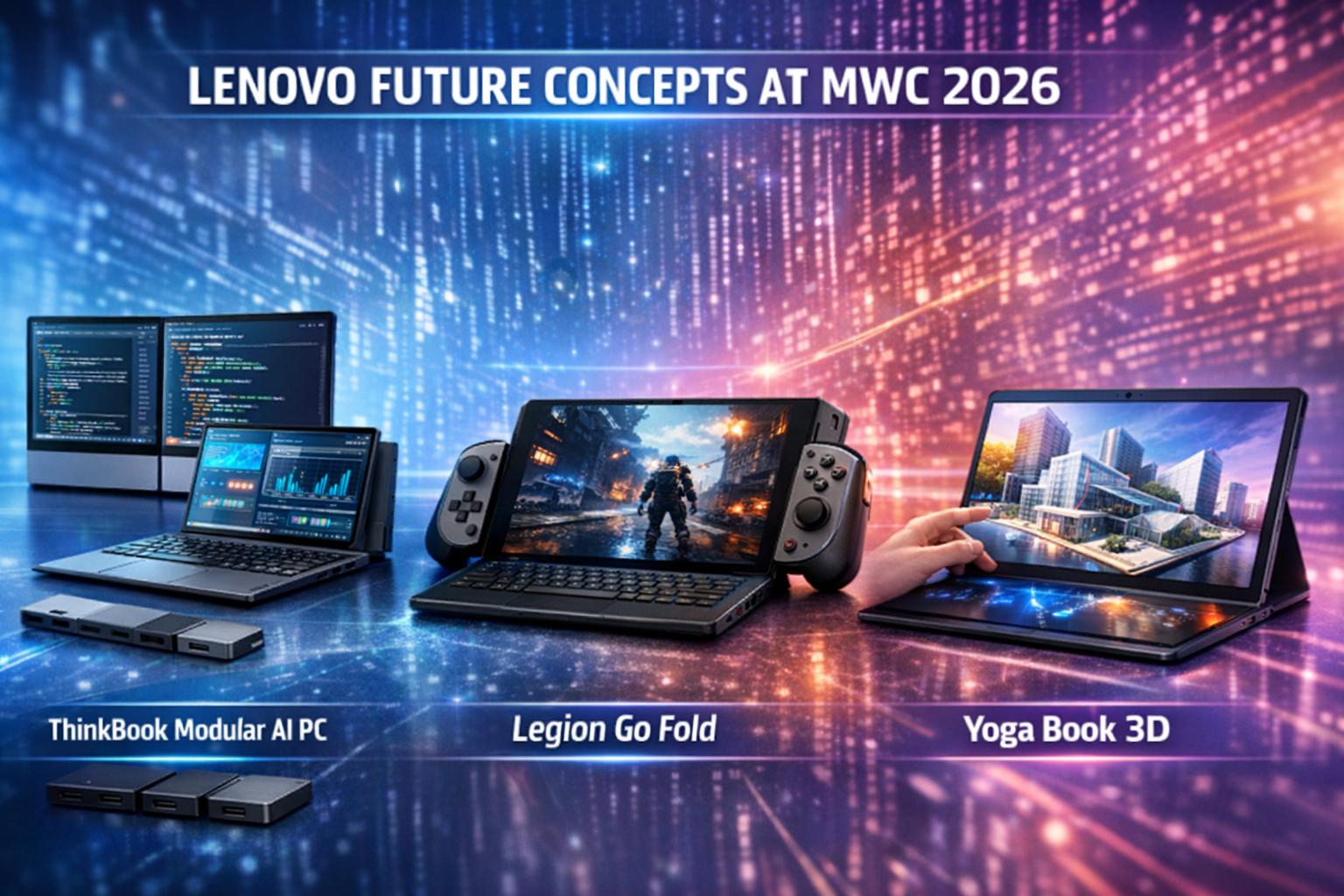
The winner of the Mobile World Congress 2026 in Barcelona was Lenovo, which displayed a range of futuristic concept products that disrupt the conventional concept of a laptop, game handheld, or creative work station. Instead of merely improving processors or making things thinner, Lenovo introduced some ambitious experiments with modular computing, foldable screens and AI-assisted interaction. Although these gadgets are current merely in theory, they do come as a valuable preview as to how the company perceives that personal computing is going to evolve over the next few years.
ThinkBook Modular AI PC: A Flexible Vision for Professionals
One of the most discussed prototypes at the event was the ThinkBook Modular AI PC. On the surface, it resembles a sleek and modern 14-inch laptop. The standout feature is a secondary display that magnetically attaches to the back of the primary screen. Users can remove it and place it beside the main display to create a dual-screen setup. This could be particularly useful for professionals who need extra screen space for coding, editing, financial analysis, or multitasking on the go. Instead of carrying a separate portable monitor, users would simply snap the second display into place.
Another intriguing element is the removable keyboard. In this configuration, users can replace the keyboard with the secondary display, turning the laptop into a compact dual-screen workstation. Lenovo also experimented with modular port systems, allowing customization of connectivity options such as USB-C or HDMI modules depending on specific requirements.
From an editorial perspective, this concept reflects a deeper industry trend toward adaptability. Modern workers demand flexibility, especially in hybrid and remote work environments. However, modular systems can introduce complications. Consumers expect devices to “just work,” and any friction in switching modes could limit real-world appeal. Still, the ThinkBook concept demonstrates that the traditional laptop form factor is no longer sacred; it is open to reinvention.
There is also the other interesting aspect of the removable keyboard. In this setup, the user will be able to use the secondary display instead of the keyboard and make the laptop a small two-screen workstation. Lenovo had also tried modular port systems, whereby connectivity options could be customized to include USB-C or HDMI modules at the time of purchase based on a particular need.
This idea is an expression of a more general industry trend of flexibility in an editorial view. Modern employees require flexibility in hybrid and remote working conditions. Modular systems can, however, be complex. The presence of moving parts would contribute to the higher probability of wear and tear, and a seamless optimization of software will be essential. Consumers want the devices to have a feature of just working, and any difficulty in switching modes may also restrain practicality. Nevertheless, the ThinkBook concept proves that the conventional form of a laptop is not sacred anymore; it can be reinvented.
Legion Go Fold Concept: Blending Gaming and Productivity
Lenovo also presented a concept of an ambitious foldable gaming handheld in its Legion brand, the Legion Go Fold Concept. This device will help in closing the divide between portable gaming consoles and smaller PCs. It will have a foldable OLED screen that will start with a smaller handheld screen size and an expanded screen size of a tablet when unfolded. It will have controllers that can be removed, which can be deployed in different ways depending on the usage. The gadget is used as a formidable handheld console in its gaming mode. Combined with a keyboard case, it becomes a small Windows PC, which can also be used for productivity. This multi-functional design indicates an increasing demand on multi functional devices by consumers.
The key element of the appeal is the foldable screen. Smartphone foldable screens have already been implemented, but when trying to extend the technology to gaming PCs, the challenges are new. Gaming devices are hot and need high-level processing power, which may be a burden on battery life and internal components. Together with a flexible hinge system that is needed, these needs demand high-level engineering.
Given that I am a news editor who notices the trends in technology, it is evident that hybrid devices are a significant change in consumer behavior. Most users, particularly the young users, do not need to have separate work and play machines. The Legion Go Fold tries to offer both together. Nevertheless, it is durability and the price that will make or break such a device to leave the concept phase and enter the mainstream world.
Yoga Book 3D Concept: Immersive Creativity Without Glasses
In addition to gaming and modular hardware, Lenovo also launched an innovative idea that aims to take immersive computing to the next level. Yoga Book 3D Concept has two OLED displays that can present 3D images without glasses. The device can interpolate 3D data, expose it to the screen and provide interaction with the screen by using an AI-guided depth map and gesture tracking.
The author is also addressing this notion to creative specialists like designers, architects, engineers and digital artists. Conventional flat screens may restrict the depth and perspective visualization. Incorporating 3D features in an embedded form factor, Lenovo will benefit the process of developing and interacting with digital spaces by professionals.
The 3D display technology has historically not been able to have mass adoption. Previous solutions involved the use of special glasses or made users uncomfortable when they were used on a long-term basis. The solution of Lenovo also does not consider extra accessories that help to enhance the usability. Nevertheless, software support is a key factor in the long-lasting success of such a concept. The 3D interaction should be optimized with creative applications, and developers will be forced to invest in suitable tools.
In terms of editorials, Yoga Book 3D is possibly the most experimental among the demonstrated devices. Although it might not attract common consumers, it is an indication that Lenovo can venture into niching and venture further than the traditional computer.
AI as the Foundation of Lenovo’s Strategy
Lenovo featured the idea of artificial intelligence in all its concepts. The company outlined its vision of smarter AI for everyone, with on-device AI, which is expected to enhance efficiency and personalization. AI in the present-day PCs is not just voice assistants. It is able to summarize documents, maximize system performance, multitasking elements of work, and accommodate user habits. Lenovo is planning to make devices that do not respond but take initiative by ensuring that artificial intelligence is built-in into the hardware systems.
The focus is in line with industry-wide trends. With the increasing commoditization of computing capabilities across the brands, software intelligence and integration into the ecosystem are progressively becoming the key differentiators. The features promoted by artificial intelligence may also become productive in insidious but effective ways, including file sorting automatically or optimizing battery usage depending on usage trends.
Nonetheless, the increased level of AI integration is accompanied by issues of privacy and data protection. On-device processing can be presented as a solution, as it minimizes the need to use cloud servers. Lenovo has paid attention to the issue of local AI capabilities, which implies that the company understands such issues, particularly as regulatory oversight of data security continues to expand worldwide.
Industry Implications and Competitive Landscape
Lenovo’s showcase at MWC 2026 sends a clear message to competitors: innovation in PC hardware is far from stagnant. While many brands focus on refining established designs, Lenovo appears willing to experiment publicly with radical ideas.
Concept devices play a strategic role in shaping industry direction. Even if the exact products do not reach market shelves, the technologies behind them often influence future releases. Modular attachments, foldable gaming systems, and integrated AI accelerators may gradually appear in more practical, consumer-friendly formats.
The timing is also notable. As global PC shipments stabilize after years of fluctuation, manufacturers are searching for compelling reasons for consumers to upgrade. Incremental improvements are no longer enough. Devices must offer meaningful new experiences to justify investment.Lenovo’s approach suggests that the company sees adaptability and intelligence as the next major selling points. Whether through detachable screens or foldable displays, the goal is to move beyond static computing toward dynamic, user-centric design.
A Calculated Bet on the Future
What stands out most from Lenovo’s presence at Mobile World Congress 2026 is its willingness to experiment publicly. Not all concepts succeed, and some may never reach commercialization. Yet innovation often requires visible risk-taking. As an experienced observer of technology cycles, it is evident that we are entering a transitional phase in computing. Traditional laptops and desktops are evolving into multi-form devices that adapt to work, gaming, and creative tasks seamlessly. Lenovo’s concepts reflect this shift.
The modular ThinkBook explores structural flexibility. The Legion Go Fold merges gaming with productivity in a foldable format. The Yoga Book 3D reimagines visual interaction. Together, they demonstrate a broader strategy centered on adaptability, immersion, and AI integration. While challenges remain, including cost, durability, and consumer readiness, Lenovo’s showcase at Mobile World Congress 2026 highlights an industry in motion. Rather than repeating past formulas, the company appears determined to redefine what a PC can be in the AI era.