
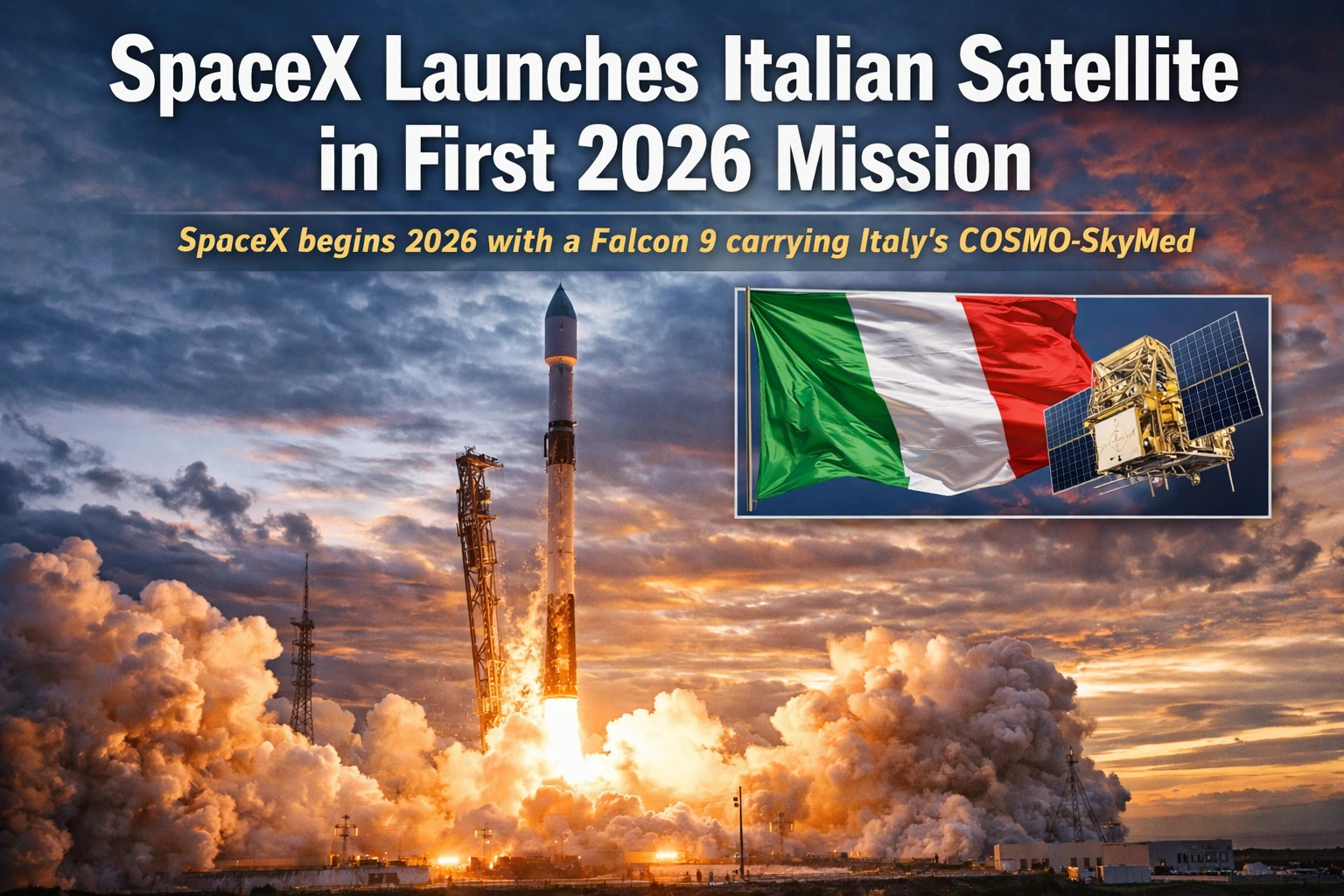
SpaceX officially launched the world space calendar of 2026 by launching an Italian Earth-observing satellite into orbit on Friday evening, not only marking the first mission of the year by the company but also the first orbital insertion in the world in 2026. The mission is a strategic merger of the launching of commerce and global scientific and defense concerns, and this indicates how the collaboration between the government and the business is still a factor that leads to contemporary space voyages and the observation of the Earth.
At exactly 9:09 p.m. Eastern Standard Time (6:09 p.m. local Pacific time) on Jan. 2, a SpaceX Falcon 9 rocket thundered off Space Launch Complex-4 East at Vandenberg Space Force Base carrying the COSMO-SkyMed Second Generation Flight Model-3 (CSG-FM3) satellite. About 4.5 minutes later, the upper stage deployed the Italian spacecraft into its designated low Earth orbit, completing a flawless ascent.
The Falcon 9 booster used for the mission — designated B1081 — also executed a precision landing back at the base about 8.5 minutes after liftoff, showcasing SpaceX’s continued mastery of reusable rocket technology. This was the booster’s 21st flight, underscoring the operational and economic efficiencies of reuse in modern rocketry.
About the Satellite and Its Mission
The satellite, which was launched on Friday, is part of the COSMO-SkyMed Second Generation programme, which is a constellation of satellites that are meant to monitor the Earth, designed by the Italian Space Agency (ASI) and the Italian Ministry of Defence. The spacecraft was intended to orbit the Earth in a circular Sun-synchronous orbit, at an altitude of around 620 kilometers (385 miles) and possesses synthetic aperture radar (SAR), which is capable of taking high-resolution images irrespective of weather or light conditions.
This is an all-weather imaging feature that offers COSMO-SkyMed a massive edge compared to the conventional optical satellites, which depend on clear skies and the sun. The radio wave emitted by SAR devices can reflect off the surface of the earth, and the satellite can see the clouds, smoke, and darkness, which is essential in disaster management and environmental monitoring.
According to the space and defense officials in Italy, the program has been termed as a valuable property in national security as well as scientific studies globally. Besides emergency response and disaster prevention, COSMO-SkyMed constellation data will be useful in risk assessment, environmental conservation, agricultural planning, maritime surveillance and land-use management applications, which are well beyond national borders.
A Broader Role in Global Earth Observation
The importance of COSMO-SkyMed is found not only in the imaging that can be done by the system but also in the role that it plays within a bigger setup of monitoring programs on the Earth. The mission will complement the already established observation programs, including the Sentinel series of the European Space Agency as part of the larger Copernicus Earth observation program, and other national satellite systems which assist scientists and policymakers in tracking climate change, rising sea-level, natural disasters and environmental degradation.
These satellite groups also act as early warning systems of the planet. They offer close to real-time information that may be exploited to monitor forest fires, floods, melting ice caps and other activities that are associated with global climate change. With the increased effects of climate change, the need to have a more developed, global Earth observation architecture is becoming more evident.
SpaceX’s Role in the Evolving Space Economy
This introduction highlights the superiority of SpaceX in the international launch market. It is in 2025, the year the company launched the largest number of 165 orbital missions ever to be launched by any launch company, public or otherwise. The approach used by SpaceX has been to reduce the cost of launching a rocket and the frequency by reusing rocket boosters and simplifying the process. Such a strategy has made space accessible to a broader range of clients – commercial companies and scientific organizations, as well as to national space agencies. The outcome is a successful launch ecosystem in which missions that were previously thought to be uncommon are nearly commonplace.
However, this commercialisation of space also has its problems, as well. The higher the launch cadence, the higher the orbital traffic – raising the issue of space garbage and or orbital railways. Even with the better handling of space traffic and the rules on how satellites and rocket stages should be disposed of at the end of their lives, this multifold increase in the number of satellites and rocket stages will necessitate further collaboration between the international space agencies, commercial actors and the regulatory organizations.
Public-Private Partnerships: A Growing Paradigm
The Italian satellite failure exemplifies the more widespread standard of joint effort between the government and businesses. Although the governments have long relied on launch providers such as SpaceX to deliver the payload into space, traditionally, they advanced their own spacecraft and launched them into space. This is a win-win relationship which enables government agencies to concentrate on their core missions, science, security and public service and to use commercial innovations and efficiencies.
The COSMO-SkyMed (created by aerospace companies like Thales Alenia Space and funded by civil and defense funding) can be considered a bright example of how such alliances may lead to strategic advantages. The success of the program to date has already seen several satellites of the constellation be launched in space that are offering continuity and resilience in the streams of Earth observation data.
Editorial Perspective: A New Year, a New Space Frontier
This launch as a seasoned news editor dealing with technology and science is an illustration of the phenomenal transformation of space exploration from a niche government preserve to an active ecosystem in which commercial and citizen interests continue to be more intertwined.
The fact that SpaceX will be able to launch the first orbital mission of 2026 can be attributed to the operational maturity and the strategic vision of the company. The emergence of Earth observation systems such as COSMO-SkyMed indicates a greater realization among the international community: to know and conserve our planet, we need to have more observational capabilities than ever before. Satellites are not scientific gadgets of curiosity, but important infrastructure to environmental management, disaster management, national security, and economic planning.
Yet, this growth in space activity also invites reflection on governance and sustainability. The race to orbit must be balanced with responsible practices that minimize debris, ensure equitable access to data, and address concerns about militarization and commercialization of space. International cooperation, not just competition, will be essential in shaping a space environment that benefits all of humanity. In the coming months, all eyes will be on SpaceX and other launch providers as they pursue even more ambitious missions — from lunar landings to deep space exploration. But for now, as the Falcon 9’s first flight of 2026 fades into Earth’s night, it serves as a powerful reminder that space, once distant and mysterious, is now deeply woven into the fabric of modern life.