
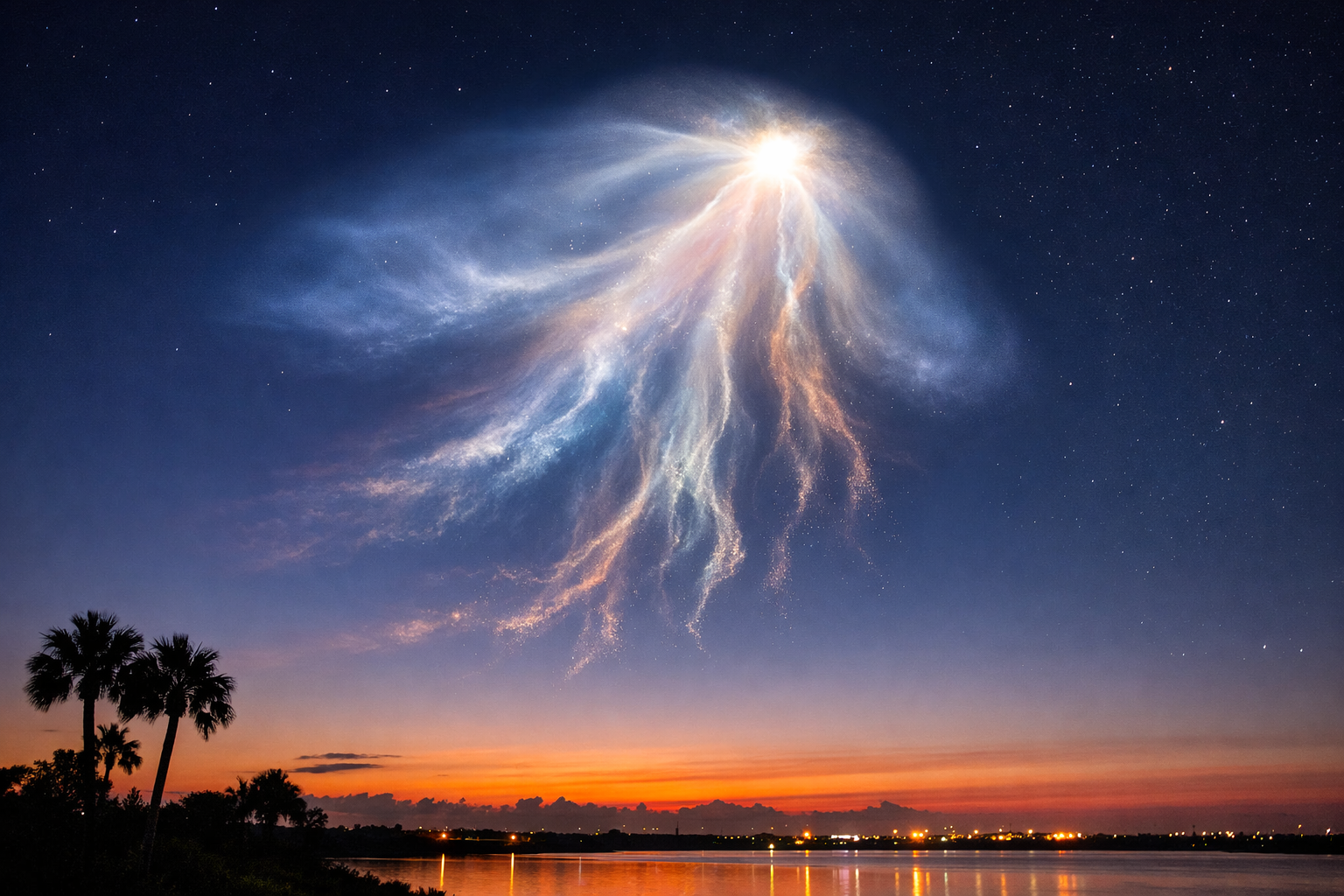
The people of Florida and some of the southeastern United States were given a once-in-a- lifetime and very beautiful sight one morning, just after a rocket launching at Cape Canaveral, as a glow cloud formation was seen in the sky. The strange structure, which most onlookers said looked like a giant jellyfish drifting through the sky was attributed to a SpaceX Falcon 9 rocket launch of Starlink satellites into orbit.
The incident created an interest and excitement among the skywatchers, photographers and other space lovers who witnessed the lightened building spanning across the pre-dawn sky. Although some people speculated at first, that the phenomenon could have been due to a weird weather condition or even a UFO sighting, the experts were quick to point out that the display was due to high-altitude rocket exhaust reflected through the sun. This effect is popularly known as a space jellyfish or noctilucent cloud phenomenon, which takes place whenever rockets are launched at twilight.
The spectacular show explains why the recent rocket launches have the ability to produce amazing atmospheric effects that can be seen several hundred miles away by the launch location.
SpaceX Falcon 9 Launches Starlink Satellites
The spectacular sky scene was witnessed soon after a SpaceX Falcon 9 rocket was launched at Cape Canaveral Space Force Station in Florida. It successfully launched 29 Starlink satellites into low-Earth orbit as part of the expanding global satellite internet network by SpaceX.
The actual launch was in the early morning, at about 5:52 a.m., Eastern Time, about an hour before sunrise. The exhaust plume of the rocket was lighted up due to the speed at which the rocket was rising into the upper atmosphere where sunlight was already available, yet the earth beneath was still in darkness. This contrast produced the dramatic visual image that could be observed by people in Florida and the surrounding states.
The plume rose tremendously in the thin upper atmosphere as the rocket was rising. The sun rays that filtered through the gases gave vivid colors of blue and white to orange and pink. The enlarging form was like a luminous bulb with tails of wisps trailing out like tentacles–which was why it was nicknamed space jellyfish.
What People Saw Across Florida
The witnesses all over the state claimed to see the mysterious cloud soon after rallying the cloud. Numerous locals uploaded images and videos to social media and depicted a luminous ball slowly growing over the sky and a shimmering path behind it.
The experience in such cities as Tampa, Fort Myers, Naples, and Orlando was surreal and unexpected in the eyes of observers. A few at first thought that it was a rare weather phenomenon, or some rare atmospheric occurrence. Other people made fun of it that it was a thing a science-fiction film could have made.
The glowing cloud was soon cleared up by local weather forecasters and other space gurus who said it was a rocket smoke plume that was being lit up by the rising sun. The plume was vast as it rose above much of the state of Florida in a few minutes after its launching, it was of such height.
Since the plumes of rockets are expansive in the near vacuum of the upper atmosphere, it is capable of spreading within hundreds of miles. This enables individuals very distant to the launch site to view the exhibition.
Science Behind “Space Jellyfish” Clouds
The incandescent structure positioned following the launch belongs to an effect commonly known as twilight rocket clouds or space jellyfish. These happen when rocket launches are done at sunrise and sunset.
When a rocket attains high altitudes, it will find itself in an area of the atmosphere where the sun is still shining despite the fact that the ground below is in the dark. At this stage, the exhaust gases produced by the rocket burst tremendously since the air pressure is very low.
The sunlight in turn bounces and bends back and forth off these gases forming a bright cloud as seen by people on the ground. This influence may result in abnormal shapes, vivid colors and theatrical structures in the sky.
The plume itself is mainly made up of water vapor and carbon dioxide which are generated by the engines of the rocket. As the plume diffuses in the thin upper atmosphere it is lit up by the sunlight thereby causing the glow effect as observed on the earth.
In other instances, the effect may take a number of minutes before the plume fades into the atmosphere.
What Are Noctilucent Clouds?
The phenomenon is commonly referred to as a space jellyfish but it is also linked to noctilucent clouds, occasionally referred to as night-shining clouds.
Noctilucent clouds are extremely high in the atmosphere of the earth, usually 76 to 85 kilometers above the earth, much higher compared to normal weather clouds. They consist of minute ice crystals which reflect the sunshine at a time when it is already dark down below.
Such clouds occur in the Polar Regions during summer seasons but the same cloud formations can be formed by launching rockets and releasing water vapor and particles into the atmosphere. When they are hit by sunlight, these artificial clouds may resemble the natural noctilucent formations.
The intensity of the effect is dependent on how bright and visible the combination of the exhaust of the rocket, atmospheric conditions, and the angles of the lighting can make it.
Why the Phenomenon Appears So Dramatic
The space jellyfish effect is an effect of physics in the near space which makes it appear dramatic. As the rocket ascends, there is a significant decrease in the air pressure around the rocket. This expands the exhaust plume in a bursting outward motion, resulting in a large spherical cloud instead of a narrow trail of exhaust plume, as can be seen when it is closer to the ground. As the sun rays reach the plume which is growing below the horizon, it lights the cloud in bright colors.
The form may be nearly organic such as a jelly-fish with trailing tails due to turbulence in the exhaust gases and contact by atmospheric winds. Due to the optimum light effects because of a launch at sunrise or sunset, such launches tend to be the most spectacular.
Growing Spectacle of the Modern Space Age
Rocket-related sky phenomena are becoming increasingly common as launch activity increases around the world. Companies such as SpaceX, along with national space agencies, conduct frequent launches for satellite deployment, space exploration missions, and technology demonstrations.
In particular, SpaceX has dramatically increased the pace of launches to build out its Starlink satellite constellation, which aims to provide global broadband internet coverage. The constellation already includes thousands of satellites in orbit, with many more planned in the coming years.
As launch frequency grows, twilight launches that produce visible atmospheric effects may become more common, especially along the U.S. East Coast and other major launch regions.
Public Fascination with Rocket Launch Phenomena
One reason these events attract such widespread attention is that they combine cutting-edge technology with visually striking natural effects.
For many people, seeing a glowing cloud expand across the sky is both beautiful and mysterious. The unfamiliar shape and brightness often prompt speculation before experts explain the cause.
Similar events in the past have triggered reports of UFO sightings or missile launches, particularly when observers are unaware that a rocket launch has just occurred.
Today, however, widespread access to live launch broadcasts and social media updates allows people to quickly connect unusual sky phenomena with scheduled space missions.