
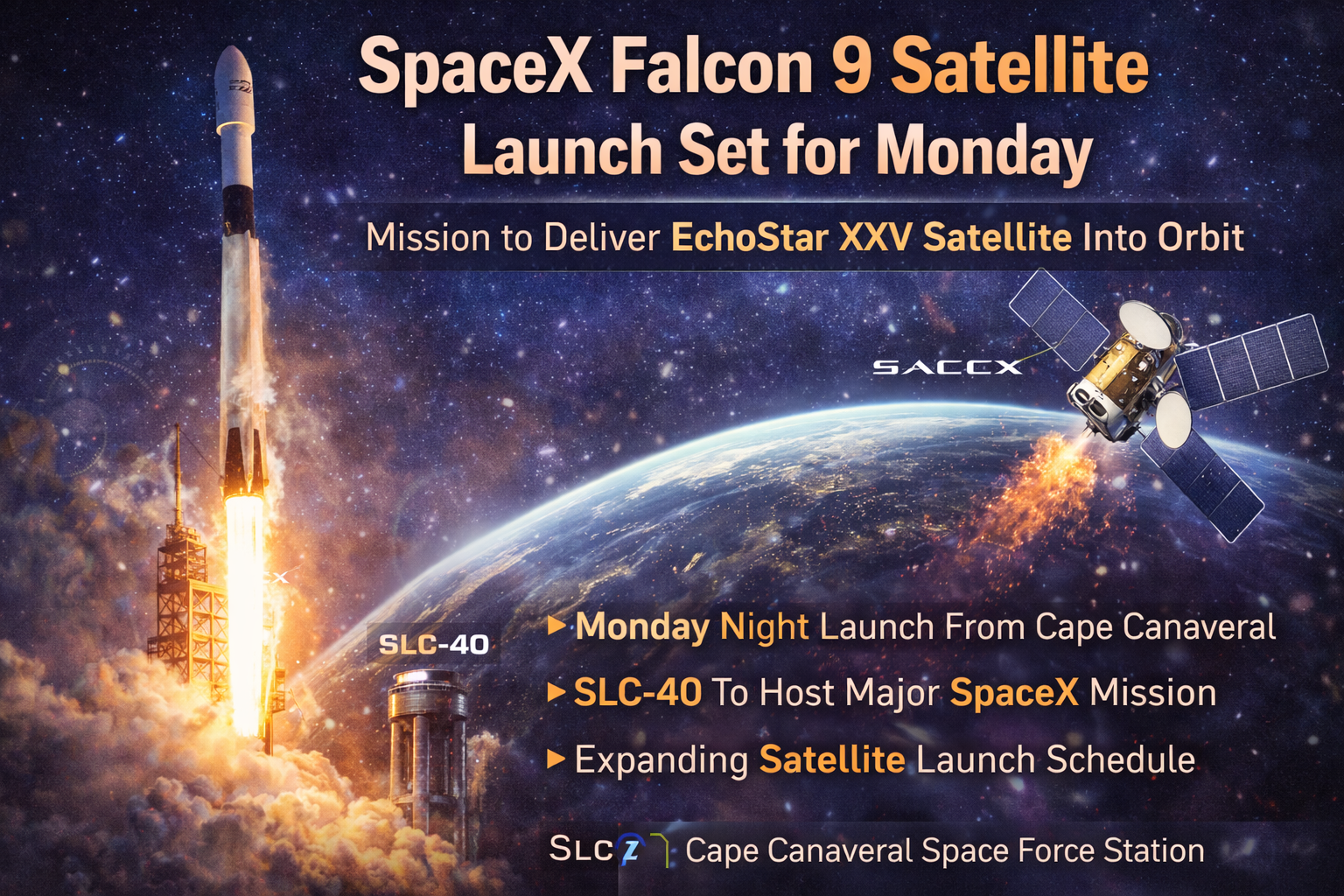
SpaceX is preparing for another important mission from Florida’s Space Coast as the company plans to launch a Falcon 9 rocket from Cape Canaveral Space Force Station on Monday night. The mission will send a communications satellite into orbit, marking another milestone in the rapidly expanding schedule of commercial space launches.
The upcoming launch highlights how frequently modern rockets now lift off from Florida, transforming the region into one of the busiest launch centers in the world. With dozens of launches already conducted this year, SpaceX continues to lead the global commercial launch market while supporting government, military, and private satellite operators.
The mission will carry EchoStar XXV, a direct-broadcast communications satellite designed to deliver television and broadband services across North America. According to mission plans, the Falcon 9 rocket will lift off from Space Launch Complex-40 at Cape Canaveral, a site that has hosted hundreds of launches since the 1960s and now serves as one of SpaceX’s primary launch facilities.
This launch is expected to draw attention from both space enthusiasts and residents along the East Coast, many of whom will have an opportunity to see the rocket streak across the night sky.
Details of the Falcon 9 Mission
The Falcon 9 rocket scheduled for the mission is part of SpaceX’s workhorse launch fleet. The rocket is designed to carry satellites, cargo, and astronauts into orbit while featuring a reusable first stage that can return to Earth for landing and refurbishment.
The planned mission will deploy EchoStar XXV, a communications satellite built to provide direct broadcast services. Once in orbit, the satellite will support television distribution and data transmission across large parts of North America.
Falcon 9 launches from Cape Canaveral typically follow a similar profile. After liftoff, the rocket ascends vertically for several seconds before tilting onto its orbital trajectory. Roughly two and a half minutes into flight, the first stage separates from the second stage and begins its return journey to Earth.
Meanwhile, the second stage continues into space, eventually deploying the satellite into its designated orbit. The first stage booster then attempts to land either at a landing zone near Cape Canaveral or on a drone ship stationed in the Atlantic Ocean.
Reusable booster landings have become a signature feature of SpaceX missions. This technology allows the company to significantly reduce launch costs while increasing the frequency of missions.
Cape Canaveral: The Center of U.S. Launch Activity
Cape Canaveral Space Force Station remains one of the most important launch sites in the world. Located on Florida’s eastern coastline, the complex benefits from its proximity to the Atlantic Ocean, which allows rockets to launch safely eastward over open water.
Space Launch Complex-40, commonly known as SLC-40, is currently leased to SpaceX and is used primarily for Falcon 9 launches. The facility has been operational since the mid-1960s and originally supported Titan rocket missions before transitioning to modern commercial launches.
Today, the pad hosts an increasing number of missions each year as SpaceX expands its satellite constellation and supports commercial customers. The steady cadence of launches has turned Florida’s Space Coast into a hub of space activity, with launches sometimes occurring several times within a single week.
Growing Demand for Satellite Launches
The upcoming EchoStar mission illustrates the rising demand for satellite launches worldwide. Communications satellites play a vital role in modern society by supporting television broadcasting, internet connectivity, navigation systems, and emergency communications.
Companies and governments alike rely on satellites to maintain global connectivity. As technology advances, new satellites are being designed with greater capacity, longer lifespans, and improved efficiency.
EchoStar, the customer for this mission, is one of the leading satellite communication providers in North America. Its fleet supports television services, broadband connectivity, and other communications infrastructure across large regions.
Launching a new satellite allows the company to expand coverage, replace aging spacecraft, and improve service quality for millions of users.
SpaceX’s Expanding Launch Schedule
SpaceX has dramatically increased the pace of launches in recent years. The company now conducts missions for a wide range of customers, including commercial satellite operators, government agencies, and international partners.
A significant portion of SpaceX’s launches support its Starlink satellite internet constellation, which already includes thousands of satellites in low Earth orbit. These satellites work together to deliver high-speed internet services to users around the world, particularly in remote or underserved areas.
Recent Falcon 9 missions from Cape Canaveral have carried batches of Starlink satellites into orbit, contributing to a network that continues to expand rapidly. Some launches have even been visible hundreds of miles away due to the bright rocket plume and high altitude of the spacecraft.
The company’s ability to launch rockets frequently has positioned it as the dominant commercial launch provider in the global space industry.
Viewing Opportunities for East Coast Residents
Rocket launches from Cape Canaveral often attract large crowds of spectators along Florida’s Space Coast. Tourists and local residents gather at beaches, parks, and viewing areas to watch the powerful rockets lift off into the sky.
Because the upcoming mission is scheduled for nighttime, the launch could be visible across much of the southeastern United States depending on weather conditions and cloud cover. When launches occur at night, the rocket’s bright exhaust plume can create dramatic streaks of light in the sky.
Observers along the East Coast may see the rocket rising above the horizon a few minutes after liftoff as it climbs toward orbit. In some cases, the rocket’s trajectory allows viewers hundreds of miles away to witness the event.
These viewing opportunities have made rocket launches a popular attraction, drawing photographers, amateur astronomers, and curious onlookers alike.
Technological Achievements of Falcon 9
The Falcon 9 rocket has become one of the most successful launch vehicles in history. First introduced in 2010, the rocket has undergone numerous upgrades and improvements, leading to an impressive record of reliability and performance.
One of the key innovations of Falcon 9 is its reusable first stage booster. After completing its job of propelling the rocket toward space, the booster returns to Earth and lands vertically using onboard guidance systems and rocket engines.
This reusability dramatically reduces the cost of launching satellites. Traditional rockets were designed to be used only once, meaning that each launch required building an entirely new vehicle. SpaceX’s approach allows boosters to be refurbished and flown again, sometimes dozens of times, greatly increasing efficiency in the launch industry.