
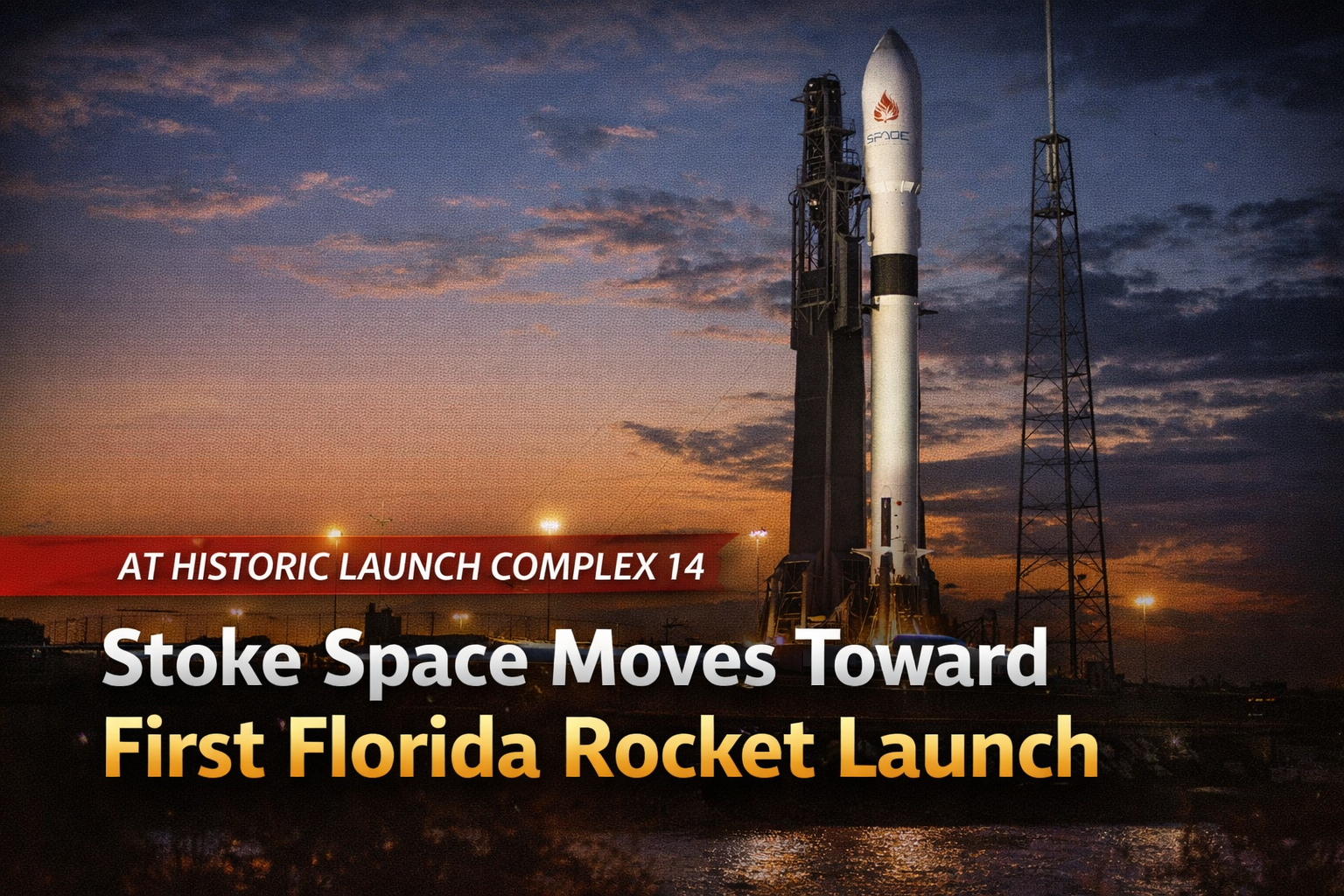
The commercial space industry continues to expand rapidly, and a new entrant is preparing to join the growing list of rocket launch providers operating from Florida’s Space Coast. Stoke Space, a Washington-based aerospace startup, is making significant progress toward conducting its first rocket launch from Cape Canaveral Space Force Station. The company is developing a fully reusable launch vehicle called Nova, designed to deliver satellites and other payloads into low Earth orbit while dramatically lowering the cost of access to space. As construction and infrastructure work advance at Cape Canaveral, Stoke Space is moving closer to a milestone that could mark the beginning of a new chapter in commercial spaceflight.The planned launch would represent Stoke Space’s first orbital mission and the first time its innovative reusable rocket technology is tested in a full operational environment.
Reviving a Historic Launch Site
One of the most remarkable aspects of Stoke Space’s Florida launch preparations is the location itself. The company has been assigned Launch Complex 14 (LC-14) at Cape Canaveral Space Force Station, a site deeply embedded in American space history.
LC-14 was the launch pad used for several missions in NASA’s Project Mercury, including the historic Friendship 7 mission in February 1962, when astronaut John Glenn became the first American to orbit Earth. After the early days of the space race, the launch complex was eventually retired and remained largely inactive for decades.
Now, more than half a century later, the site is being revived for a new era of commercial spaceflight. Stoke Space has reconstructed and modernized the launch pad to support operations for its Nova rocket. Engineers have been working to install advanced launch infrastructure, including propellant systems, support towers, and an umbilical connection that links the rocket to the ground systems prior to liftoff. The transformation of LC-14 symbolizes the evolving nature of the American space industry—from government-led exploration to a more dynamic ecosystem driven by private companies and technological innovation.
Introducing the Nova Rocket
At the center of Stoke Space’s ambitions is the Nova rocket, a medium-lift launch vehicle designed to be fully reusable. Unlike many existing rockets that recover only their first stage, Nova is intended to reuse both the booster and the upper stage.
This design approach represents a bold step forward in rocket engineering. Traditional rockets discard upper stages after launch because they experience extreme heat during atmospheric reentry. Stoke Space aims to overcome this limitation by using a novel thermal protection system that allows the upper stage to survive reentry and land safely.
The Nova rocket is expected to carry payloads of about 3,000 kilograms to low Earth orbit, making it suitable for launching small and medium-sized satellites. The first stage will be powered by seven Zenith engines using methane and liquid oxygen as propellants, while the upper stage uses a hydrogen-oxygen engine surrounded by multiple thrust chambers integrated into a regenerative heat shield.
By combining these technologies, Stoke Space hopes to create a rocket capable of rapid turnaround between launches—similar to how airplanes are reused in aviation.
Funding and Development Progress
Building a reusable rocket is an expensive and technically demanding challenge. To support development of the Nova vehicle and related infrastructure, Stoke Space has raised significant funding from investors. In early 2026, the company expanded its Series D financing round, bringing total investment for the program to approximately $860 million. This funding will help complete development of the Nova rocket and finalize launch infrastructure at Cape Canaveral. The financial backing reflects strong confidence from investors in the company’s technological vision and its potential role in the future launch market. Stoke Space has already conducted several early tests of its rocket technology, including engine test firings and experimental “hopper” flights of a prototype upper stage. These tests have demonstrated key elements of the vehicle’s design, including its ability to control thrust without traditional gimbaling mechanisms. Each milestone brings the company closer to a full orbital launch.
Preparing for the First Flight
Although Stoke Space has not yet conducted an orbital launch, the company has been steadily working toward that goal. Independent estimates and company statements suggest that the first launch of the Nova rocket could occur in 2026, once development and testing milestones are completed.
The inaugural mission will likely focus on demonstrating the rocket’s performance and validating key systems rather than carrying large commercial payloads. Early flights often serve as test missions designed to evaluate propulsion, guidance, structural performance, and reentry capabilities.
If successful, these initial launches could open the door to regular commercial missions delivering satellites and other payloads to orbit.
Competing in a Crowded Launch Market
The global rocket launch industry has become increasingly competitive in recent years. Companies such as SpaceX, Rocket Lab, and Blue Origin have expanded launch capabilities while new startups continue to emerge with innovative technologies. Stoke Space is entering a market already dominated by SpaceX’s Falcon 9 rocket, which has achieved a high launch cadence thanks to its reusable booster system. However, Stoke Space aims to differentiate itself by developing full reusability, including recovery of the upper stage. If successful, this approach could further reduce launch costs and increase the frequency of missions. Industry analysts note that the demand for satellite launches continues to grow as companies deploy communications networks, Earth observation satellites, and scientific spacecraft. This expanding market creates opportunities for new launch providers capable of delivering reliable and affordable services.
The Strategic Importance of Reusability
Reusability has become one of the most important trends in modern rocket design. Historically, rockets were expendable systems, meaning they were destroyed after each launch. This made spaceflight extremely expensive because every mission required a brand-new rocket.
SpaceX revolutionized the industry by demonstrating that first-stage boosters could return to Earth and fly again. Now, companies like Stoke Space are pushing the concept further by designing rockets that reuse every major component.
The ability to reuse both stages could significantly reduce manufacturing costs and enable faster launch schedules.
In theory, a fully reusable rocket could operate more like an aircraft than a traditional rocket, launching multiple times per month without requiring extensive rebuilding.
Florida’s Growing Role in Commercial Spaceflight
Florida’s Space Coast has become the center of America’s commercial space industry. Cape Canaveral and nearby Kennedy Space Center host launch facilities used by numerous companies, including SpaceX, United Launch Alliance, Blue Origin, and several emerging startups. The addition of Stoke Space to this ecosystem highlights the region’s importance as a hub for aerospace innovation. In recent years, multiple companies have begun developing new launch infrastructure along Florida’s coastline. These projects include launch pads, rocket manufacturing facilities, and testing centers designed to support an increasing number of missions.