
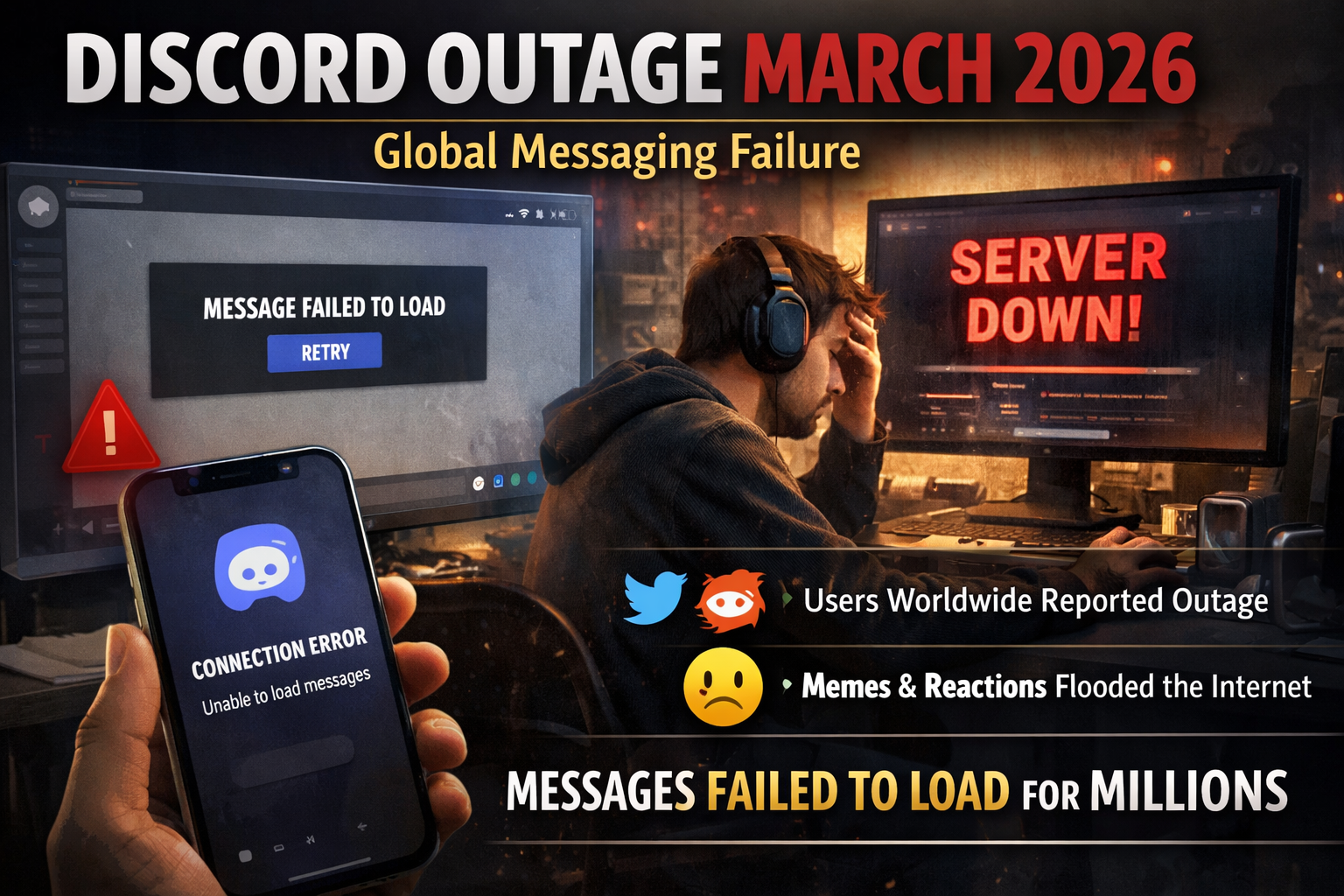
Users worldwide also felt a sudden disturbance when they were on Discord in March 2026, one of the most popular communication systems on the internet. The failure made users unable to send or load messages across servers, and direct messages and millions of people were unable to maintain communication with their communities. Users of both desktop and mobile versions were soon affected by the problem in other regions. When individuals tried to refresh chats or add new messages, most of them got an error message or a blank conversation screen. This was a big confusion and frustration among internet users, even with a small hitch that affected the online communication platform, which has become central to online communication.
The fact that Discord is now much bigger than it was originally as a gamer-oriented tool has led to its emergence of discord. It now has thousands of communities today, including educational communities and developer forums, professional teams and fan clubs. Due to this growth, any disruption on the platform today has a widespread global presence. There was similarity in the number of problems that had been experienced by users during the March outage, which indicated that the problem was with the underlying messaging infrastructure of the platform and not necessarily with a network problem affecting a certain region.
How the Outage Began
The issue began being reported as users were noticing that messages were not loading in servers and in private chats. In others, messages showed as being delayed, whereas in other incidences, conversations just did not update at all. The first assumption most users made was that the problem was due to a slow internet connection or machine issues. But, as more and more people started sharing their complaints on their social media accounts and outage monitoring websites, it soon became evident that the issue was wiping out the whole platform.
Discord technical teams started working on the issue as early as the initial reports emerged. System updates indicate that engineers tried to locate the cause of the disruption and put in place a solution. Although the company did not disclose specific technical details of the failure at once, the outage seemed to be related to the issues in the messaging communication that processes and delivers chat messages as they come.
After a few days, the company started providing a solution and recovered services step-by-step. After an extended period, the messaging feature came back to normal, and the users could go on with their conversation. Though the outage was fixed rather swiftly, the event has revealed that big communication platforms can be very vulnerable to technical breakdowns.
Immediate Reaction from the Online Community
When a popular site has fallen, the internet responds to it almost immediately. In the case of the March 2026 incident, thousands of users resorted to other social media to assure themselves that Discord was not undergoing issues. Numerous of them shared screenshots of error messages or were asking whether other people were experiencing the same problems. Memes/jokes concerning the outage promptly started to spread on the Internet, which is not a new trend when it comes to large digital services going offline.
Discord represents the primary meeting point of many communities where they discuss and plan, share resources, and socialize. The outage, therefore, interfered with gaming, online meetings, and group discussions. People who were hosting big groups on the internet also had to wait until the service became online again, even though some of their gatherings had to be held temporarily or relocated to different sites by the same moderator.
The event showed the speed at which online communities are vulnerable to communication interruptions. A brief outage can put the activities of high dependence on real-time messaging.
Why Communication Platforms Experience Outages
The technical infrastructure under which large-scale communication platforms are based is highly complicated. With millions of messages every second, systems are required to make it through massive messages, server links, database harmonies, and make conversations seem immediate to users worldwide. When any of the elements of this system malfunction or overload, the consequences may occur across the platform in a short period.
The outage in messaging services can be caused by several factors. Traffic spikes can happen suddenly, as one of the common causes is server overload. The other option is a technical bug that is added by updating the software. Delivery of messages may also be interrupted by network routing problems or problems with the database synchronization sometimes. Since messaging systems are based on a combination of different systems, a minor malfunction may have a temporary impact on the entire system.
Though such companies as Discord invest a lot in infrastructure and monitoring systems, it is a serious challenge to maintain impeccable functionality in the number of people who can use it millions. Outages are a relatively frequent yet inescapable aspect of digital platform operation.
Growing Dependence on Online Communication Platforms
The March outage also highlighted the growing dependence on centralized digital communication tools. Over the past decade, many communities have shifted their conversations away from traditional forums and independent websites toward platforms like Discord. These services provide convenient features such as voice channels, text chats, file sharing, and real-time notifications.
However, this convenience also creates a vulnerability. When a single platform becomes the primary communication hub for millions of people, any technical failure can temporarily silence entire communities. Unlike decentralized systems such as email or forums hosted on independent servers, centralized platforms create a single point of failure. If the main system stops functioning, users have few alternatives available in the moment.
For developers, educators, online creators, and remote teams, the reliability of communication tools has become increasingly important. Even brief disruptions can interrupt workflows, meetings, or collaborative projects.
Lessons for Technology Companies
The outage offers several important lessons for technology companies operating large-scale platforms. First, continuous investment in infrastructure resilience is essential. Systems must be designed with redundancy and scalability so that they can handle unexpected technical challenges without affecting users.
Second, companies must maintain strong monitoring systems capable of detecting problems early. Advanced monitoring tools can analyze server performance and network activity in real time, allowing engineers to respond quickly when anomalies appear.
Third, transparency plays a critical role in maintaining user trust. When outages occur, users appreciate clear communication about the issue and regular updates on progress toward resolution. Providing accurate information helps prevent confusion and reassures communities that the problem is being addressed.
Finally, technology companies should continue improving incident response strategies. Fast identification of technical problems and efficient deployment of fixes can significantly reduce downtime.
The Future of Reliable Digital Communication
Despite occasional disruptions, platforms like Discord remain essential tools for modern online interaction. The ability to instantly connect with communities around the world has transformed the way people collaborate, learn, and socialize. As these platforms continue to grow, maintaining reliability will become an even greater priority.
Future improvements in cloud infrastructure, artificial intelligence monitoring systems, and distributed networking technologies may help reduce the frequency of outages. By adopting more advanced technologies and strengthening their systems, communication platforms can provide more stable and reliable services for their global user base.