
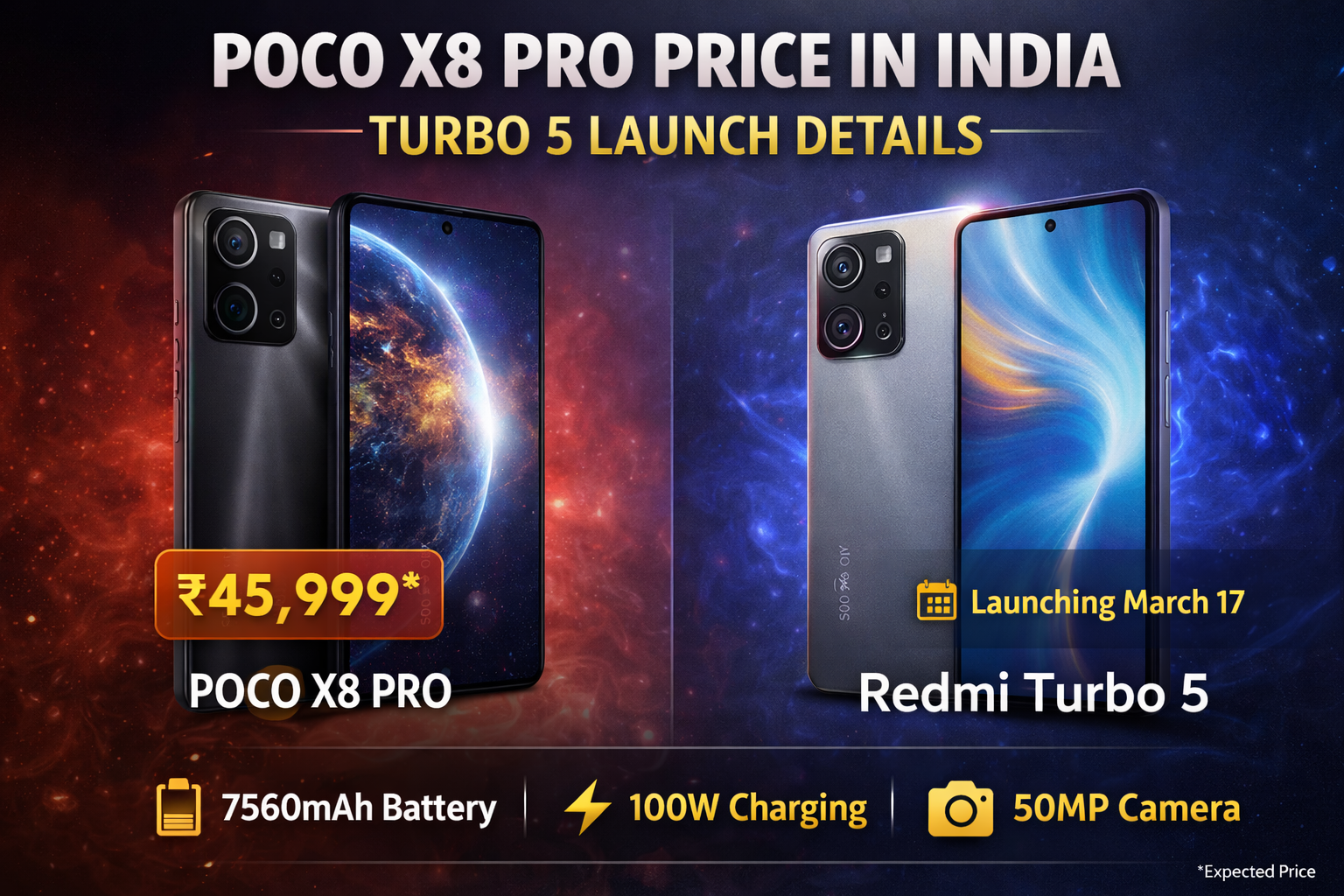
The smartphone market around the globe is preparing to launch another competitive product, with Poco preparing to launch the Poco X8 Pro series. It is said that the device will be available in India soon with a strong pricing strategy targeting performance-oriented consumers. In the meantime, its close analog with Redmi, the Redmi Turbo 5, is set to be unveiled officially on March 17, which gives even greater anticipation among the tech enthusiasts, as well as gamers.
Both smartphones are the new attempt of the Chinese technological giant Xiaomi to reinforce its presence in the competitive mid-range and upper-mid-range. Over the past few years, Poco and Redmi have been very instrumental in Xiaomi’s approach of providing flagship performance at low prices. It seems that the next devices may be based on the same philosophy, as they pay much attention to the battery capacity, processing power, and camera capabilities.
According to industry observers, these introductions are important since the mid-range smartphone segment has turned out to be one of the most competitive markets in the world. More than price, brands now compete in the quantity of features like the speed with which they are charged, the quality of the cameras, and performance that is enhanced by AI. The Redmi Turbo 5 and Poco X8 Pro are supposed to fulfill all those boxes.
Expected Price of Poco X8 Pro in India
According to early pricing suggestions, the Poco X8 Pro would be priced somewhere around ₹45,999 in India, which would put it slightly above the mainstream categories of the mid-range pricing structure but below flagship smartphones. Should such a pricing plan be truly the case, the device will compete directly with a number of other popular premium mid-range smartphones in the Indian market. Poco has had a long reputation of providing good specifications at affordable prices, and analysts think that the X8 Pro would do the same.
These prices also indicate that there is a change in the smartphone market where phones costing approximately 40,000 to 50,000 more are almost flagship in terms of their performance. In this category, customers demand high-performance processors, high refresh rate screens, sophisticated cameras and quick charging capacity.
In the case of Poco, it will be necessary to preserve the reputation of the brand as a performance brand. The popularity of the previous models in the series among mobile gamers and power users was based on the power of their chipsets and the performance of the hardware.
Launch Timeline and Global Availability
The powerful processors will be considered one of the key highlights of the upcoming devices. To offer high efficiency and offer high gaming capabilities, the Poco X8 Pro can be fuelled by the MediaTek Dimensity 8500 series chipset.
It will also include configurations up to 12GB of RAM and fast UFS 4.1 storage that will enable seamless multitasking and fast access to data. These specifications put the smartphone in a position where it can comfortably process high-performance gaming, high-resolution video editing and sophisticated AI applications. The Redmi Turbo 5 is no exception, as it also shares similar hardware specifications that help to further strengthen Xiaomi’s strategy of upping its devices by using powerful processors in order to compete with its competitors at the same price bracket.
Powerful Hardware and Performance Focus
Display technology has developed into a major selling point of the new smartphones, and the Poco X8 Pro seems to do the same. It is also rumored to have a 6.59-inch 1.5K OLED screen with a 120Hz refresh rate and a peak brightness of 3,500 nits.
The high refresh rate will provide better scrolling and better performance of the game, whereas the higher brightness will help in better visibility in outdoor circumstances. It is anticipated that the display will be covered with high-tech glass protection, and it might have HDR support to achieve better multimedia experiences.
Design-wise, the smartphone might have a metal frame that is of high quality and a glass back that is smooth, making it durable yet stylish in appearance. Ratings of water and dust resistance, including IP68 and IP69, should also be anticipated, which means that the device will be capable of solving difficult environmental conditions.
Display and Design Upgrades
Display technology has become a key selling point in modern smartphones, and the Poco X8 Pro appears to deliver on that front as well. Reports suggest it could feature a 6.59-inch 1.5K OLED display with a 120Hz refresh rate and peak brightness reaching up to 3,500 nits.
A high refresh rate ensures smoother scrolling and improved gaming performance, while the increased brightness enhances visibility in outdoor conditions. The display is expected to be protected by advanced glass protection and may include HDR support for enhanced multimedia experiences.
Design-wise, the smartphone could feature a premium metal frame and a sleek glass back, offering durability while maintaining a stylish appearance. Water and dust resistance ratings such as IP68 and IP69 are also expected, indicating the device’s ability to withstand challenging environmental conditions.
Massive Battery and Ultra-Fast Charging
Perhaps the most talked-about feature of the Redmi Turbo 5 and Poco X8 Pro is the massive battery capacity. The device is expected to include a 7,560mAh battery, significantly larger than the industry average. Most smartphones in the mid-range segment typically offer batteries between 4,500mAh and 5,500mAh. By pushing the capacity beyond 7,500mAh, Xiaomi appears to be targeting heavy users who rely on their phones for gaming, video streaming, and productivity tasks.
Complementing the large battery is 100W wired fast charging technology. This feature could allow the device to charge from zero to full in a short period, reducing the inconvenience of long charging times. The focus on battery technology reflects a broader trend in the smartphone industry where endurance and charging speed are becoming major differentiators.
Camera Capabilities
In the photography department, the Poco X8 Pro is expected to feature a dual-camera system led by a 50-megapixel primary sensor with optical image stabilization (OIS). The main camera may be accompanied by an 8-megapixel ultra-wide lens, allowing users to capture broader scenes and landscapes. For selfies and video calls, the device is expected to include a 20-megapixel front camera capable of recording high-quality videos.
While the camera configuration might not be as elaborate as flagship devices with triple or quad camera systems, the focus on a high-quality primary sensor suggests that Xiaomi is prioritizing image quality over sheer camera count.
Software and User Experience
The Poco X8 Pro and Redmi Turbo 5 are expected to run HyperOS 3 based on Android 16, bringing improved performance, better security, and enhanced AI features.
HyperOS represents Xiaomi’s attempt to create a unified ecosystem across smartphones, tablets, and other connected devices. The system integrates cloud connectivity, AI-powered optimizations, and smoother animations. Users can also expect additional features such as an ultrasonic fingerprint sensor, advanced cooling systems for gaming, and improved connectivity options, including 5G, Wi-Fi, Bluetooth, and NFC.
My Editorial Perspective: Why This Launch Matters
From an editorial standpoint, the Poco X8 Pro and Redmi Turbo 5 represent more than just another smartphone launch. They highlight how the industry is evolving toward delivering flagship-like experiences at mid-range prices. A few years ago, features such as 100W charging, 120Hz OLED displays, and advanced processors were limited to premium flagship devices costing over ₹70,000. Today, companies like Poco and Redmi are bringing those capabilities to a much broader audience.
However, the success of the Poco X8 Pro will depend on more than just specifications. Consumers are increasingly looking for long-term software support, reliable performance, and strong after-sales service. If Xiaomi can address these factors while maintaining competitive pricing, the device could become one of the most popular smartphones in its category.
Another interesting trend is the growing importance of battery capacity. With the rise of mobile gaming, content creation, and streaming, users are demanding phones that can last more than a full day without charging. The 7,560mAh battery in the Redmi Turbo 5 is a clear response to that demand.
The Road Ahead for Poco
Poco has built a loyal fan base by focusing on performance and value. The upcoming Poco X8 Pro appears to continue that legacy with a combination of powerful hardware, large battery capacity, and premium design. If the device launches at the expected price and delivers on its promises, it could further strengthen Poco’s position in the competitive smartphone market. At the same time, the launch of the Redmi Turbo 5 signals Xiaomi’s broader ambition to dominate the performance-focused mid-range segment.
As the March 17 launch date approaches, smartphone enthusiasts and industry analysts will be watching closely to see whether these devices can live up to the hype. One thing is certain: the battle for the mid-range smartphone crown is far from over, and Poco is determined to remain at the center of it.