
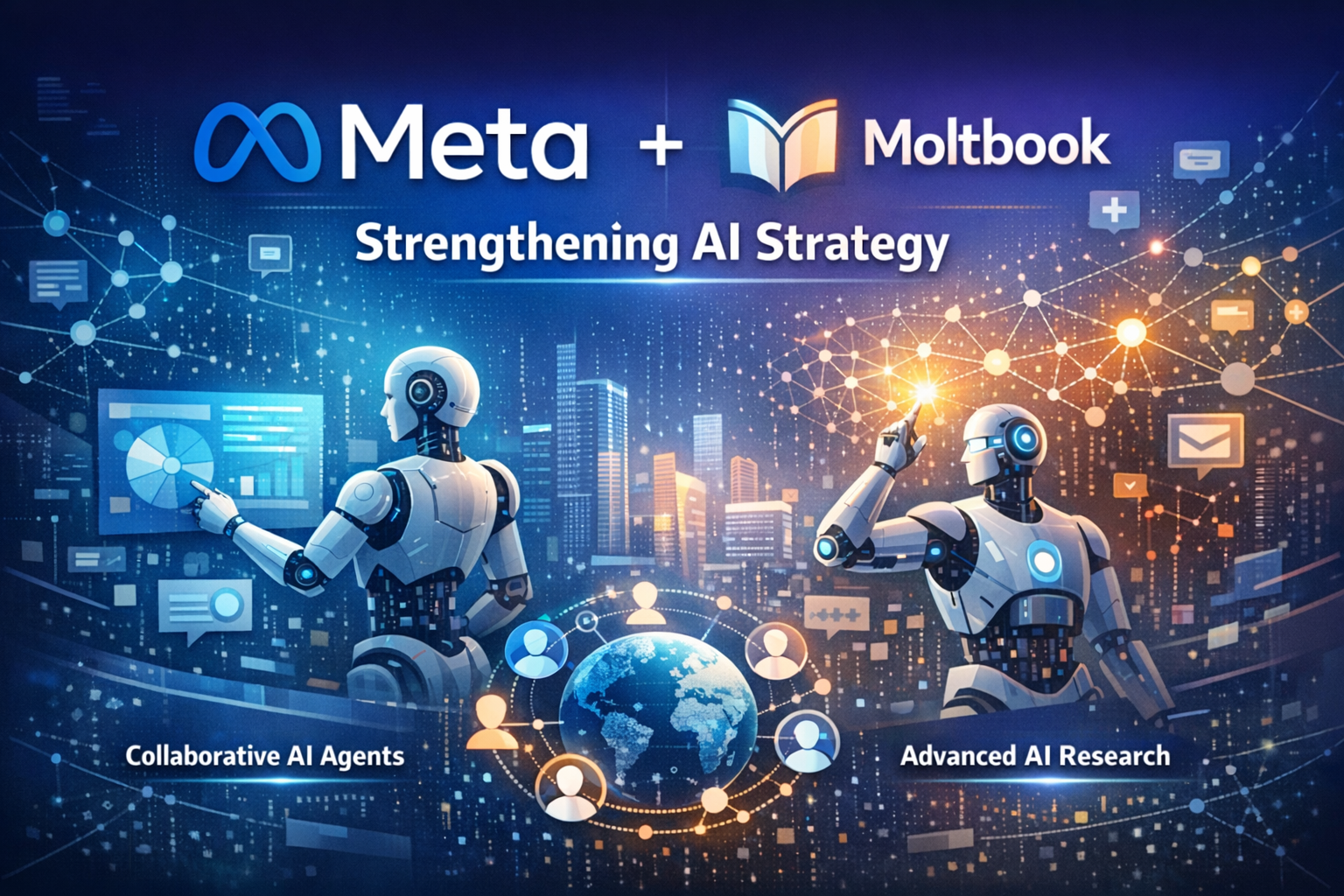
Another step that Meta Platforms has made towards the global artificial intelligence race is acquiring the emerging AI startup Moltbook. The takeover will mark the increased interest of the company in the creation of sophisticated AI technology that may transform the way digital platforms are used. The financial conditions of the transaction have not been announced publicly, but according to the industry observers, the decision made by the company is mainly to enhance the capacity of the AI ecosystem, which is rapidly developing.
The acquisition is also tied to a long-term goal of Meta to develop more intelligent systems and thus automate activities, enhance user interaction and develop new digital experiences. Mark Zuckerberg and his company had substantially increased their investments in AI research and development over the last few years. Incorporating the technology and talent behind Moltbook into its company, Meta will seek to hasten the development of tools that can help to enable next-generation AI agents and digital assistants.
The acquisition emphasizes the fact that large technology firms are competing to acquire promising startups and highly talented engineers. Not only is the pace of AI innovation unprecedented, but smaller companies have become one of the most popular means for tech giants to increase their capabilities and stay competitive.
What Moltbook Does and Why It Matters
Moltbook was an exclusive app that allowed developers and AI enthusiasts to test autonomous software agents. In contrast to the traditional AI instruments that execute a single task, Moltbook was aimed at allowing AI agents to communicate and share information and engage in complex workflow completion. The developers would be able to make agent profiles about what was available in their AI systems in the form of tools, access to the data or capabilities. These capabilities would then be recognized by other agents, and they would get attached to do a certain task.
This notion is a significant change in terms of the way artificial intelligence is going to work in the future. Rather than a single AI system working alone, a number of agents can work together as an online labor force. One agent may gather information, the other may interpret it, and a third may report findings to customers. The AI networks connected like this will have the potential to alter the sectors of customer service and marketing, software development and healthcare. Meta will be able to access this collaborative AI environment through the technology acquired by acquiring Moltbook.
Integration Into Meta’s AI Research Infrastructure
After the acquisition, the founders and team of Moltbook are supposed to participate in advanced research at Meta, concentrated on artificial intelligence. Their skills will probably be applied to the continued development of AI work in the internal laboratories of Meta, where engineers are working on large-scale models, smart assistants, and automation tools. Meta has already developed a series of AI systems that operate the recommendation of content, advertising technology, and user interaction on its platforms. These systems can be improved by integrating Moltbook, which has a collaborative agent technology to allow various AI tools to coordinate better.
As an illustration, AI agents may help companies to deal with customer interactions on various platforms, including messaging services and social media. On the technical aspect, the acquisition can also assist Meta to enhance interoperability in AI systems and respond to queries, create marketing content, or streamline digital processes. It implies that various AI applications would have more effective communication and information exchange, which may result in smarter and more reactive digital services.
Competition in the AI Talent Race
The acquisition also reflects the intense competition among global technology companies to recruit skilled AI engineers and researchers. Companies such as Google, Microsoft, and OpenAI are all investing heavily in artificial intelligence research, creating a fierce race for talent. Many startups working on innovative AI tools are being acquired not only for their products but also for the expertise of their founding teams. Engineers who understand how to design scalable AI systems are among the most sought-after professionals in the technology sector today.
Meta has been particularly aggressive in recruiting AI specialists as it attempts to build systems capable of competing with industry leaders. Bringing Moltbook’s team into the company adds a group of developers who already understand the challenges of building collaborative AI platforms. This strategy mirrors a broader trend in Silicon Valley, where large corporations absorb startups to accelerate innovation rather than developing every technology internally.
Potential Applications Across Meta Platforms
One of the most interesting questions surrounding the acquisition is how Moltbook’s technology might be integrated across Meta’s existing ecosystem. Meta operates some of the world’s most widely used social platforms, including Facebook, Instagram, and WhatsApp.
If collaborative AI agents are introduced into these platforms, users could eventually interact with automated assistants that handle a wide range of activities. For instance, businesses could deploy AI agents to manage customer service chats, recommend products, or analyze user feedback.Content creators might also benefit from AI tools that help them generate ideas, manage audiences, or optimize posts for engagement. Meanwhile, advertisers could rely on AI agents to design marketing campaigns and track performance across platforms. Although Meta has not yet revealed specific plans for using Moltbook’s technology, the possibilities highlight how AI could become deeply integrated into everyday online experiences.
Industry Reactions and Market Impact
News of the acquisition has sparked discussions among technology analysts and developers who closely follow the AI industry. Some experts view the move as a strategic attempt by Meta to position itself at the center of the emerging “AI agent economy.”This concept suggests that in the future, digital services may rely on networks of specialized AI agents that cooperate to complete tasks. Companies that control the infrastructure enabling those interactions could gain significant influence over the digital ecosystem.
At the same time, critics warn that consolidating AI innovation within a few major corporations could reduce competition and limit open collaboration among developers. Many AI researchers advocate for open standards that allow different systems to communicate freely without being locked into proprietary platforms. How Meta manages the integration of Moltbook’s technology may therefore shape broader industry attitudes toward collaborative AI networks.
Editor’s Perspective: A Strategic but Calculated Move
From an editorial standpoint, the acquisition of Moltbook appears less about immediate product launches and more about long-term positioning. Major technology companies often make early investments in emerging ideas that could define future digital infrastructure. Moltbook’s concept of AI agents collaborating in shared digital environments aligns with trends already visible across the industry. As AI systems grow more capable, the next challenge will be coordinating multiple intelligent tools to work together efficiently.
Meta seems to recognize that controlling the platform where these interactions occur could offer enormous strategic advantages. If successful, the technology might enable Meta to create new services, expand its developer ecosystem, and strengthen its role in the AI economy. However, the company will also need to address concerns around data privacy, platform control, and ethical use of AI agents. Transparency and responsible governance will be crucial if such systems become widely adopted.
The Future of Collaborative AI Platforms
The acquisition of Moltbook underscores a broader transformation taking place in the artificial intelligence landscape. Instead of isolated AI applications, the industry is moving toward interconnected systems capable of sharing knowledge and working collaboratively. For developers, this shift could open new opportunities to build specialized AI agents that plug into larger ecosystems. Businesses may also gain access to more powerful automation tools capable of handling complex digital tasks with minimal human intervention.
For Meta, the success of this acquisition will depend on how effectively it can integrate Moltbook’s technology into its vast digital infrastructure while maintaining trust among users and developers. What is clear, however, is that the race to define the next generation of AI platforms is intensifying. With Moltbook now part of its portfolio, Meta has positioned itself to play a significant role in shaping how collaborative artificial intelligence evolves in the coming years.