
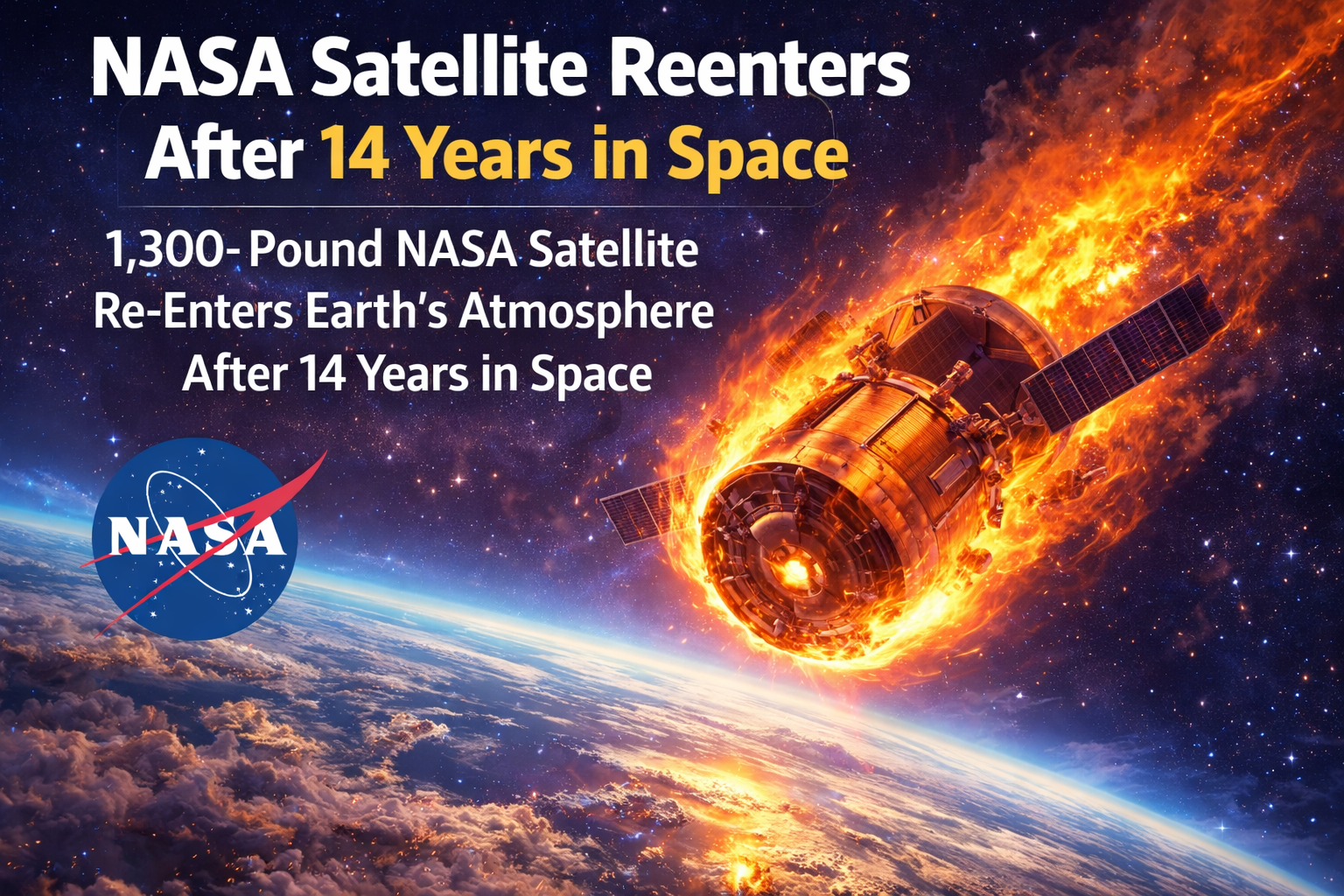
A NASA satellite that spent nearly 14 years orbiting Earth has finally returned to the planet’s atmosphere, marking the end of a mission that significantly improved scientists’ understanding of the hazardous radiation environment surrounding Earth. The spacecraft, known as Van Allen Probe A, reentered the atmosphere in March 2026 after completing one of NASA’s most influential space weather research missions.
The satellite, weighing approximately 1,323 pounds (about 600 kilograms), was part of a pair of spacecraft launched in August 2012 to study the mysterious Van Allen radiation belts, zones of high-energy particles trapped by Earth’s magnetic field. These radiation belts pose serious risks to satellites, astronauts, and spacecraft electronics, making them an important focus of space research.
After more than a decade in orbit and years of scientific discoveries, Van Allen Probe A eventually succumbed to orbital decay and reentered Earth’s atmosphere, where most of the spacecraft burned up during descent. The event marks the closing chapter of a mission that changed the way scientists understand the dynamic space environment surrounding our planet.
The Van Allen Probes Mission
The Van Allen Probes mission was designed to explore one of the most dangerous and least understood regions of near-Earth space. The mission consisted of two identical spacecraft—Van Allen Probe A and Probe B—which were launched aboard an Atlas V rocket from Cape Canaveral in Florida in 2012. The satellites were tasked with studying the Van Allen radiation belts, two donut-shaped regions of charged particles trapped by Earth’s magnetic field. These belts are created when energetic particles from the Sun become captured within Earth’s magnetosphere. Scientists have long known that these radiation zones can fluctuate dramatically depending on solar activity. During strong solar storms, particle levels can increase dramatically, posing threats to satellites and even astronauts aboard spacecraft.
The Van Allen Probes were built to travel directly through these hazardous regions, gathering data about how radiation particles move, accelerate, and disappear within the belts. Their mission was initially planned to last two years, but the spacecraft continued operating successfully for nearly seven years, far exceeding their original design life. The mission ended in 2019, when both satellites ran out of fuel and could no longer properly orient their solar panels toward the Sun.
Scientific Discoveries from the Mission
During their years of operation, the Van Allen Probes made several groundbreaking discoveries that transformed scientists’ understanding of Earth’s radiation environment. One of the most surprising findings occurred shortly after launch, when the spacecraft detected a temporary third radiation belt forming around Earth during periods of intense solar activity. This discovery challenged long-standing models that assumed the radiation belts consisted of only two stable zones.
The mission also revealed how high-energy particles can suddenly accelerate to extreme speeds during solar storms. These events can produce radiation levels strong enough to damage spacecraft electronics or disrupt satellite communications. Researchers also learned more about how radiation particles are lost from the belts. Previously, scientists believed the process was gradual, but the Van Allen Probes showed that particle losses can happen rapidly during certain space weather events. These discoveries have had practical benefits. By improving models of space weather, scientists can better predict how solar storms might affect satellites, power grids, and communication systems on Earth.
The Satellite’s Final Descent
Although the mission officially ended in 2019, Van Allen Probe A continued orbiting Earth for several years after its instruments shut down. Over time, natural atmospheric drag slowly pulled the spacecraft closer to the planet. Originally, scientists predicted the satellite would remain in orbit until around 2034. However, increased solar activity during the current solar cycle expanded Earth’s upper atmosphere, increasing atmospheric drag and causing the spacecraft to descend faster than expected. As the spacecraft’s orbit decayed, scientists began tracking its eventual reentry. The U.S. Space Force monitored the satellite’s trajectory and predicted it would reenter the atmosphere around 7:45 p.m. Eastern Time on March 10, 2026, though the exact timing could vary within a 24-hour window due to the unpredictable nature of atmospheric conditions. Eventually, the spacecraft reentered Earth’s atmosphere and burned up as friction heated it during descent.
What Happened During Reentry
When satellites reenter the atmosphere, they encounter intense friction that generates extreme heat. Temperatures can reach thousands of degrees Celsius, causing most spacecraft materials to melt or vaporize. NASA predicted that most of the Van Allen Probe A spacecraft would burn up during reentry. However, some components made of heat-resistant materials—such as titanium or stainless steel—could potentially survive the descent and reach the ground. Despite this possibility, the risk to people on Earth was extremely small. NASA estimated the probability of someone being injured by falling debris at approximately 1 in 4,200, which is considered very low when compared with everyday risks. Because oceans cover about 71 percent of Earth’s surface, most uncontrolled reentries end with debris falling into remote areas of the ocean or uninhabited land.
Monitoring the Reentry
The satellite’s final descent was closely monitored by NASA and the U.S. Space Force, which tracks thousands of objects in orbit around Earth. Space surveillance systems continuously monitor satellites, debris fragments, and other objects that could pose risks to spacecraft operations. In the case of Van Allen Probe A, tracking allowed scientists to estimate when and where the spacecraft might reenter the atmosphere. However, predicting the exact location of reentry is extremely difficult because atmospheric conditions change constantly. Small variations in atmospheric density, solar activity, and orbital speed can alter the timing and location of reentry by hundreds or even thousands of kilometers. As a result, most reentry predictions include a wide uncertainty range.
The Future of the Twin Satellite
While Van Allen Probe A has now completed its journey, its twin spacecraft—Van Allen Probe B—remains in orbit. Scientists expect Probe B to continue orbiting Earth for several more years before it eventually reenters the atmosphere sometime in the early 2030s or later. Like its twin, Probe B will likely burn up during reentry, bringing the historic mission to a final conclusion. Even though the spacecraft are no longer active, the enormous amount of data collected during the mission continues to be analyzed by scientists around the world.
Space Debris and Reentry Risks
The reentry of Van Allen Probe A highlights a broader issue facing modern space operations: the increasing amount of space debris orbiting Earth. Thousands of inactive satellites, rocket stages, and debris fragments currently circle the planet. Many eventually reenter the atmosphere as their orbits decay. Most of these objects burn up harmlessly during reentry, but larger spacecraft can occasionally produce debris that reaches the ground. Historically, injuries from falling space debris are extremely rare. Only one confirmed case occurred in 1997, when woman in Oklahoma was lightly struck by a small fragment of a rocket component. Nevertheless, as the number of satellites in orbit increases—particularly with large satellite constellations—space agencies are working to develop improved debris-mitigation strategies. These include designing spacecraft that burn up completely during reentry and planning controlled reentries for larger satellites.