
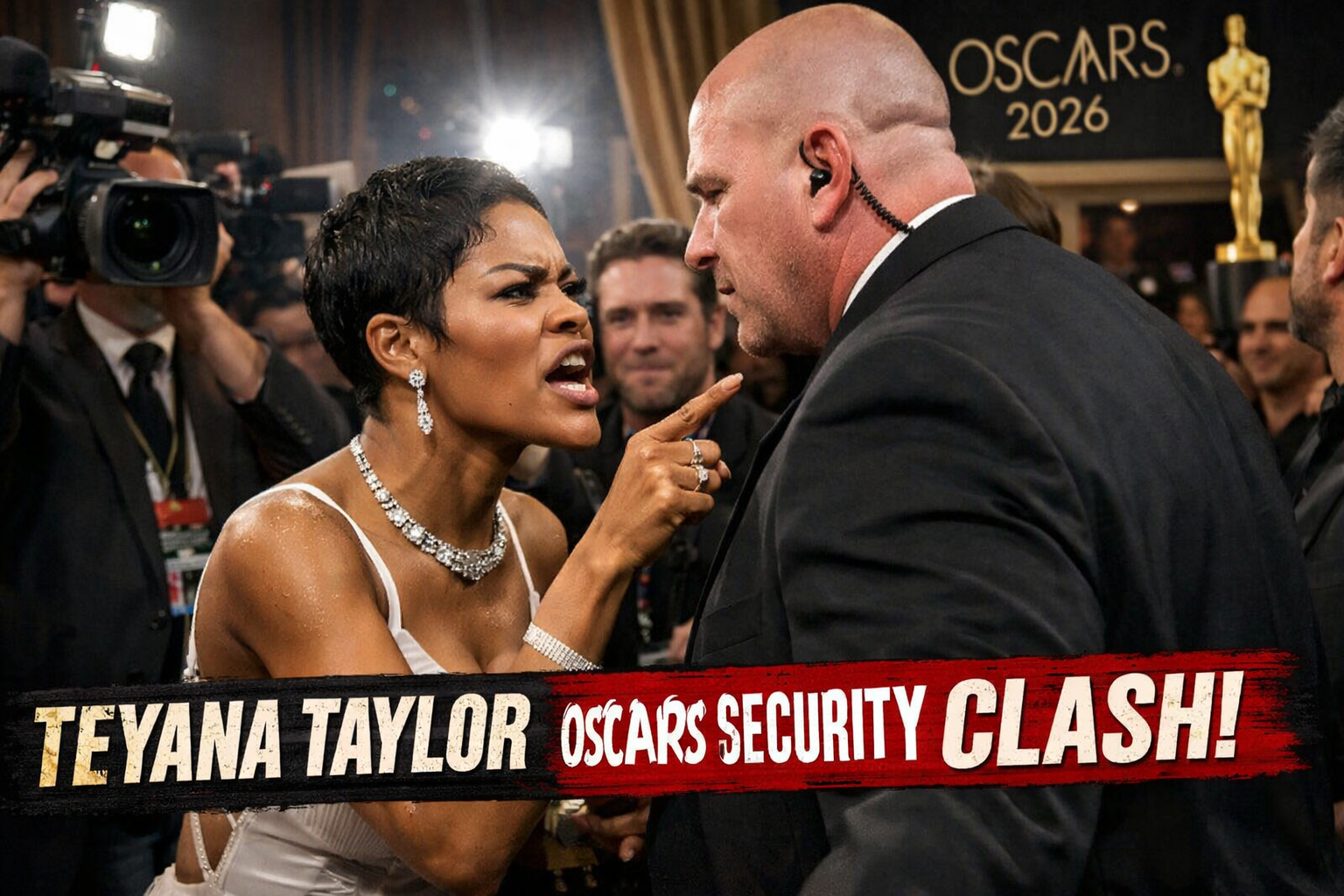
During an otherwise joyful night at the 2026 Academy Awards, actor-singer Teyana Taylor was in the middle of a viral nightmare after allegedly confronting a security guard. The event that took place following the ceremony at the Dolby Theatre in Los Angeles has elicited a lot of debate concerning the treatment of celebrities, the security measures of the events and the personal space of individuals at high-profile events.
A Night of Triumph Interrupted
Taylor went to the Oscars as one of the nominees for the Best Supporting Actress category due to her work in One Battle After Another, which dominated the night, receiving six awards, including the Oscars of the Best Picture. Although Taylor lost her category to Amy Madigan, she looked to be in good spirits, and she was celebrating with her co-stars and director, Paul Thomas Anderson.
Nevertheless, the mood of celebration was abruptly interrupted as Taylor tried to go back to the stage area to get a post-win group photo. As various reports and video footage of viral videos tell, she was confronted by a security guard who is said to have employed physical force when dealing with the movement of crowds.
In the circulating clip, Taylor is directly facing the guard, telling him that he had shoved her and that he should not put his hand on her. According to witnesses and sources, the guard could have stood in her way and even touched her in an attempt to limit her access to the stage.
Unprovable and Unwarranted: Taylor Speaks Out
After the incident, Taylor was not afraid to express her anger. She defined the interaction as being unprovoked, and it is clear that she does not tolerate disrespect, particularly when it touches on physical contact.
Simultaneously, she then assumed a more moderate voice in press relations, indicating that increased security measures might have been one of the factors. She also assured the fans that nothing was wrong because everything was fine, meaning that the moment, though disappointing, was not the characterization of her night.
This two-sided reaction, to admonish the act and then to downplay it later on, is the experience of knowing the bright spotlight and press attention that would come with such events.
Security Reaction and Academy Reaction
The security company in question, Security Industry Specialists (SIS), admitted that some contact took place, but described it as an incidental one in the process of crowd control. The company was apologetic and assured that the issue had already been addressed internally.
In the meantime, the Academy of Motion Picture Arts and Sciences released a statement which said that it was disappointed by the incident and that the safety of the guests and their respect are key priorities. The Academy was reported as rebuking the security team and vowed to undertake actions to avert such cases in the future.
Viral Moment Garners Greater Controversy
When the video of the conflict was disseminated quickly on social media, the response by people was immediate and diffuse. Most spectators stood in favor of Taylor, claiming that no one, celebrity or otherwise, should be physically touched without any compelling reason. Still others mentioned the difficulties security teams will have to deal with when large crowds of people move about at the globally televised events.
This incident has rekindled the debate on the issue of finding a balance between upholding order and observing personal space, particularly in places where passions are rife, and entry is strictly monitored.
Background: A High-Stakes Setting
The Oscars are not an awards show; it is a highly planned international event, with rigorous movement procedures. Stage areas are extremely limited after major wins, in particular, Best Picture. The security personnel have the responsibility of ensuring safety, preventing overcrowding, and integrity in broadcasts.
Even the slightest miscommunication may grow very fast in such high-pressure conditions. What is meant to be normal crowd control can be construed as aggression, especially when physical contact is considered.
Editorial Viewpoint: An Easily Avoidable Slip
Regarding editorial perspective, this incident highlights a problem that is common in live event management: the human factor.
The work of the security team is characterized by high pressure and decisions made in a split second. Nevertheless, training should not just be logistics-based; its sensitivity should also be employed, particularly with high-profile persons in emotionally charged situations.
This was an assertive reaction by Taylor that was not proportionate. This demand to be respected also represents a cultural change in which the publicities, and the publics, are less indulgent of physical overstep, however, with intention or not.
Simultaneously, her later choices to downplay the incident are professional. She did not want to extend the controversy, the interest getting back to the success of the night.
To the Academy, this is a reminder to them that the guest experience is not less important than the production itself. This is a time and age where, within a few seconds, every moment can trend on Twitter, and even small oversights can eclipse well-thought-out parties.
The Bigger Picture
After all, the episode did not spoil Taylor’s evening. She would attend the post-Oscars parties like the Vanity Fair after-party and remained calm and collected.
During the days after the incident, industry insiders and event planners have come out to lay more emphasis on the need to refine the backstage access systems. According to some professionals, clearer identification procedures, improved communication between the stage management and the security team, and special escorts for nominees and winners are proposed. These might go a long way in decongesting the situation during peak times following major awards announcements. Also, more favorable views of increasing behavioral training of security personnel, not only with the control but also with respect and de-escalation of conflicts, are gaining ground.
The other dimension to add to this problem is the social media amplification. What could have been a small backstage misunderstanding has nowadays become an international point of discussion in a few minutes. This change leaves an extra task to organizers to consider not only physical risks, but reputational ones. In the case of celebrities such as Taylor, such incidents can easily cut across professional achievements, and it is therefore important that event teams ensure that there is a smooth and respectful atmosphere.
There are, however, some significant questions that the episode brings up:
How does security staff strike a balance between power and respect?
Are the current measures adequate to address the after-ceremony riots?
And the thing is, what can be done to avoid such incidents in the future?
As the entertainment sector continues to mature under the scrutiny of the social media platform, the associated circumstances are valuable teaching experiences, not only to organizers but to anyone engaged in the delivery of large-scale live events.