
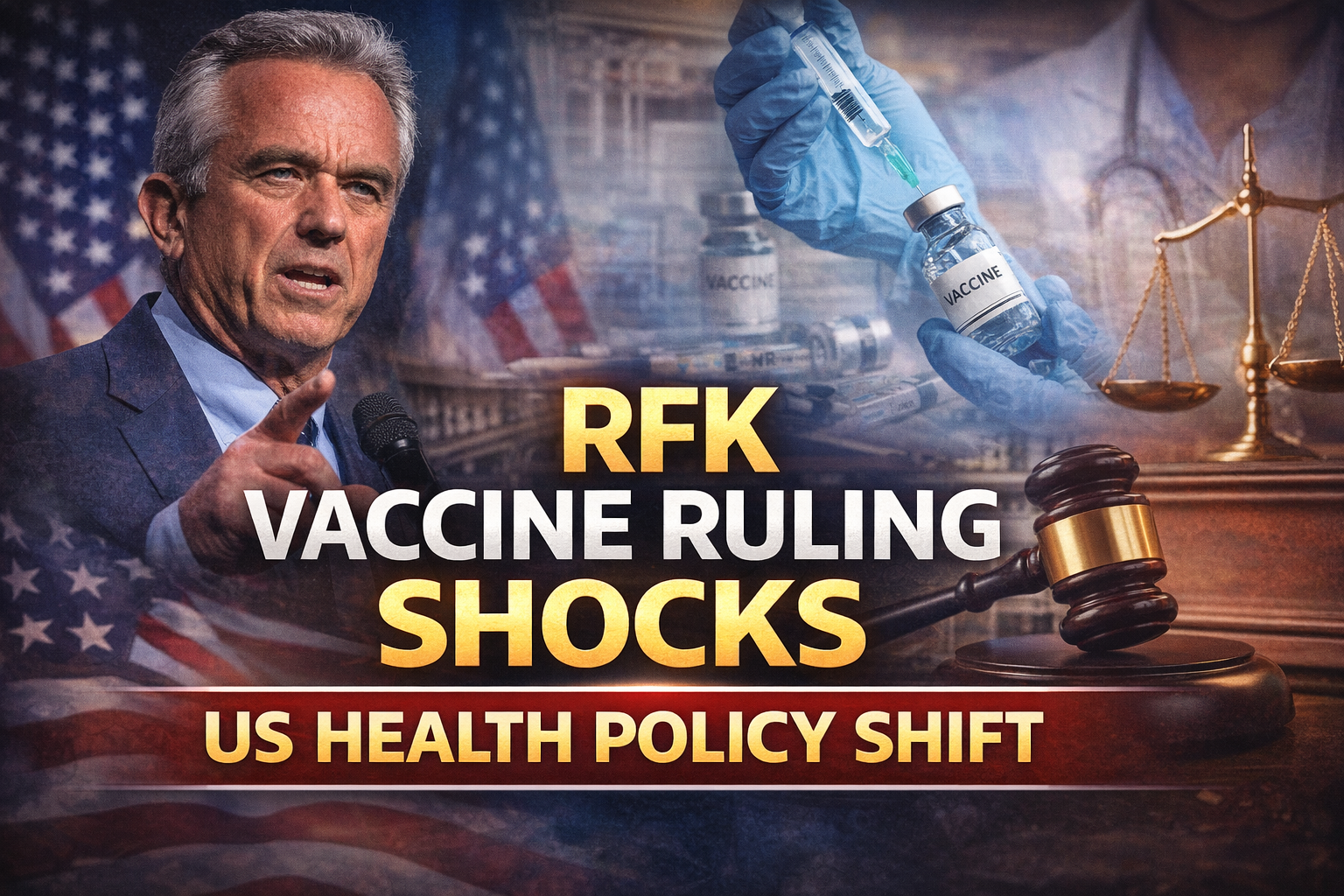
The sweeping changes in the policy of mandatory vaccinations proposed by Robert F. Kennedy Jr. have been blocked by a federal court in a major development of the policy on the health of the population in the United States. This ruling is against a backdrop of increased fears about the course of national immunization policies and the mechanisms involved to effect the same. The decision supports the scientific integrity and legal transparency in the decision-making in the field of public health.
Court Decision and Legal Foundation
It was decided by a federal judge in Massachusetts, who concluded that the changes in vaccine policy in recent years had not been made with the appropriate procedures in both legal and administrative terms. One of the main problems in the case was the reorganization of the Advisory Committee on Immunization Practices (ACIP), which is one of the most important institutions in the development of evidence-based vaccine recommendations.
The court concluded that there was no transparency in the removal of committee members, and the replacement method was not in conformity with the set guidelines. This made the policy changes arbitrary and capricious, which was a legal criterion that the actions were not founded on compelling reason or due process. The judge granted an interlocutory injunction against the applied new vaccine guidelines, which is more or less a restoration of the old immunization schedule.
Policy Controversy and Changes
The suggested reforms were supposed to make profound changes in the standard schedule of childhood vaccinations by decreasing the number of recommended vaccines and redefining some of them as optional. Other changes involved updated recommendations regarding vaccines like COVID-19 and hepatitis B, with less focus on recommendations and more on individual choice.
Advocates said that this would make it more flexible and that people were worried about the safety of the vaccine. Critics, however, cautioned that tampering with well-established immunization regimes without significant scientific evidence may be very dangerous. Healthcare professionals stressed that any recommendation regarding vaccines is made in the course of thorough research, and any possible deviation is likely to hinder the process of preventing diseases.
Reaction by the Medical Community
The reforms were adamantly opposed by healthcare institutions and child pediatric organizations, many of which took the policy changes to court. A large number of medical workers supported the ruling, and they saw it as the necessary measure to safeguard evidence-based practices.
Researchers emphasized that regular and scientifically approved immunization programs are also necessary to protect the health of the population. They also raised worries that the introduction of sudden changes or changes that are politically motivated may confuse providers and patients, and thus, providing clear information to them becomes more challenging.
Impact on Public Trust
It is because the controversy has had a great impact on the confidence people had in health institutions. The success of vaccination programs is based on the belief in the safety of vaccines and the credibility of the officials who endorse the vaccination program. The presence of contradicting messages provided by various sources has resulted in a state of uncertainty, and people can hardly make informed decisions.
The loss of trust may be very harmful as it leads to a decrease in vaccination rates and an increased risk of disease outbreaks. It is also important to maintain clear and constant communication in order to make the initiatives of public health successful.
Federal and State-Level Problems
The situation has also brought out tension between federal and state authorities. Although the national agency offers guidance on immunization, states are free to establish the school and community immunization requirements.
After the changes were proposed, some states started to depend on the independent medical guidance rather than federal recommendations. This has caused discrepancies in the vaccine policies in various areas and made it difficult to pursue consistency in the provision of uniform standards in the area of public health.
Extended Public Health Impact
Vaccination is among the most effective ways of preventing infectious diseases. Widespread immunization-based programs have managed the control of diseases like measles and polio. Any form of interference with these systems may pose a risk of disease recurrence.
Scientists caution that as a result of undermining vaccination systems, herd immunity can falter, and the population can become susceptible to epidemics. This may impose more pressure on healthcare systems and pose more health risks to the population, especially those who are vulnerable.
Future Outlook
The court fight over vaccine policy will probably not end, as the authorities are able to appeal the decision. At present, the old immunization policies are still in effect, which is a stability factor among the healthcare givers and the population.
In the future, it will be necessary to make sure that the policy-making process relies on scientific findings and is executed in a transparent manner. The reconstruction of the public trust and the regularity of the communication will be among the challenges in the changing environment of public health policy.