
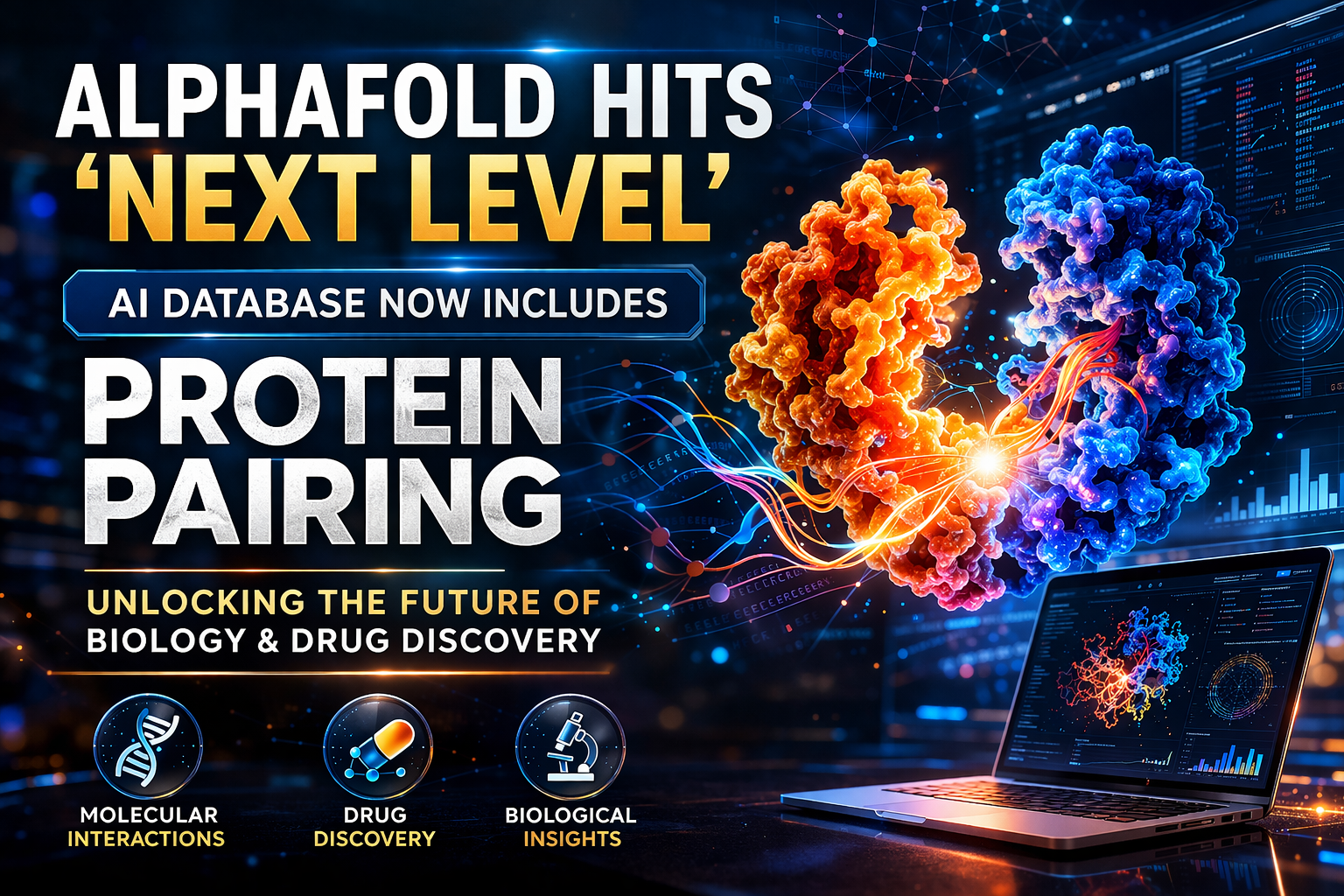
A major advancement in artificial intelligence–driven biology has been announced with the latest update to the AlphaFold protein structure database, a resource that has already transformed scientific research worldwide. The database, originally designed to predict the three-dimensional shapes of individual proteins, has now reached what researchers describe as a “next level” by incorporating protein pairing predictions, enabling scientists to study how proteins interact with one another. This development significantly expands the scope of AlphaFold, moving it beyond static structural predictions toward a more dynamic understanding of biological systems. By including data on how proteins form complexes—such as pairs known as homodimers—the database now offers insights that are far closer to how molecules behave inside living cells. The update represents a crucial step forward in computational biology, with implications for drug discovery, disease research, and the broader understanding of life at the molecular level.
What Is AlphaFold?
AlphaFold is an artificial intelligence system developed by Google DeepMind that predicts the three-dimensional structure of proteins based solely on their amino acid sequences. Proteins are essential molecules in all living organisms, responsible for functions ranging from chemical reactions to structural support. For decades, determining protein structures required labor-intensive experimental techniques such as X-ray crystallography or cryo-electron microscopy. These methods could take months or even years for a single protein.
AlphaFold changed this landscape dramatically. Introduced in its breakthrough form in 2020, the system achieved near-experimental accuracy in predicting protein structures, solving a problem that had challenged scientists for more than 50 years. Since then, the AlphaFold database has grown into a massive digital resource containing predictions for more than 200 million proteins, covering nearly all known organisms. This open-access database has been used by millions of researchers worldwide, accelerating discoveries in medicine, agriculture, and biotechnology.
From Single Proteins to Protein Pairing
Until now, the AlphaFold database primarily focused on predicting the structure of individual proteins. While this was a monumental achievement, it represented only part of the biological picture. In living cells, proteins rarely act alone. Instead, they interact with other proteins and molecules to form complexes that carry out specific functions. These interactions are essential for processes such as:
- Cell signaling
- Immune responses
- Metabolism
- DNA replication
The latest update introduces protein pairing predictions, allowing scientists to explore how proteins bind and interact with each other. Specifically, the database now includes structures of protein complexes such as homodimers, where two identical protein molecules join together. This enhancement brings the database closer to modeling real biological systems, where interactions between molecules determine function.
Why Protein Pairing Matters
Protein interactions are fundamental to biology. Many diseases, including cancer and neurodegenerative disorders, arise from disruptions in how proteins interact. By predicting how proteins pair and form complexes, AlphaFold provides researchers with new tools to investigate these processes in detail. For example, enzymes often function as multi-protein complexes, and immune responses rely on precise interactions between proteins. Understanding these interactions can help scientists identify how diseases develop and how they might be treated. The ability to model protein pairing also has major implications for drug discovery. Many drugs work by binding to specific proteins or interfering with protein interactions. With AlphaFold’s new capabilities, researchers can better predict how potential drug molecules might interact with their targets, potentially reducing the time and cost required to develop new treatments.
The Scale of the Database
The AlphaFold database is one of the largest and most widely used scientific resources in the world. It contains predictions for nearly every protein sequence known to science, making it a comprehensive reference for researchers. With the addition of protein pairing data, the database becomes even more powerful. The scale of this resource is staggering. With over 200 million protein structures, it represents a near-complete map of the protein universe. Scientists can access this data freely, enabling researchers from around the world—including those in resource-limited settings—to conduct advanced biological research. This democratization of scientific data has been one of AlphaFold’s most significant contributions.
Moving Toward Complex Biological Systems
The inclusion of protein pairing marks a shift in focus from static structures to dynamic biological interactions. Proteins often change shape when they interact with other molecules. These changes can affect how they function and how they participate in cellular processes.
By modeling these interactions, AlphaFold begins to capture the complexity of real biological systems. This development aligns with broader efforts in computational biology to simulate entire cellular environments. Recent advancements, including newer versions of AlphaFold, aim to predict interactions not only between proteins but also with DNA, RNA, and small molecules. Such capabilities could eventually allow scientists to simulate entire biochemical pathways or even complete cells.
Challenges and Limitations
Despite its impressive capabilities, AlphaFold is not without limitations. While the system can predict protein structures with high accuracy, it does not fully account for all the factors that influence protein behavior in living organisms. For example, environmental conditions, chemical modifications, and cellular context can all affect how proteins function. Additionally, predicting protein interactions is more complex than predicting individual structures. Interactions can be transient, context-dependent, and influenced by many variables. Scientists emphasize that experimental validation remains essential. AlphaFold predictions are best viewed as high-quality hypotheses that guide further research rather than definitive answers. Even so, the tool has dramatically reduced the time required to generate these hypotheses.
Implications for Medicine and Biotechnology
The ability to predict protein interactions has major implications for medicine. Many modern drugs are designed to target specific proteins or disrupt harmful interactions. By providing detailed models of these interactions, AlphaFold can help researchers identify promising drug targets more quickly. This could accelerate the development of treatments for diseases such as cancer, Alzheimer’s disease, and infectious diseases. In addition, the technology could aid in the design of custom proteins for therapeutic purposes, such as engineered antibodies or enzymes. The integration of AI into biological research is expected to reduce the cost and time associated with drug development, potentially bringing new treatments to patients faster.
A Milestone in AI-Driven Science
The evolution of AlphaFold reflects a broader trend in science: the increasing role of artificial intelligence in discovery. By automating complex calculations and analyzing vast datasets, AI systems like AlphaFold are enabling scientists to tackle problems that were previously considered intractable. The addition of protein pairing capabilities represents a new phase in this transformation. Rather than simply providing answers, AI tools are becoming partners in scientific research, helping to generate hypotheses, design experiments, and interpret results. This shift has the potential to reshape the entire scientific process.
From an editorial standpoint, the latest update to AlphaFold is more than just a technical improvement—it is a signal of how quickly the boundaries of science are expanding. The transition from predicting individual protein structures to modeling their interactions marks a fundamental shift in how scientists approach biology. It reflects a move toward understanding life as a network of interconnected systems rather than isolated components. What makes this development particularly significant is its accessibility. By making these tools and data freely available, AlphaFold has democratized access to advanced scientific capabilities. At the same time, the rapid pace of progress raises important questions about how researchers validate and interpret AI-generated results. The balance between computational prediction and experimental verification will be crucial in ensuring that these tools are used effectively and responsibly.