
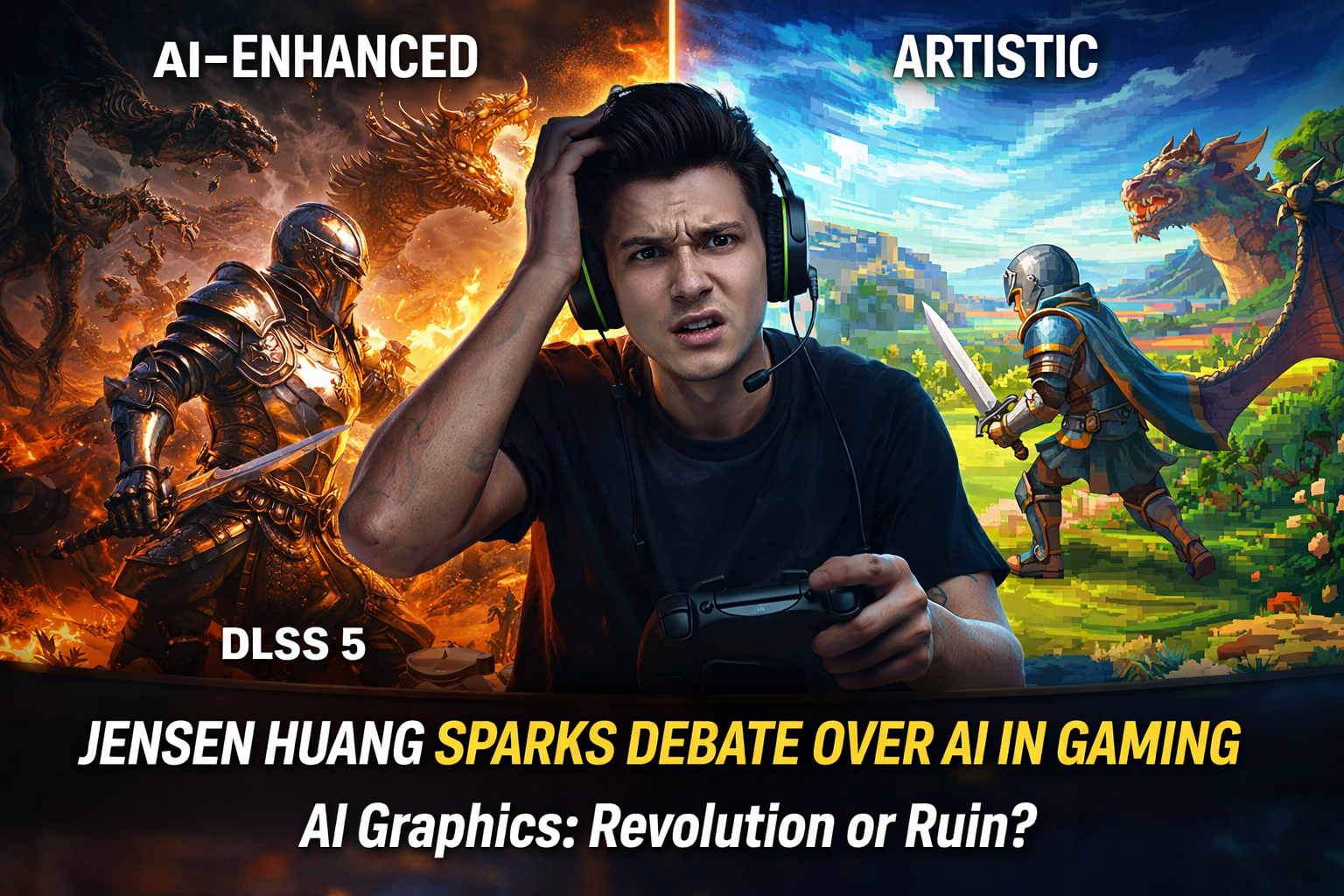
Jensen Huang, the chief executive of Nvidia, has ignited a major debate in the gaming and technology community after dismissing criticism of the company’s latest AI-powered graphics technology. Responding to backlash surrounding its newly unveiled DLSS 5 system, Huang stated bluntly that gamers are “completely wrong” in their assessment of the feature.
His remarks came during discussions following Nvidia’s GTC 2026 event, where the company introduced DLSS 5 as a breakthrough in real-time rendering. While the company positioned the technology as a leap forward in visual fidelity, the reaction from gamers was swift and largely critical. Huang’s strong rebuttal has only intensified the conversation, turning what could have been a routine product launch into a broader debate about the role of artificial intelligence in gaming.
What is DLSS 5 and Why It Matters
DLSS 5 (Deep Learning Super Sampling) represents the next evolution of Nvidia’s AI-driven graphics technology. Unlike earlier versions that primarily focused on upscaling resolution, DLSS 5 uses generative AI models to enhance lighting, textures, and materials in real time. The goal is to create more photorealistic visuals by “infusing pixels” with AI-generated detail tied to the underlying 3D environment.
Huang has described this advancement as a “GPT moment for graphics,” signaling its potential to redefine how video game visuals are created and experienced. The technology operates at a deeper level than traditional post-processing techniques, integrating directly with geometry and scene data. This allows developers to manipulate not just surface-level visuals but the foundational elements of a game’s rendering pipeline. Supporters of the technology argue that DLSS 5 could significantly reduce development time while improving graphical fidelity. By automating aspects of lighting and material rendering, developers can focus more on gameplay and design rather than manual graphical adjustments.
Gamer Backlash and Visual Concerns
Despite Nvidia’s ambitious claims, the initial reception from gamers has been far from positive. Many critics argue that DLSS 5 introduces an artificial, overly polished look that detracts from the original artistic style of games. Some have compared the effect to an “Instagram filter” applied to gameplay, while others have labeled it “AI slop.”One of the most controversial aspects is how the technology appears to alter character designs. In demo footage, characters from well-known franchises appeared noticeably different, with smoother skin, altered facial features, and a more homogenized aesthetic. Critics argue that this “AI enhancement” can override the artistic intent of game developers, effectively replacing handcrafted designs with algorithmically generated visuals.
There is also concern that DLSS 5 may lead to a loss of visual diversity in games. If widely adopted, the technology could standardize how characters and environments look, resulting in a uniform style across different titles. This fear reflects a broader चिंता within creative industries about AI tools potentially diluting originality and artistic expression.
NVIDIA’s Defense: “Developers Are in Control”
Huang has strongly rejected the idea that DLSS 5 undermines creativity. According to him, the technology does not impose a fixed visual style but instead provides developers with greater control over how their games look. He emphasized that DLSS 5 is a form of “content-control generative AI,” meaning that developers can fine-tune its effects to align with their artistic vision. This distinction is central to Nvidia’s defense. Unlike fully generative AI systems that create content from scratch, DLSS 5 works by enhancing existing assets. Huang argues that this ensures the original design remains intact while benefiting from improved realism and detail.
He also pointed out that early demonstrations may not fully represent the technology’s capabilities. As developers gain more experience with DLSS 5 and refine its implementation, the visual results are expected to improve. In this view, current criticism may be premature, based on incomplete or unpolished examples.
Industry Support vs Public Skepticism
Interestingly, while gamers have expressed skepticism, some game developers and industry insiders have shown support for DLSS 5. Developers from major studios have highlighted its potential to push visual fidelity forward and create more immersive gaming experiences. This divide between developers and players highlights a recurring pattern in technological innovation. Developers often see new tools as opportunities to expand creative possibilities, while end users may initially resist changes that alter familiar experiences.
However, the success of DLSS 5 will ultimately depend on how it is implemented in real-world games. If developers use the technology subtly and thoughtfully, it could enhance visuals without compromising artistic intent. On the other hand, heavy-handed use could reinforce the concerns currently being voiced by the gaming community.
The Bigger Picture: AI’s Growing Role in Gaming
The controversy surrounding DLSS 5 is part of a larger conversation about the increasing role of artificial intelligence in gaming. From procedural content generation to AI-driven NPC behavior, machine learning is already reshaping how games are developed and played.
DLSS 5 represents a significant step in this evolution, moving AI from a supporting role into the core of visual rendering. This shift raises important questions about authorship, creativity, and control. If AI begins to handle more aspects of game design, what role will human artists play?
At the same time, the technology reflects broader industry trends. Companies like Nvidia are heavily investing in AI as a central pillar of their business strategy, and gaming is a natural testing ground for these innovations. The outcome of this experiment could influence not just gaming but also other fields such as film, animation, and virtual reality.
Editorial Perspective: Innovation vs Artistic Integrity
From an editorial standpoint, the debate around DLSS 5 is less about whether the technology works and more about what it represents. NVIDIA is clearly pushing the boundaries of what is technically possible, and DLSS 5 is an impressive demonstration of AI’s capabilities in real-time graphics. However, the backlash from gamers cannot be dismissed as mere resistance to change. It reflects genuine concerns about the preservation of artistic identity in an era increasingly dominated by algorithms. When players describe the visuals as “AI-generated” in a negative sense, they are expressing a fear that something human is being lost in the process.
Huang’s assertion that gamers are “completely wrong” may be technically defensible, but it risks overlooking the emotional and aesthetic dimensions of gaming. Video games are not just technical products; they are cultural artifacts shaped by human creativity. Any technology that alters that balance will inevitably face scrutiny. At the same time, history suggests that many controversial innovations eventually gain acceptance. Features like ray tracing and earlier versions of DLSS also faced skepticism before becoming widely adopted. DLSS 5 may follow a similar trajectory provided Nvidia and developers address current concerns and demonstrate its value in real-world applications.