
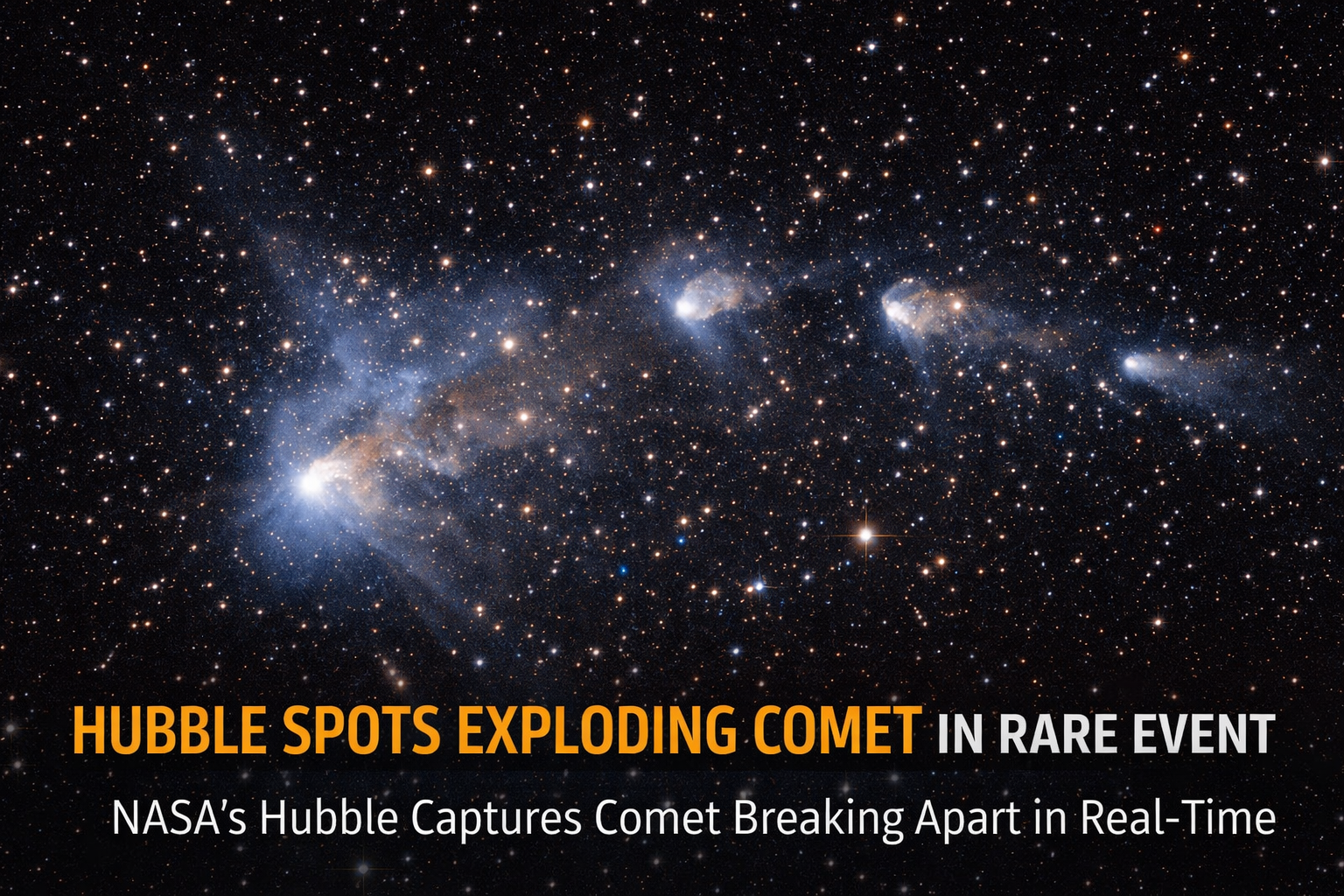
In a rare and remarkable cosmic event, astronomers using the Hubble Space Telescope have observed a comet actively breaking apart in real time, offering scientists an unprecedented look into the fragile nature of these ancient celestial objects. The discovery, involving a comet designated C/2025 K1 (ATLAS), provides new insights into how comets evolve, fragment, and ultimately disintegrate as they travel through the solar system. The observation is particularly significant because catching a comet in the act of disintegration is extraordinarily uncommon. Scientists describe the event as a “fortunate accident,” as the telescope was not originally aimed at studying the comet’s breakup. This unexpected discovery has quickly become one of the most intriguing astronomical observations of 2026, shedding light on processes that are normally hidden from view.
A Chance Discovery in Deep Space
The comet, officially named C/2025 K1 (ATLAS), was being observed as part of a broader study when scientists noticed something unusual. Over the course of several days in November 2025, the telescope captured a sequence of images showing the comet breaking apart into multiple fragments. What makes this observation unique is that the breakup was caught at a very early stage, something that has rarely been achieved before. Astronomers observed the comet splitting into at least four to five distinct pieces, each surrounded by its own cloud of gas and dust, known as a coma. The odds of witnessing such an event while the telescope is actively observing are extremely low, making the discovery a rare scientific opportunity.
What Causes a Comet to “Explode”?
Despite the dramatic term “exploding comet,” the breakup is not caused by a violent explosion like a bomb. Instead, comet fragmentation is typically driven by a combination of physical and thermal processes. As comets approach the Sun, they are exposed to intense heat and solar radiation. This causes the ice within the comet to sublimate—turn directly from solid to gas—creating internal pressure that can weaken the structure of the nucleus. Over time, this pressure can cause the comet to fracture into smaller pieces. In the case of C/2025 K1, the breakup occurred shortly after the comet passed its closest point to the Sun, known as perihelion. Scientists believe that the combination of solar heating and internal stress likely caused the comet to disintegrate.
A Detailed Look at the Breakup
The Hubble Space Telescope played a crucial role in capturing the event with unprecedented clarity. Unlike ground-based telescopes, which are limited by Earth’s atmosphere, Hubble operates in orbit, allowing it to capture highly detailed images of distant objects. In this case, Hubble’s instruments were able to resolve individual fragments of the comet, which appeared as faint, fuzzy objects aligned in space. From Earth, these fragments would have appeared as little more than blurred points of light, making it difficult to distinguish them. The telescope’s observations also revealed how the fragments moved and evolved over time, providing a dynamic view of the breakup process.
Why This Discovery Matters
Comets are often described as time capsules from the early solar system, containing pristine material that has remained largely unchanged for billions of years. Studying how comets break apart can provide valuable information about their internal structure and composition. For example, the fragmentation of C/2025 K1 suggests that the comet’s nucleus may have been loosely bound, with weak structural integrity. This supports the idea that many comets are composed of “rubble pile” structures, held together by gravity and weak cohesive forces rather than solid rock. Understanding these properties is important for several reasons:
- It helps scientists learn how the solar system formed.
- It provides insight into the behavior of comets that approach Earth.
- It informs future space missions that may attempt to study or interact with comets.
Comparing with Past Observations
While comet breakups have been observed before, they are rarely captured in such detail. For example, earlier observations by Hubble in 2006 documented the fragmentation of comet 73P/Schwassmann-Wachmann 3, but those observations occurred at a later stage of disintegration. What sets the current discovery apart is that the breakup was observed very early, allowing scientists to study the process from its initial stages. This provides a more complete picture of how fragmentation begins and progresses over time.
Implications for Planetary Science
The breakup of a comet is more than just a dramatic event—it is a key process in the evolution of the solar system. When comets fragment, they release dust and debris into space. This material can contribute to the formation of meteor streams and, in some cases, influence planetary environments.Studying these processes helps scientists understand how material is distributed throughout the solar system. It also provides clues about how planets, moons, and other celestial bodies may have formed.
The Role of Advanced Telescopes
The discovery highlights the importance of advanced space telescopes like Hubble in modern astronomy. Even after more than three decades in operation, the telescope continues to deliver groundbreaking discoveries. Its ability to capture high-resolution images of distant objects allows scientists to study phenomena that would otherwise remain invisible. In recent years, Hubble has been complemented by newer telescopes such as the James Webb Space Telescope, which focuses on infrared observations. Together, these instruments are helping astronomers build a more complete understanding of the universe.
From an editorial standpoint, this discovery is a striking reminder of how dynamic and fragile the universe can be. Comets are often portrayed as majestic, enduring travelers of the solar system. Yet this observation reveals a different reality: these objects can be delicate and short-lived, susceptible to destruction as they journey around the Sun. What makes this event particularly compelling is the element of chance. The fact that scientists were able to witness the breakup in real time underscores the importance of continuous observation and the role of advanced technology in expanding our knowledge. It also highlights the value of curiosity-driven research. The telescope was not specifically searching for a disintegrating comet, yet it captured one of the most informative events of the year.
The observation of a comet breaking apart by the Hubble Space Telescope marks a significant milestone in the study of small bodies in the solar system. By capturing the fragmentation of C/2025 K1 (ATLAS) in real time, scientists have gained a rare glimpse into the processes that shape and ultimately destroy these ancient objects. The findings not only deepen our understanding of comet behavior but also provide valuable insights into the broader dynamics of the solar system. As telescopes continue to monitor the skies, discoveries like this remind us that the universe is constantly changing—and that even the smallest objects can reveal profound truths about the cosmos.