
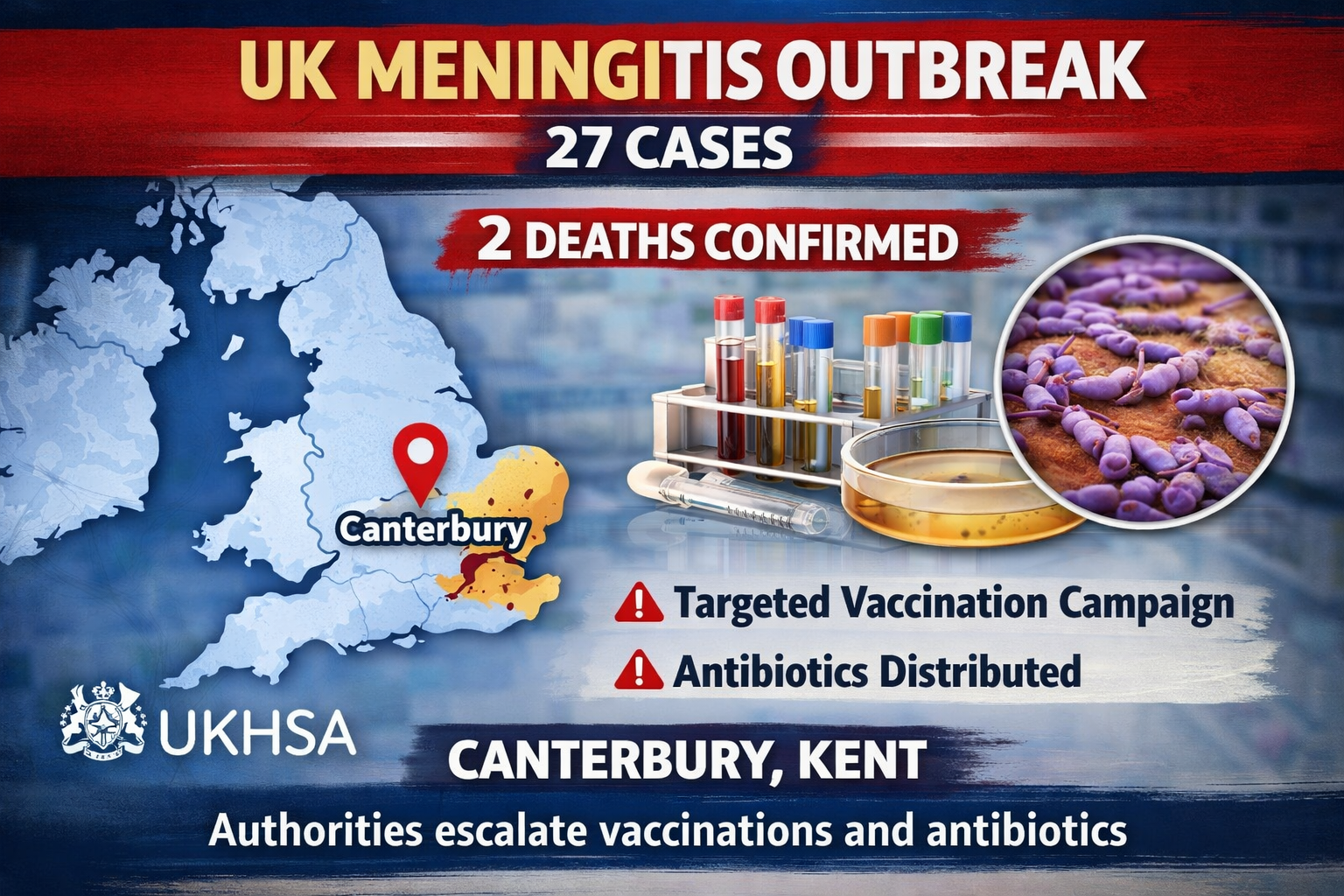
There has also been a rare and alarming outbreak of cases of meningitis in southeast England, where the health authorities are now investigating 27 confirmed and probable cases of meningitis caused by a bacterial meningitis epidemic that appears to have started in Canterbury, Kent. The health security agency of the UK (UKHSA) has been in focus of a growing response comprising antibiotic distribution, targeted vaccinations, and rapid contact tracing. According to officials, it is an unanticipated and unprecedented situation, especially in the rate at which cases have emerge in a short span of time.
What Is Meningitis and Why It Matters
Meningitis is a condition of inflammatory membranes that protect the brain and the spinal cord. Bacterial forms, particularly the Neisseria meningitidis serogroup B (MenB), are not common and are life-threatening when left unattended. The symptoms may consist of fever, headache, stiff neck, vomiting and a characteristic rash, and the disease may develop fast. Sepsis, which is a severe systemic response, is also a risk of invasive meningococcal disease, and it is potentially fatal.
In spite of the fact that bacterial meningitis is not as widespread as respiratory viruses, such as influenza or COVID-19, it is transmitted during close and prolonged contact, i.e., through kissing, sharing drinks, or being in close contact in overcrowded indoor places, such as nightclubs or university dormitories. This has raised concerns since the majority of them have been associated with social settings among the youths.
The Outbreak Timeline
Public health surveillance shows that the outbreak was initially identified at the beginning of March, and the first cases of the outbreak were reported in the period between March 12 and 13. The outbreak seems to be concentrated around Club Chemistry, a Canterbury nightclub, in which a few infected persons had been to between March 5-7.
After the initial cases, the situation was developing rapidly. Several students of the University of Kent and children of local schools in Kent and other areas were later diagnosed. The reported cases have been constantly increasing, indicating both confirmed laboratory cases and likely cases being investigated. The latest count reveals that 27 cases are being monitored by authorities, i.e., cases of hospitalised patients and those on preventive treatment.
Two Deaths Confirmed
It is a tragedy that two deaths have been confirmed as a result of the outbreak. One of the victims was a 21-year-old university student, and another was a sixth-form student in a local grammar school. Both fatalities have heightened the concern of the population and even created the demands of increased vigilance among dwellers, students, and families in the impacted locations.
Response to Public Health: Antibiotics and Vaccination
UK health officials have packed together a procession of actions that will limit further transmission in response to the outbreak:
Antibiotics
The preventive antibiotics have been administered in thousands of doses, especially to individuals who may be likely to have been in close contact with the infected individuals. It is a widespread approach to public health to decrease the possibility of being infected after exposure to an invasive meningococcal disease.
Vaccination against Targeted Viruses
The UK government has increased access to the vaccine against meningitis B among the highest-risk groups. This vaccine is intended to be given as part of the childhood immunisation schedule since 2015, but was not traditionally provided to older teenagers and young adults before that time, which complicates the coverage of older groups of students. The government has established vaccination centers and has made students of the University of Kent, learners of schools impacted, and all other individuals who visited the Canterbury nightclub during the pertinent timeframe eligible.
The reason behind the concern of this outbreak
According to experts, this meningitis cluster is unusual and explosive on its own, since the cases started appearing in a tight spot at a high rate. The head of the UKHSA, Susan Hopkins, said that she has never witnessed such a sharp increase in cases in one weekend during her 35 years of work. This gives an indication of the potential super-spreader event, which was related to the nightlife environment and overcrowded student dormitories.
Researchers are sequencing bacteria samples in order to have a clearer picture of whether certain genetic traits could have been used to contribute to the disease epidemic or its severity. Meanwhile, the public health messaging focuses on the fact that the overall risk of meningitis is low in the general population, but that by definition of meningitis, most incidences are limited to contacts that can be identified.
Risk Communication and Public Awareness
The UK Health Security Agency has issued warnings to people to be on the lookout for the symptoms of meningitis, especially fever, headache, vomiting, stiffness in the neck, or rashes that do not disappear. Individuals who visited the nightclub or were in close contact with an affected individual are advised to seek medical advice or treatment in good time.
There has been a mixed public response to more awareness or concern over the availability of vaccines, where the MenB shot has had a huge demand. The shortage of supplies in some pharmacies also led to redistribution and further distribution of vaccines to address the local needs.
Wider Background: Meningitis Surveillance and Prevention
In the UK, meningococcal disease is rather rare. Historically, big outbreaks are rare, although small groups of cases have historically taken place. Living conditions have sometimes caused meningitis outbreaks in universities
Cases of some strains of meningococci have been greatly decreased through routine vaccination programmes, especially in childhood. Nonetheless, the disparity between older teens and young adults (who may not have yet been vaccinated against MenB) supports a possible weakness in the immunity of the community.