
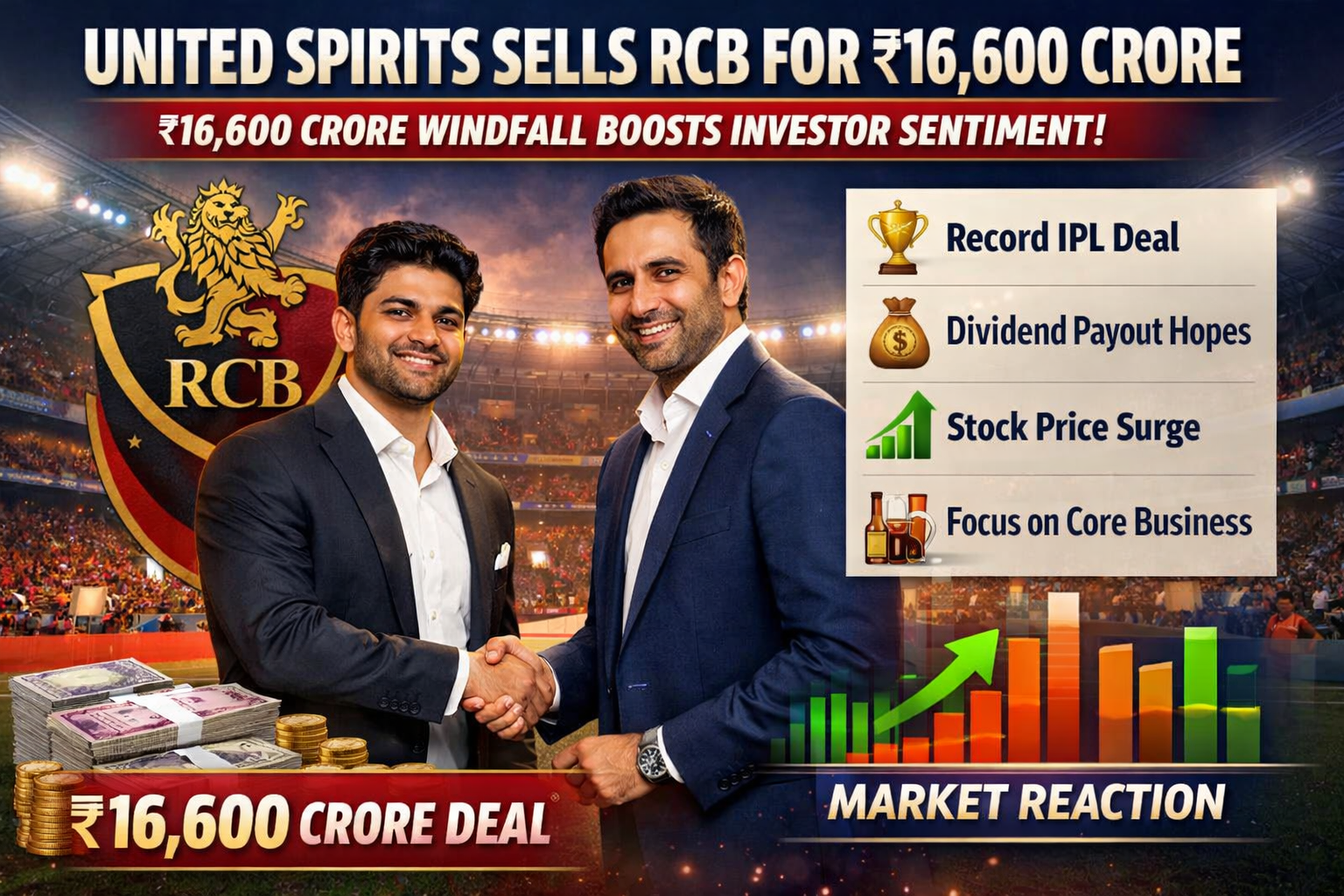
Shares of United Spirits Limited (USL) are expected to attract significant market attention following the company’s landmark decision to sell its Indian Premier League (IPL) franchise, Royal Challengers Bengaluru (RCB), in a deal valued at approximately ₹16,600 crore. The transaction, one of the largest in the history of sports franchise sales, marks a strategic shift for the liquor giant and its parent company, Diageo plc, as they move to sharpen focus on their core business operations.
The sale has not only generated a massive financial windfall but has also triggered speculation among investors about potential dividends, share price movement, and long-term growth strategy. As markets digest the implications of the deal, analysts believe the development could redefine how investors view United Spirits in the coming quarters.
A Record-Breaking Deal in Indian Sports
The sale of Royal Challengers Bengaluru has set a new benchmark in the valuation of sports franchises in India. The team was acquired by a consortium comprising the Aditya Birla Group, The Times of India Group, Blackstone, and Bolt Ventures, led by global sports investor David Blitzer. Valued at around $1.78 billion (₹16,600 crore), the deal makes RCB one of the most expensive cricket franchises ever sold. This valuation reflects the explosive growth of the IPL as a global sporting brand. Over the past decade, the league has evolved into a multi-billion-dollar entertainment ecosystem, attracting global investors, private equity firms, and multinational corporations. For United Spirits, the deal represents a nearly 16-fold return on its original investment when the franchise was acquired in 2008.
Strategic Exit: Why United Spirits Sold RCB
The decision to sell RCB is part of United Spirits’ broader strategy to streamline its business and focus on its primary operations in the alcoholic beverages segment. Company executives have indicated that the sale will allow USL to unlock value from a non-core asset and redeploy capital into areas with higher long-term growth potential. While RCB has been a successful and high-profile asset, managing a sports franchise requires a different operational focus compared to running a consumer goods business. By exiting the franchise, United Spirits is aligning its portfolio more closely with its core expertise. This move also reflects a broader trend among corporations to divest non-core assets and optimize capital allocation in a competitive global market.
Financial Impact of the Deal
The ₹16,600 crore windfall is expected to have a significant impact on United Spirits’ financial position. At the time of the announcement, the company’s market capitalization stood at roughly ₹96,000 crore, meaning the deal represents a substantial proportion of its overall valuation. The infusion of cash could be used in several ways:
- Strengthening the balance sheet
- Reducing debt
- Investing in premium product segments
- Returning value to shareholders through dividends
The deal also highlights the strong financial performance of RCB itself. The franchise reported revenues exceeding ₹500 crore annually, with growing profitability driven by media rights, sponsorship deals, and fan engagement.
Dividend Expectations and Investor Sentiment
One of the key questions surrounding the deal is how United Spirits will utilize the proceeds. Market analysts believe there is a strong possibility of a special dividend payout, which could provide immediate returns to shareholders. Such a move would likely boost investor sentiment and could drive short-term gains in the company’s stock price. In addition, the company may choose to reinvest part of the proceeds into expanding its premium product portfolio, particularly in fast-growing markets. The announcement has already generated positive momentum in the stock market, with shares rising ahead of the deal confirmation.
The Growing Value of IPL Franchises
The record valuation of RCB underscores the rapid growth of the IPL and the broader sports economy in India. According to industry estimates, the IPL’s brand value has crossed $10 billion, driven by lucrative media rights deals and a massive global audience. Franchises like RCB benefit from multiple revenue streams, including:
- Broadcasting rights
- Sponsorship agreements
- Ticket sales
- Merchandising
The success of RCB, including its recent IPL title win, has further enhanced its brand value, making it an attractive asset for investors. The involvement of global players like Blackstone and David Blitzer highlights the increasing international interest in Indian sports assets.
Market Reaction and Stock Outlook
United Spirits’ shares are expected to remain in focus as markets react to the news. In the short term, the stock could experience increased volatility due to:
- Speculation around dividend payouts
- Rebalancing by institutional investors
- Profit booking after initial gains
In the long term, however, the deal could strengthen the company’s investment profile by improving its financial metrics and strategic focus. Analysts are likely to revise their target prices based on updated earnings projections and capital allocation plans.
Leadership and Ownership Transition
Under the new ownership structure, Aryaman Vikram Birla is expected to take on a leadership role as chairman, while Satyan Gajwani will serve as vice chairman. The consortium brings together expertise from multiple sectors, including media, finance, and global sports management. This combination is expected to drive further growth for the franchise, both on and off the field. For RCB fans, the transition marks the beginning of a new chapter, with expectations of continued success and expansion.
On one hand, the move appears to be a strategic masterstroke. The company has monetized a non-core asset at peak valuation, unlocking significant capital and enhancing shareholder value. In a market where capital efficiency is increasingly important, such decisions are often rewarded by investors. On the other hand, there is an argument that United Spirits may be exiting a high-growth segment too early. The IPL continues to expand globally, and franchise valuations could rise even further in the coming years.
However, managing a sports franchise is fundamentally different from running a consumer goods business. By focusing on its core operations, United Spirits may achieve more consistent and predictable growth. Ultimately, the success of this decision will depend on how effectively the company deploys the proceeds from the sale.
Broader Implications for Corporate India
The RCB deal reflects a broader trend in corporate India, where companies are reassessing their investment strategies and focusing on core competencies. It also highlights the growing importance of sports as an asset class, attracting interest from private equity firms, global investors, and conglomerates. As valuations continue to rise, more companies may consider entering or exiting the sports sector based on strategic priorities.