
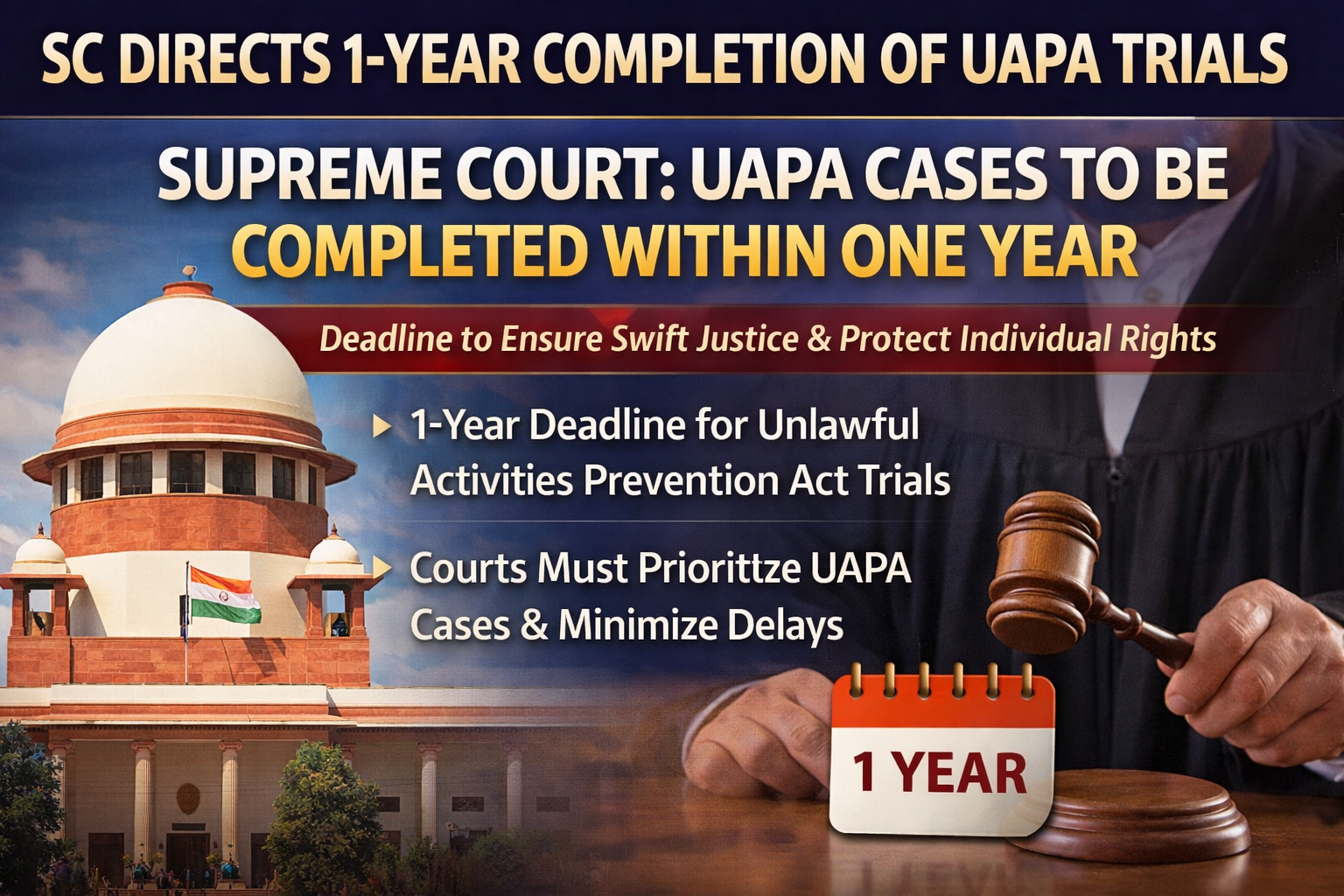
In a landmark decision aimed at ensuring swifter justice, the Supreme Court of India has directed that all trials under the Unlawful Activities (Prevention) Act (UAPA) must be completed within one year from the date of the charge sheet being filed. This ruling seeks to address long-standing concerns regarding delays in trials for cases involving terrorism, unlawful activities, and national security, where prolonged judicial processes have often left accused individuals in extended pre-trial detention.
The directive comes as part of a broader effort by the judiciary to strike a balance between the state’s interest in national security and the protection of fundamental rights, particularly the right to a speedy trial, guaranteed under Article 21 of the Constitution. Legal experts say this decision could significantly impact how courts, investigative agencies, and legal practitioners manage UAPA cases in India.
Background on UAPA and Trial Delays
The Unlawful Activities (Prevention) Act, enacted in 1967 and amended several times since, empowers authorities to prevent and prosecute activities deemed threatening to India’s sovereignty and integrity. UAPA cases often involve complex investigations, multiple accused, and sensitive national security information, which historically has led to prolonged trials spanning several years. Critics of UAPA have long argued that such delays can compromise the rights of the accused, with many individuals spending years in jail before a verdict is delivered. While the Act grants extensive powers to law enforcement agencies for investigation and arrest, the judiciary has now recognized the necessity of a timeline to prevent indefinite legal limbo. By mandating a one-year window for completion, the Supreme Court has effectively set a deadline for judicial efficiency, emphasizing that national security concerns cannot override fundamental procedural rights.
The Supreme Court’s Ruling
In its ruling, the Supreme Court clarified that:
- All UAPA trials must conclude within one year of the filing of the charge sheet.
- Courts may extend the timeline only under exceptional circumstances, which must be explicitly documented.
- Investigating agencies and prosecutors are expected to expedite evidence collection and presentation, ensuring no unnecessary procedural delays.
The judgment stresses that prolonged trials not only affect the accused but also undermine the credibility of the criminal justice system. Justice Chandrachud, delivering the verdict, observed that “speedy trials in UAPA cases are essential to maintain public confidence in the judicial system while safeguarding the rights of the accused.”
Implications for the Judiciary and Legal System
The one-year mandate will require a radical reorganization of court schedules, particularly in sessions courts and special courts dealing with terrorism and UAPA cases. Judges may need to prioritize UAPA trials, possibly at the expense of less urgent cases, to comply with the directive. The decision also signals a push towards modernizing judicial procedures. The Supreme Court highlighted the importance of using technology, video conferencing, and digitized case management systems to facilitate faster hearings, especially for cases involving multiple defendants or sensitive evidence.
Impact on Investigating Agencies
Investigative bodies like the National Investigation Agency (NIA) and local law enforcement authorities will face increased pressure to complete evidence collection, witness examination, and charge sheet filing within strict timelines. Delays in investigation may no longer be a justification for extending trial proceedings, compelling agencies to adopt more structured and efficient methods.
Legal analysts believe that this may also encourage better coordination between investigators, prosecutors, and courts, improving overall case management. Additionally, forensic and intelligence inputs may need to be streamlined to comply with the one-year deadline.
Rights of the Accused
One of the most significant aspects of the Supreme Court’s ruling is its recognition of the rights of the accused. UAPA cases, often involving serious allegations like terrorism or funding unlawful activities, have historically led to prolonged pre-trial detention. Critics have pointed out that extended incarceration without a verdict amounts to a violation of constitutional protections. By enforcing a one-year trial limit, the court reinforces the principle that speedy justice is a fundamental right, even in cases of national security. This could lead to a reduction in the average time individuals spend in jail awaiting trial under UAPA, potentially safeguarding human rights without compromising public safety.
Challenges in Implementation
While the ruling sets a clear mandate, implementation may pose significant challenges:
- Complexity of Cases: UAPA trials often involve multiple defendants, classified intelligence, and cross-border evidence, making a one-year timeline ambitious.
- Court Infrastructure: Many lower courts lack sufficient judges and resources to conduct multiple high-profile trials concurrently.
- Evidence Management: Coordinating witnesses, forensic reports, and sensitive documents within tight timelines will require procedural reforms and strict adherence to deadlines.
Despite these hurdles, experts emphasize that the court’s decision is a step toward judicial accountability and should encourage systemic reforms to improve trial efficiency.
Reaction from Legal Experts and Stakeholders
Legal experts have widely welcomed the Supreme Court’s ruling as a progressive step for justice reform. Advocate Meera Sanyal noted, “This decision is a reaffirmation of the constitutional right to a speedy trial. Even in cases of national security, the judiciary has acknowledged that justice delayed is justice denied.” However, some law enforcement officials have expressed concern that the mandate could pressure investigators and prosecutors, potentially compromising thorough investigations. They argue that rushing complex UAPA cases may affect the quality of evidence presented and could impact conviction rates. Despite the concerns, most analysts agree that the ruling will enhance transparency and improve public confidence in the legal process for sensitive cases.
Broader Implications for Indian Law
The Supreme Court’s directive sets a precedent for other special laws, including the National Security Act (NSA) and Prevention of Money Laundering Act (PMLA), where cases can often drag on for years. By imposing a one-year trial limit, the judiciary signals that efficiency and fundamental rights must coexist, regardless of the gravity of charges. This could inspire legislative and procedural reforms, prompting lawmakers to consider statutory limits on trial duration for other complex cases, thereby reinforcing the principle of timely justice.
From an editorial standpoint, the Supreme Court’s ruling represents a milestone in balancing national security with civil liberties. UAPA cases are often politically and socially sensitive, and the judiciary’s intervention ensures that the accused are not subjected to indefinite legal limbo. While challenges in implementation are real, the decision underscores a broader commitment to judicial efficiency, accountability, and fairness. By demanding that trials be completed within a year, the court has set a benchmark for the entire criminal justice system, highlighting that constitutional protections are paramount, even in cases involving national security.