
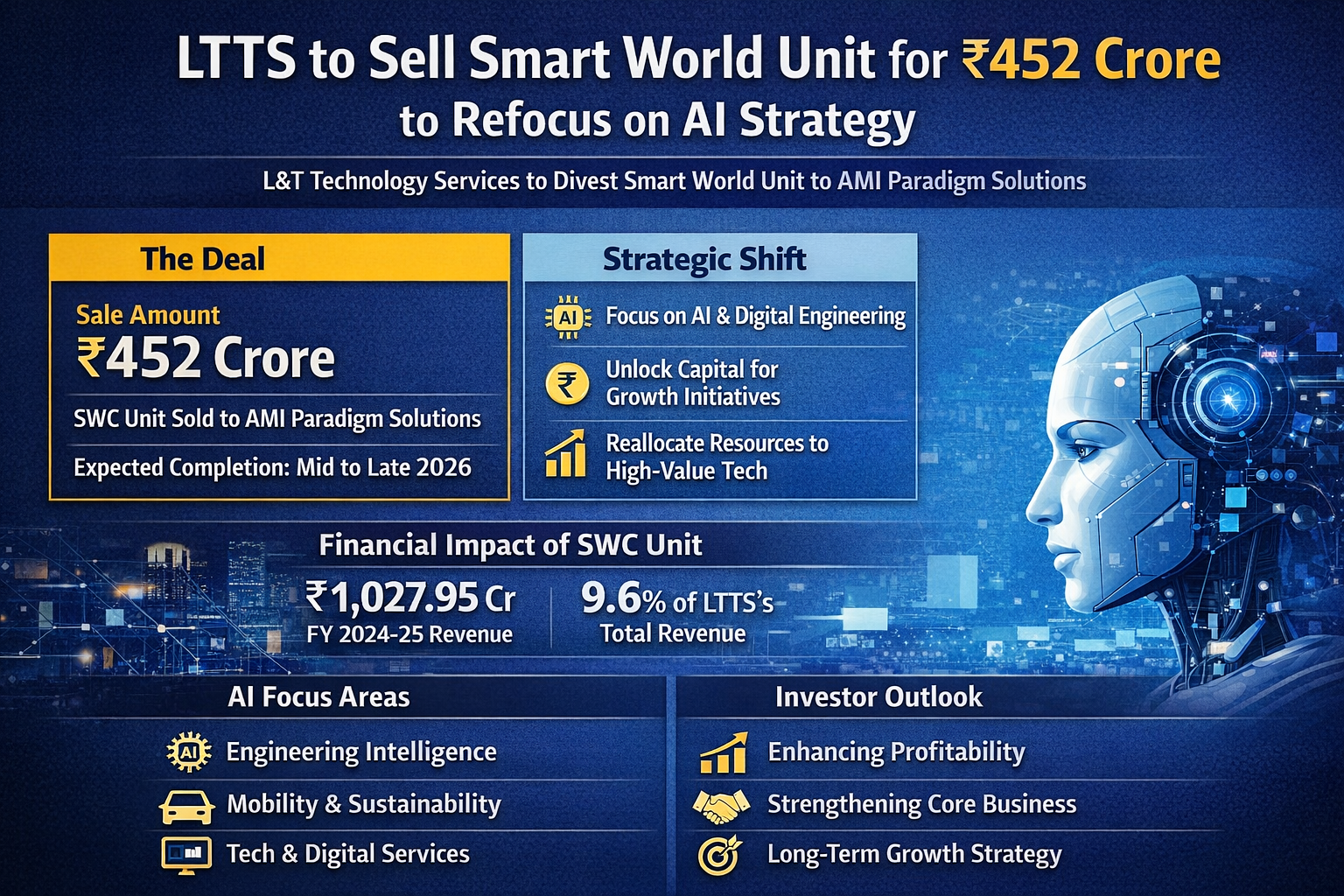
In a decisive strategic move, L&T Technology Services (LTTS) has announced the sale of its Smart World and Communication (SWC) business unit to AMI Paradigm Solutions for ₹452 crore. The transaction marks a significant shift in the company’s long-term vision, as it seeks to realign its operations toward artificial intelligence (AI), digital engineering, and high-value technology services.
The deal is part of LTTS’s broader five-year roadmap, which prioritizes Engineering Intelligence (EI) and AI-driven transformation as key growth drivers. Industry experts view this divestment as a calculated step to streamline operations, unlock capital, and strengthen the company’s position in a rapidly evolving global technology landscape.
Deal Overview and Key Details
The transaction, structured as a cash deal valued at ₹452 crore, involves the complete transfer of LTTS’s SWC unit to AMI Paradigm Solutions. The SWC business, which focuses on smart infrastructure, communication systems, and public-sector digital solutions, has been a notable part of LTTS’s portfolio. However, the company has now chosen to divest this segment to sharpen its focus on higher-growth areas. The deal is expected to be completed by mid to late 2026, subject to customary approvals and adjustments related to working capital and liabilities. Importantly, the transaction includes the transfer of contracts, intellectual property, and workforce associated with the SWC division, ensuring continuity for clients and employees under the new ownership.
Financial Significance of the SWC Unit
The Smart World and Communication unit has been a substantial contributor to LTTS’s business. In the financial year 2024–25, the division generated approximately ₹1,027.95 crore in revenue, accounting for nearly 9.6% of the company’s total consolidated revenue. Additionally, the unit had a net worth of around ₹445.89 crore, reflecting its operational scale and importance within LTTS’s portfolio. Despite its financial contribution, the company has chosen to divest the unit, indicating a clear preference for strategic focus over diversification. This decision underscores LTTS’s commitment to prioritizing areas with higher margins and long-term growth potential.
Strategic Rationale: The Shift Toward AI
The divestment aligns with LTTS’s “Lakshya” five-year strategic plan, which places Engineering Intelligence at the center of its growth strategy.
Engineering Intelligence refers to the integration of AI, data analytics, and advanced engineering capabilities to create intelligent systems and solutions. LTTS believes this domain will drive the next phase of innovation in sectors such as:
- Mobility and transportation.
- Sustainability and energy.
- Industrial manufacturing.
- Technology and digital services.
By exiting the SWC business, LTTS is freeing up both financial resources and management bandwidth to invest in these high-priority areas.
Capital Allocation and Portfolio Optimization
The sale enables LTTS to reallocate capital toward AI and digital engineering initiatives, which are expected to deliver higher returns. This strategic realignment reflects a broader trend in the technology sector, where companies are focusing on core competencies and high-growth segments rather than maintaining diversified portfolios. The company has also emphasized its intention to strengthen its presence in Mobility, Sustainability, and Tech segments, which are seen as critical to its future growth.
The Buyer’s Perspective: AMI Paradigm’s Expansion
For AMI Paradigm Solutions, the acquisition represents a major step in building a comprehensive AI platform for public systems and infrastructure. The company, backed by AM Group and ParadigmIT, aims to leverage the SWC unit’s capabilities to develop AI-powered solutions for governments, cities, utilities, and transportation networks. The acquisition aligns with AMI Paradigm’s broader vision of creating an end-to-end AI ecosystem, spanning:
- High-performance computing infrastructure.
- AI software and applications.
- Smart city and governance solutions.
The group is also investing heavily in AI infrastructure, including plans for a 1 GW high-performance computing hub in Uttar Pradesh, highlighting its long-term ambitions in the AI space.
Industry Context: A Broader Shift Toward AI
LTTS’s decision reflects a wider industry trend, where engineering and IT services firms are pivoting toward AI, automation, and digital transformation. The global market for AI in government and enterprise applications is projected to grow rapidly, reaching nearly $100 billion by the early 2030s, driven by demand for automation, security, and data-driven decision-making. In this context, companies that focus on AI-led services and engineering intelligence are expected to gain a competitive edge.
Market and Investor Implications
In the short term, the divestment may raise questions among investors about the loss of a revenue-generating unit. However, analysts believe the move will enhance LTTS’s profitability and strategic clarity over the long term. By concentrating on high-margin segments, the company is likely to:
- Improve operational efficiency
- Increase return on capital
- Strengthen its competitive positioning
Investors will closely monitor how LTTS deploys the proceeds from the sale and whether it successfully accelerates growth in its core AI and engineering segments.
Challenges and Risks
While the strategic rationale is clear, the transaction is not without risks. The successful completion of the deal depends on meeting regulatory and contractual conditions, as well as ensuring a smooth transition for employees and clients. There is also the challenge of replacing lost revenue from the SWC unit in the short term. LTTS will need to demonstrate that its investments in AI and Engineering Intelligence can generate sufficient growth to offset this impact. In today’s technology landscape, where AI is becoming the central pillar of innovation, companies must make difficult choices about where to focus their resources. LTTS has clearly chosen to prioritize depth over breadth, betting that AI and engineering intelligence will define the next wave of growth. However, such strategic shifts require disciplined execution. The company must ensure that it not only invests in the right technologies but also builds the capabilities needed to deliver on its vision. At the same time, the deal highlights the growing importance of AI in public infrastructure and governance, as seen in AMI Paradigm’s ambitions. This convergence of AI, infrastructure, and policy could reshape how cities and governments operate in the coming decades.
Conclusion
The ₹452 crore sale of LTTS’s Smart World and Communication unit marks a significant turning point for the company. By divesting a substantial but non-core business, LTTS is positioning itself for a future driven by AI, digital engineering, and intelligent systems.
While challenges remain, the move reflects a clear strategic vision and a willingness to adapt to changing market dynamics. For investors, industry observers, and competitors alike, this transaction serves as a reminder that the future of technology lies in focused innovation and strategic agility. As LTTS embarks on this new phase, its success will depend on how effectively it translates its AI ambitions into tangible growth and value creation. In an era defined by rapid technological change, such bold decisions may well determine the leaders of tomorrow’s digital economy.