
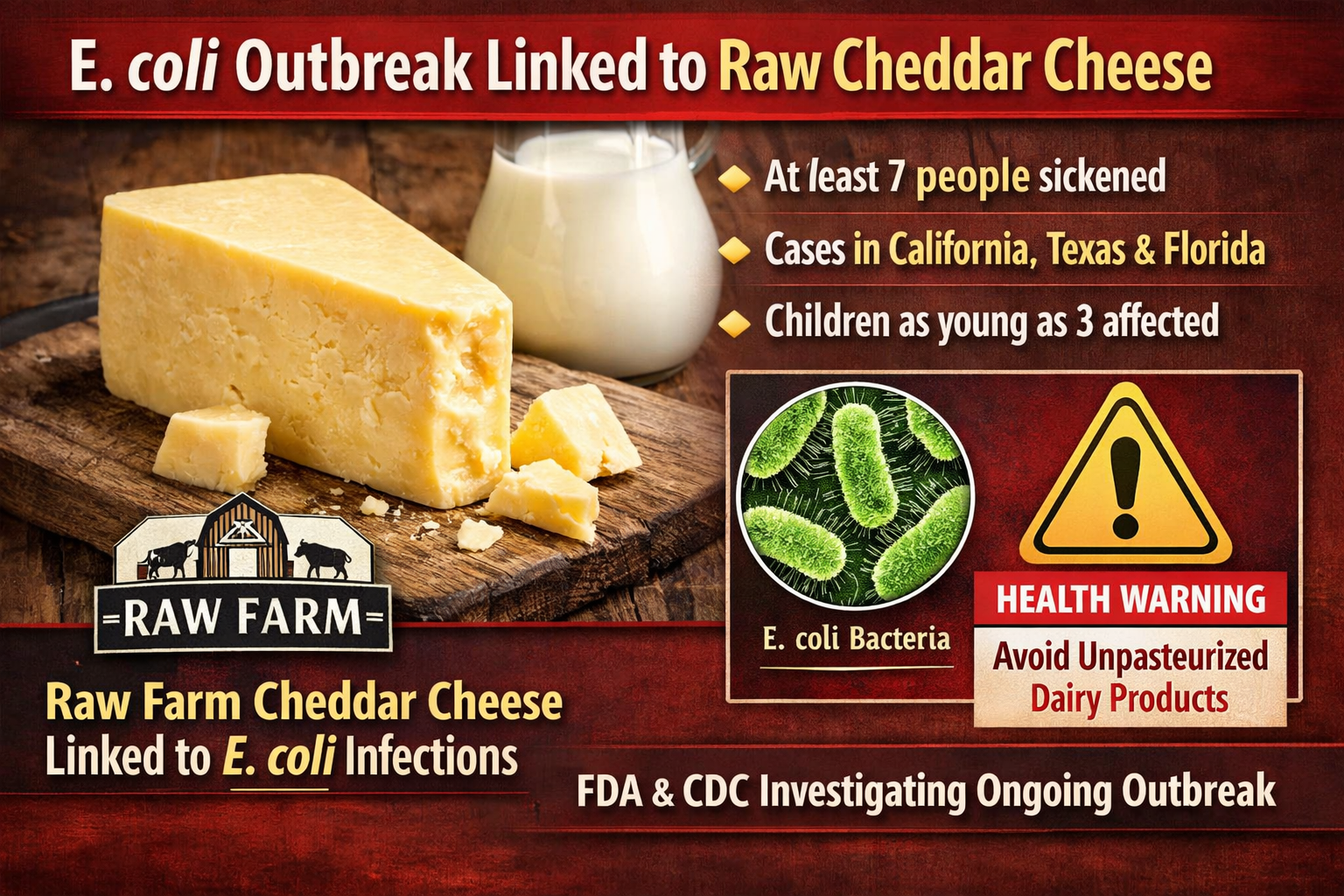
Once again, due to a multistate outbreak of E. coli infections in the United States, a raw milk cheddar cheese has been implicated in the outbreak, causing further concerns over the safety of unpasteurized dairy products. The outbreak that has already affected at least seven individuals in various states is already under investigation by health officials such as the US Food and Drug Administration (FDA) and the Centers for Disease Control and Prevention (CDC).
The diseases have been linked to cheddar cheese made by Raw Farm, a dairy company in California, which has been selling milk products that have not been pasteurized. The investigators state that the infections took place in September 2025 and February 2026, and the cases were reported in such states as California, Texas, and Florida.
Illnesses and Health Impact
The outbreak has hit people of different ages, such as young children. Health officials reported that cases were also reported in children as young as three years old, which is an extra cause of concern since children are more susceptible to foodborne diseases.
E. coli infection is accompanied by symptoms such as severe stomach cramps, diarrhea (which is usually bloody), vomiting, and dehydration. In severe instances, the infection may result in the development of hemolytic uremic syndrome (HUS), an ailment that is life-threatening and may result in kidney failure.
Although the majority of infected persons recover in a week, others need hospitalization, particularly children, older adults, and those with compromised immunity.
Research and Source Coercion
Federal health agencies have declared Raw Farm as the probable origin of the outbreak due to its raw cheddar cheese, which is based on epidemiological evidence. Investigators discovered that most of the infected said they had eaten the cheese before getting sick.
Although this connection is so strong, laboratory tests have not yet been able to find the E. coli bacteria in samples of the cheese itself. Such a variation has made the investigation difficult, although the officials stress that epidemiological data is a significant element in establishing sources of outbreaks.
The products that were implicated were sold throughout the country, which further expanded the possible extent of the epidemic and triggered the warnings to the consumers in the whole country.
Company Response
Raw Farm has objected to the findings and disagreed with the conclusions of the FDA. An official of the firm claimed that all the tested products are negative for the harmful bacteria including the E. coli.
Another issue where the company has been stubborn is the voluntary recall, which has raised tension between regulators and the manufacturers of raw dairy products. This position is contrary to earlier incidents of the same brand where recalls were made as a result of the pressure by the regulatory bodies.
Public Health Advisory
The health authorities have come up with stern warnings to discourage the use of raw milk cheese products that have been associated with the outbreak. Retailers and restaurants have also been advised not to sell and serve the implicated items.
Authorities advise consumers to check their refrigerator to see whether they have any raw cheddar cheese goods and dispose of them in case they can be traced to the outbreak. Also, the contact surfaces and utensils that may have been in contact with the cheese should be well cleaned to avoid cross-contamination.
Health scientists have also stressed that pasteurized milk products are far safer than raw ones since the pasteurization process destroys all the bad bacteria, including E. coli, Salmonella and Listeria.
Bigger Picture: Raw Milk Controversy
The epidemic has rekindled the debate on the issue of consuming raw milk. The proponents of raw dairy milk claim that it is more tasty and it might have certain health benefits, whereas the health officials always remind us about the danger of using unpasteurized goods.
One of the biggest producers of raw milk in the US is Raw Farm that was earlier associated with numerous contamination outbreaks, such as the cases of E. coli and Salmonella.
According to the statistical data of past research studies, raw milk products have a higher chances to carry harmful bacteria, and so it becomes a repetitive issue in food safety dialogues.
Ongoing Monitoring
The FDA has attested to the fact that the investigation is still going on, and there can still be more cases reported as more data becomes accessible. According to health officials, there is a danger that the true level of infections may be even greater than the reported cases because most cases of foodborne illnesses remain unreported.
Those in charge are still monitoring the outbreak, interviewing the sick people, and monitoring the distribution patterns to gain a better understanding of the extent and cause of the contamination.
The consumers are also being advised to be more vigilant and focus on food safety measures, especially in relation to dairy products that have not been pasteurized, as the investigation continues.