
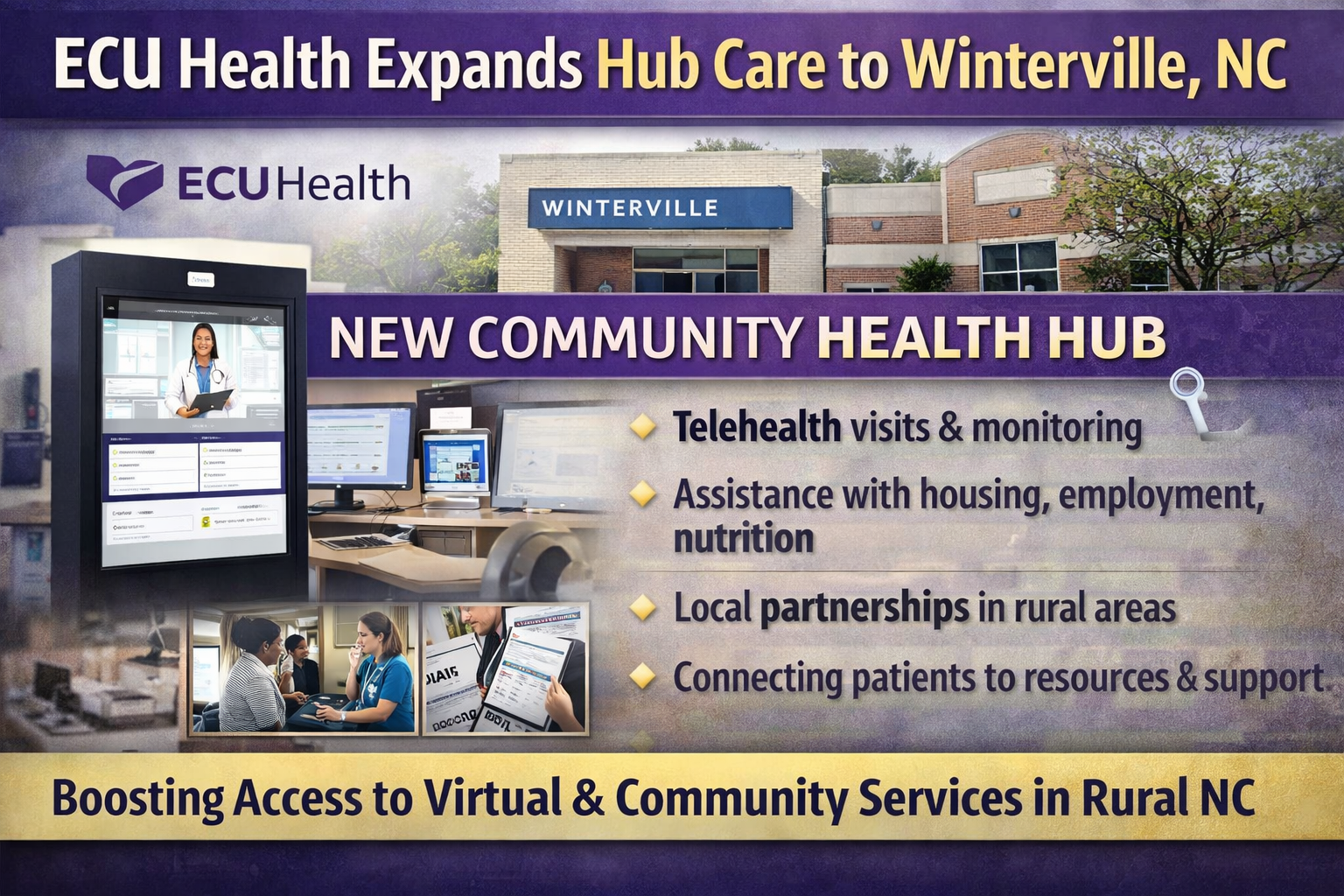
Considering the further attempt to address the healthcare disparities in the rural population, ECU Health has implemented its Health Hub program in Winterville, North Carolina, which is a big step in enhancing public access to medical and social assistance in the area.
Having been introduced to the ECU Health network, the newly created hub is the 61 st site in the system of community-based health access points. First launched in May 2023, the initiative has continued to grow steadily throughout the eastern region of North Carolina and reach underserved groups, focusing on healthcare and social determinants of health.
Reaching More People by Collaborating with Communities.
The Winterville Health Hub is an attempt by ECU Health, the local government, and community stakeholders to work together. The program will establish healthcare access points within the daily community spaces like libraries, churches, and other businesses in the community to address the residents where they are and eliminate the barriers associated with transportation, cost, and availability.
The ECU Health Assistant Director of Community Engagement, Deborah Gray, underpinned the role of accessibility in the development of the initiative. The hub also facilitates the virtual doctor visit, as well as links the residents with necessary support like employment, food stamps, and housing.
This combined strategy highlights an increasingly important understanding in the context of the public health systems that the medical results are highly interconnected with the socioeconomic context. The Health Hub model will be a step towards more holistic, community-oriented care, as it provides a one-stop access point to medical and non-medical services.
Services provided at the Health Hub.
The Winterville hub is also furnished with such tools and technology that enable people in the area to receive virtual healthcare services. Through electronic medical devices like MyChart, patients have the opportunity to make e-visits with healthcare professionals, review lab results, and communicate with doctors.
Besides the telehealth, the hub offers some basic health monitoring, such as blood pressure monitoring and temperature checks. These characteristics are especially beneficial in rural settings when there might be inadequate facilities to access primary care, or they may require extensive traveling.
The hub provides a broad spectrum of community resources in addition to clinical care. These are nutrition-related information and support, employment, housing, insurance, mental health, and advance care planning. This enlarged presence makes the hub not only a place of healthcare access but also an overall support center of community-level wellbeing.
Overcoming Medical Dilemmas in the Rural setting.
The move to Winterville shows that rural healthcare delivery is still a problem in the United States. Areas such as eastern North Carolina are highly likely to be poor in healthcare providers, infrastructure, and incidence of chronic illness.
ECU Health provides care to over 1.4 million individuals in 29 counties in the eastern region of North Carolina, most of whom are rural and underprivileged in terms of health care.
Health hubs are located strategically in regions where they are said to be socially vulnerable, with the residents facing the challenge of accessing prompt care because of economic or geographical factors. Through telemedicine and community collaboration, ECU Health will lessen disparities and enhance the overall health outcomes.
The Winterville program is a sign of a bigger healthcare trend towards decentralization. Rather than only using hospitals and clinics, health systems are exploring more community-based models that would take care to the lives of patients.
Leadership and Community Impact.
The Winterville Health Hub was also facilitated by the work of a local council member, organization member, and licensed clinical social worker, Dr. Brandy Harrell. Harrell was instrumental in supporting the partnership and promoting greater access to care in the community.
In her speech, Harrell emphasized the importance of collaboration in the field of healthcare disparity and that efforts such as the Health Hub can serve to eliminate the barriers present over time and enhance the quality of life of residents.
The leaders of the community perceive the hub as a revolutionary change, especially to the people who might have had difficulties before accessing healthcare services. The initiative also minimises stigma and enhances the overall participation of the community by placing the hub in a community centre that is easily reachable, such as a public library.
Expansion of the Health Hub Network.
The Health Hub initiative by ECU Health was launched in 2023; however, in the following year, it has grown exponentially and currently includes dozens of facilities in multiple counties, including Pitt, Beaufort, Martin, and Edgecombe.
The introduction of the Winterville location indicates the desire of the organization to expand the program and access more communities in need. Authorities have also suggested that they would keep on broadening the network, and hope to establish a sustainable model on how to deliver healthcare to rural areas.
This development is in line with the larger trends within the healthcare sector across the country to implement new innovative solutions in the form of telemedicine or community-based models of care. With the COVID-19 pandemic, these methods have become especially relevant due to the potential and need of remote health care.
A Healthcare Delivery Model of the Future.
The Health Hub program is a major development in the delivery of healthcare, especially in rural areas. The program provides a versatile and replicable model that can be implemented in other areas experiencing the same problem by integrating digital health tools with community-based support in those areas.
Winterville expansion is a case study on how collaboration between healthcare organizations, local authorities, and local organizations can bring significant changes in care access.
With healthcare systems still grappling with the issues of workforce deficits, cost increases, and growing demands, programs such as Health Hubs of ECU Health show how innovative, community-based programs can transform the healthcare delivery model in the future.