
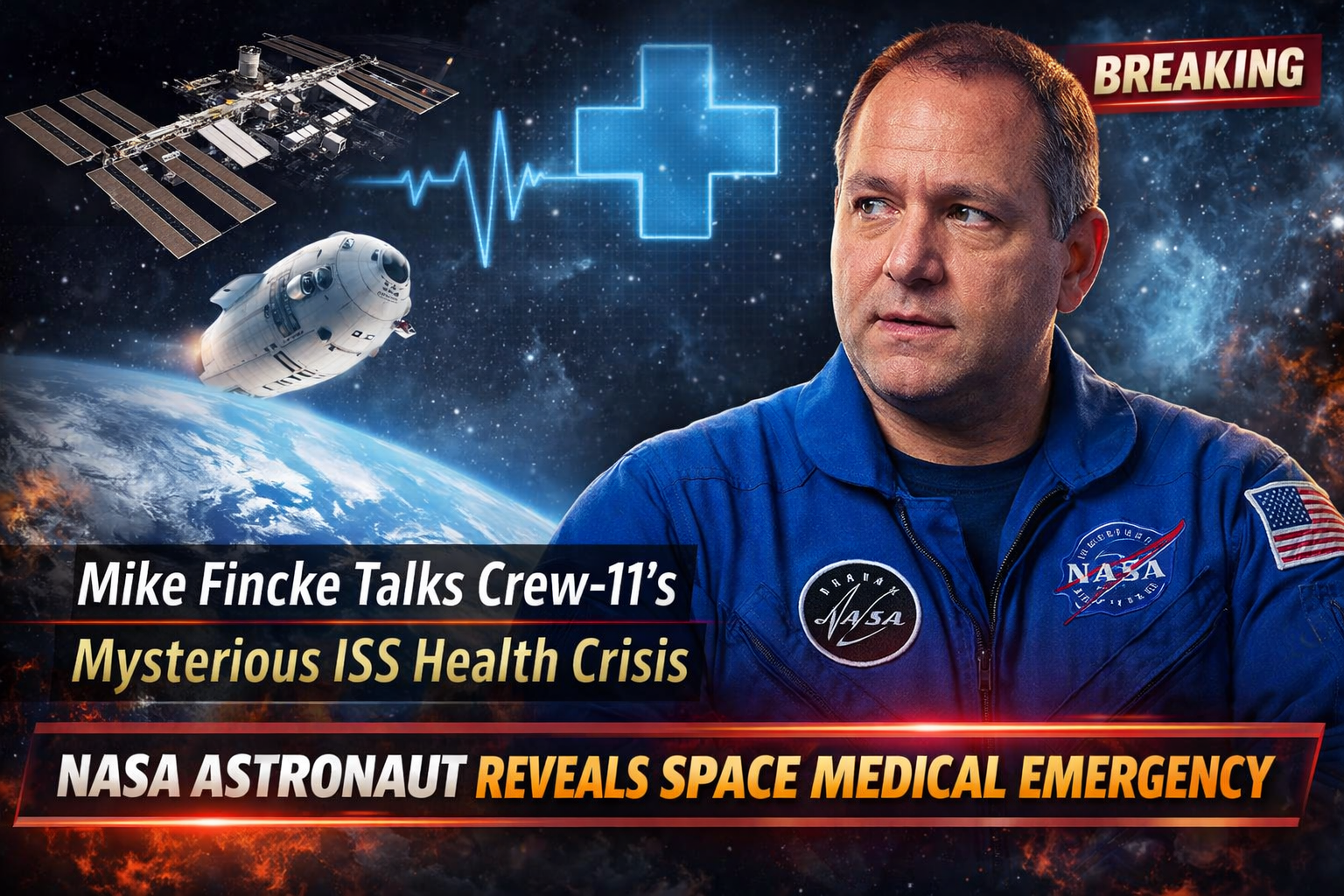
In a rare and revealing account, Mike Fincke, a veteran astronaut of multiple space missions, has spoken publicly about the mysterious medical emergency he experienced aboard the International Space Station (ISS) earlier in 2026. The incident not only disrupted ongoing operations in orbit but also led to the first-ever medically driven early return of a crew from the ISS, marking a historic moment in human spaceflight.
Fincke’s experience has drawn attention from scientists, medical experts, and space agencies worldwide, raising important questions about the health risks of long-duration space travel and the preparedness of astronauts and mission planners for unforeseen medical crises in space.
The Incident: A Sudden and Unexplained Event
The medical emergency occurred on January 7, 2026, during the SpaceX Crew-11 mission. Fincke reported that the event came without warning while he was aboard the ISS. According to his account, the situation required immediate attention from fellow crew members, who acted quickly under the guidance of NASA’s flight surgeons.
In a more detailed description reported in news coverage, Fincke experienced a temporary inability to speak, a condition that lasted for several minutes before resolving on its own. Despite the alarming nature of the episode, he did not feel pain, and his condition stabilized rapidly thanks to prompt intervention. However, the exact cause of the event remains unknown, even after extensive medical testing.
NASA’s Response: A Historic Medical Evacuation
Following the incident, NASA made the unprecedented decision to cut the Crew-11 mission short and return all four astronauts to Earth ahead of schedule. This marked the first time in ISS history that a mission was terminated due to a medical issue affecting a crew member. The agency clarified that the return was not an emergency evacuation in the traditional sense but a “controlled medical evacuation”, designed to allow access to advanced diagnostic tools unavailable in space. The crew, including Fincke, NASA astronaut Zena Cardman, JAXA astronaut Kimiya Yui, and Roscosmos cosmonaut Oleg Platonov, safely returned to Earth on January 15, 2026, aboard a SpaceX Dragon capsule.
Medical Mystery: What Doctors Know So Far
One of the most striking aspects of the incident is that doctors have yet to determine a definitive cause. Initial concerns such as heart problems or choking have reportedly been ruled out, leaving experts to explore other possibilities. Medical teams are considering whether the episode could be linked to the effects of microgravity, prolonged exposure to space conditions, or neurological factors. Fincke himself has spent more than 500 days in space over his career, making him one of NASA’s most experienced astronauts. The lack of a clear diagnosis highlights the complexity of human physiology in space, where even minor anomalies can have unpredictable consequences.
Impact on Mission Operations
The medical event had immediate operational consequences. Planned activities, including spacewalks and maintenance tasks, were canceled to prioritize crew safety. NASA’s response demonstrated the agency’s robust safety protocols, which emphasize rapid decision-making and crew well-being over mission objectives. The coordination between astronauts, mission control, and medical teams ensured that the situation was managed effectively. The incident also underscored the importance of real-time medical support systems, including communication with Earth-based specialists who guide astronauts through emergencies.
Life After the Incident
Following the splashdown, Fincke underwent medical evaluation and treatment at Scripps Memorial Hospital in California, before continuing recovery at NASA’s Johnson Space Center in Houston. He has since reported that he is “doing very well” and is undergoing standard post-flight reconditioning, which helps astronauts readjust to Earth’s gravity. Despite the unexpected end to the mission, Fincke expressed gratitude toward his crewmates and NASA teams, emphasizing the human element of space exploration and the importance of teamwork in overcoming challenges.
Broader Implications for Space Exploration
The incident has significant implications for future missions, particularly as NASA prepares for ambitious projects such as the Artemis program and potential human missions to Mars. Long-duration missions will expose astronauts to greater risks, including radiation, muscle atrophy, and potential neurological effects. The uncertainty surrounding Fincke’s condition highlights the need for:
- Enhanced medical monitoring systems
- Advanced diagnostic tools onboard spacecraft
- Improved understanding of space-related health risks
As missions venture farther from Earth, the ability to manage medical emergencies autonomously will become increasingly critical.
The Human Side of Spaceflight
Fincke’s experience serves as a powerful reminder that astronauts, despite their training and resilience, remain vulnerable to the same medical uncertainties as people on Earth. His candid discussion of the event reflects a broader shift toward greater transparency in space missions, helping the public better understand the realities of life in orbit. It also reinforces the idea that space exploration is not just a technological challenge but a human endeavor, requiring adaptability, courage, and collaboration.
From an editorial standpoint, this incident represents a critical moment in the evolution of human spaceflight. While the successful handling of the emergency demonstrates NASA’s preparedness, the unresolved nature of the medical event raises important questions about the limits of current knowledge. As space agencies push toward longer and more distant missions, space medicine must evolve alongside engineering advancements. Investments in research, real-time diagnostics, and autonomous medical systems will be essential to ensure astronaut safety. Fincke’s experience also highlights the importance of transparency and communication, both within the scientific community and with the public. Understanding the risks of space travel is crucial for building trust and support for future missions.