
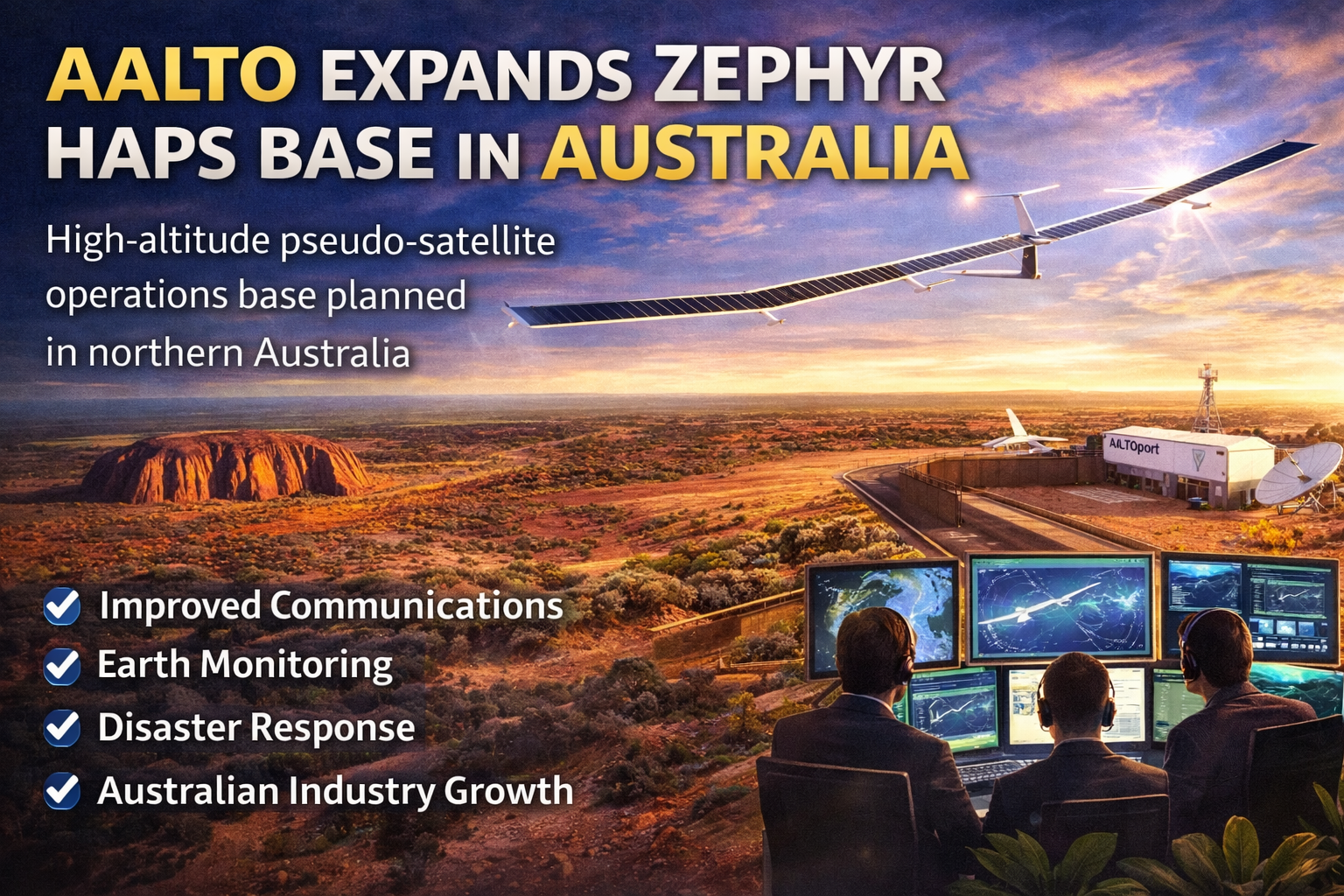
AALTO HAPS Ltd is proceeding with the project to have a new operating base in northern Australia to augment its high-altitude pseudo-satellite (HAPS) services. The Airbus-supported company desires to extend its stratospheric aircraft services in the Asia-Pacific. This new base would be the second global operating base of this company and would contribute significantly to future communication and Earth-observation service delivery in the stratosphere.
The project falls under long term objective of AALTO to offer low-endurance, flexible and inexpensive aerial platforms that will be able to carry out a sizeable portion of the activities of satellites at considerably lower costs and flexibility. The company expects to serve both commercial and government customers in the region through its establishment in Australia.
Understanding the High-Altitude Pseudo-Satellite Concept
The high-altitude pseudo-satellite is an airplane that flies very high in the atmosphere at a height of 60,000 to 70,000 feet in the stratosphere. It flies above the commercial air traffic and weather systems at this altitude. Although it is not in space, it can undertake functions that are like those of satellites, and these functions include: communication relay, Earth observation, environmental monitoring and surveillance.
Unlike the old satellite,s where the satellite is placed in the orbit and cannot easily be serviced or re-positioned, pseudo-satellites can be brought back to earth to be serviced and upgraded. This will help them to be more flexible and economical. They are also able to pay long attention time in a particular location that helps in monitoring disasters, border security and telecommunication cover in remote locations.
The Zephyr Aircraft and Its Capabilities
The plane in the middle of the service of AALTO is known as Airbus Zephyr. Zephyr is a solar-powered unmanned aircraft that is very lightweight and has a very high wingspan. It is meant to remain in the stratosphere for weeks or even months at a time. Its solar panels absorb the sun during the day. It also flies at night on stored battery power.
Zephyr is the record time holder in high altitude flight. It proved to be capable of staying in the air for more than two consecutive months in its previous operations. It is particularly useful in offering permanent communication services and around-the-clock surveillance services within a certain area because of its long-duration functionality.
The plane is able to carry light yet sophisticated loads such as communication gadgets, high-resolution cameras and scientific sensors. These payloads enable Zephyr to accommodate mobile networks of connectivity, environmental investigation and protection missions.
Why Northern Australia Was Selected
There are a number of advantages of conducting operations in stratospheric aircraft in Northern Australia. The area boasts expansive space, fairly less air traffic, and pleasant climatic conditions. All these factors make launching and recovery of high altitude aircraft easier and safer.
Geography is another important factor. The location of Northern Australia enables AALTO to serve vast parts of the Asia-Pacific with ease. It is also close to the equator to enable it to enjoy good solar conditions, which is of great importance to an aircraft that is powered by solar energy, such as Zephyr.The firm is in the process of considering the possible locations and collaborating with the local government in order to make the final decision on the site. Upon completion, the new base, also known as an AALTOport, will have launch, landing, mission control and maintenance facilities.
Economic and Strategic Benefits for Australia
The establishment of a stratospheric operations base in Australia could bring significant economic and technological benefits. First, it could create new high-skilled jobs in aerospace engineering, research, aviation operations and data analysis. Local businesses may also benefit by supplying equipment, logistics and technical services.
Second, the project could strengthen Australia’s position in the growing global space and advanced aviation industries. Although pseudo-satellites operate within Earth’s atmosphere, they are closely linked to the broader space sector. Developing expertise in this area could help Australia build sovereign capabilities in advanced aerospace technologies.
Additionally, the service could improve connectivity in remote and rural regions. Many parts of northern Australia have limited access to reliable communication networks. A stratospheric platform like Zephyr could provide broadband coverage, emergency communication services and support for disaster response efforts.
Collaboration with Industry and Government
AALTO has expressed interest in working with Australian companies, universities and research institutions. The company is encouraging local developers to design and supply payloads that can fly on Zephyr aircraft. These partnerships could help create a domestic ecosystem focused on high-altitude platform technology.
Government cooperation will also be essential. Regulatory approvals are required for high-altitude operations, airspace management and infrastructure development. AALTO plans to coordinate closely with both federal and Northern Territory authorities to ensure safe and compliant operations. Such collaboration could support research in climate monitoring, agriculture management, maritime surveillance and defense applications.
Expanding the Global HAPS Network
The proposed Australian location would establish AALO as the second large-scale operation base in addition to its operations in other localities. Through its construction of various bases across the globe, the company hopes to establish a chain of stratospheric platforms that will be in a position to offer sustained services on various continents.
This growth is a wider phenomenon in the aerospace innovation, with businesses looking at alternatives to conventional satellite systems. High altitude pseudo-satellites are the point of convergence between space technologies and aviation. They are satellites that have the stamina of aircraft.
The Future of Stratospheric Connectivity
High-altitude pseudo-satellites such as Zephyr demonstrate that aerospace technology is changing to satisfy the current communication and monitoring requirements. With the increase in the need to have faster internet, real-time data and affordable coverage in far places, the stratospheric platforms may be a relevant solution. As it expands into Australia, AALTO is putting itself in the position of leader in this up-and-coming industry. Successfully, the project would show how aircraft powered by the sun in the stratosphere can be used to supplement the traditional satellites and ground networks to make the future more connected and technologically more advanced.
Looking Ahead
In case the regulatory approvals and the site selection procedures are conducted as scheduled, the Australian base might be constructed in the near future. The facility would, once in operation, assist the normal flights of Zephyrs in addition to the commercial flights in the Asia-Pacific on a regular basis.
The development of AALTO in Australia shows the increase in the significance of stratospheric platforms in contemporary communication and observation systems. Zephyr and other aircraft like it can be used to bring about a future of connectivity and monitoring systems in the world by incorporating solar energy, lightweight materials, and an advanced digital payload.