
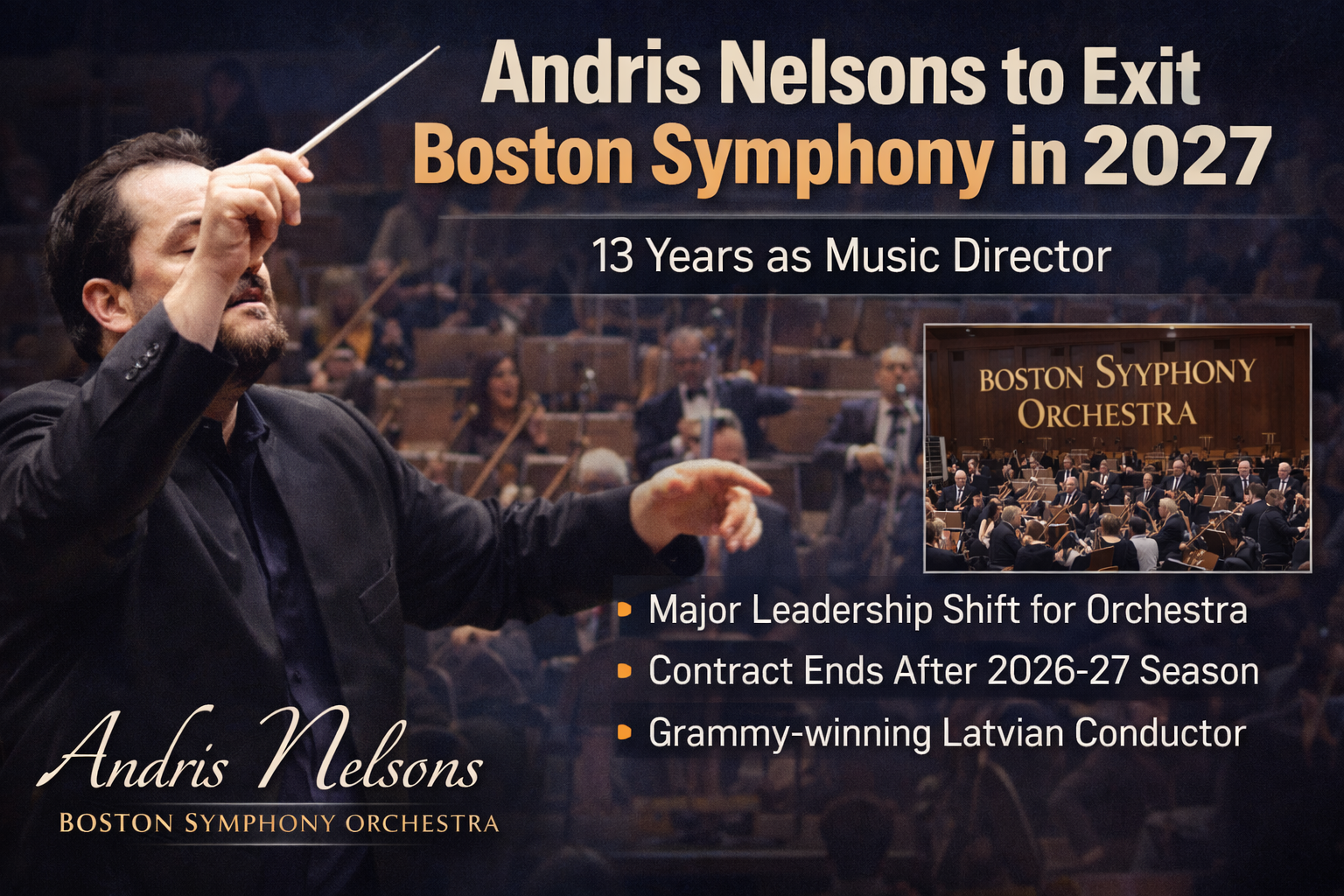
This week, the classical music world was shaken as the Boston Symphony Orchestra announced that its long-time music director, Andris Nelsons, will retire at the end of the 2026-2027 season. The move effectively terminates a 13-year leadership that has influenced the contemporary identity and the world perception of the orchestra.
The board of trustees of the orchestra affirmed that the contract of Nelsons will never be renewed for a season past 2027 at Tanglewood, citing that there was a difference in the future vision between the conductor and the leadership of the organization. It was an unusually straightforward announcement in the classical music industry, which would describe the change of leadership in a more diplomatic manner.
To Nelsons, a renowned Latvian conductor and a winner of several Grammy Awards, the move looks to be a shock. He wrote to his fellow workers and musicians and gave what can only be described as a disappointed letter saying that he did not love walking away, leaving the orchestra.
Boston Transformational Period
The Boston Symphony contacted Nelsons to be associated with the company in 2011 when he took over as a replacement conductor to lead a concert at Carnegie Hall at the last moment. The result of that acting led to a relationship that turned into a deep one. The orchestra made him the 15th music director within two years, and his official leadership started in the 2014-15 season.
Nelsons was regarded as one of the most interesting conductors of his generation at the time. His appointment marked a new dawn for the orchestra, which had hitherto been headed by such influential leaders as James Levine.
Nelsons revitalized the orchestra in his era by incorporating daring programs and international projects. His leadership also assisted in reinforcing the orchestra with a sense of European musical tradition by virtue of having an alliance with the Leipzig Gewandhaus Orchestra, wherein he is also the chief conductor.
Among the most prominent works Nelsons did was his award-winning recording cycle of the symphonies of Dmitri Shostakovich, which Deutsche Grammophon published. These recordings won a number of Grammy Awards and were acclaimed with its touching depth and historical vision.
The orchestra also increased its touring under his baton and strengthened its reputation as one of the most prestigious ensembles all over the world.
Why the Split Happened
The trustees of the orchestra said that the refusal to renew the contract of Nelsons was based on the fact that the long-term goals did not match, but not on the performance of his music.
In a statement, the orchestra said that the two parties had the same intention of not compromising on the highest artistic standards, but their vision of what the orchestra should be in the future did not coincide.
This argument implies that the shift is not as much of a quality in performance; rather, it is a direction within an institution. This is due to the fact that major cultural organizations tend to reevaluate leadership when new artistic strategies, outreach programs or financial models are being planned.
Nelsons will retire at the end of the 2027 summer with the orchestra at the legendary Tanglewood Music Center, where he has also been head of conducting. The last season should be his honourable farewell, as special concerts are set to be held.
Greater Change in the Classical Music World
The time when Nelsons left also represents a change in the wider generational outlook of the American orchestral world.
A number of large groups are looking forward to leadership transitions over the next few years. In the case of Gustavo Dudamel, he will leave the Los Angeles Philharmonic to become the music director of the New York Philharmonic. In the meantime, Franz Welser-Möst will leave the Cleveland Orchestra by the conclusion of the same 2026-2027 season.
These concomitant changes are a suggestion of notable repositioning of leadership within the world-renowned orchestras.
In the case of the Boston Symphony Orchestra, the issue at hand is to find an individual who could continue delivering the prestige that the ensemble has in the demanding times of the modern classical music listeners, and how to lead it through the changing times of the music world.
Nelson’s Legacy in Boston
However, despite the suddenness of the announcement, the legacy of Nelsons in Boston is still significant.
He came at a time when orchestras around the world were struggling with a downturn in attendance, financial problems and a sense of not being relevant in a digital world. In his turn, Nelson advanced emotional intensity as the basis of performance and enhanced the international cultural engagement of the orchestra.
His interpretations of Romantic repertoire and 20th-century repertoire, especially by composers such as Shostakovich, Mahler, and Strauss, were widely praised by critics.
Another aspect that mattered was his association with the musicians. There are numerous instances of players who have talked publicly of the team spirit he created in the orchestra.
Although the move to separate might have shocked those who witnessed it, it does not take away the impact that Nelsons has had on the artistic identity of the orchestra.
What Comes Next
The Boston Symphony Orchestra has yet to declare the timeframe of its search for the next music director. Nevertheless, the choice of the successor will be one of the most far-reaching in the recent history of the organization.
The music directors influence the selection of repertoires for recording projects and international tours. They are also very crucial in raising funds and involvement in the community.
The prestige of the orchestra will bring to the position, probably, the top conductors in the world.
Nelsons will proceed to serve his duties up to the 20262027 season, and will stay committed in other places like Leipzig.
An Editor’s Perspective
Only editorial-wise, this progression is not so dramatic a break but rather a pivot.
Classical institutions tend to be long-term oriented, and the change of leadership never happens abruptly. The name of the vision of the board is a hint that the orchestra is in the stage of going forward to something different, such as repertoire, increased community exposure or new online projects.
But the scene in which Nelson leaves is also emotional. His reign has been among the epochs of art in the modern life of the orchestra. To conclude that chapter so suddenly may be interpreted as the attempt to instill the sense of the instability of the institution, despite the fact that the real reasons behind it are strategic.
The true challenge to the Boston Symphony Orchestra will be the way it manages the transition. Provided that it is capable of commemorating the achievements of Nelsons and strategizing its new era of leadership, the organization might become even stronger.
However, when the process of finding a successor becomes lengthy and controversial, it can put a longer shade on what is otherwise supposed to be remembered as a colorful and prosperous era in the orchestra’s history.
In the meantime, however, the viewers are given two seasons to continue watching Nelsons on the podium in Boston- a reminder that there is no world where even classical music can go without the idea that everything has a time to pass.