
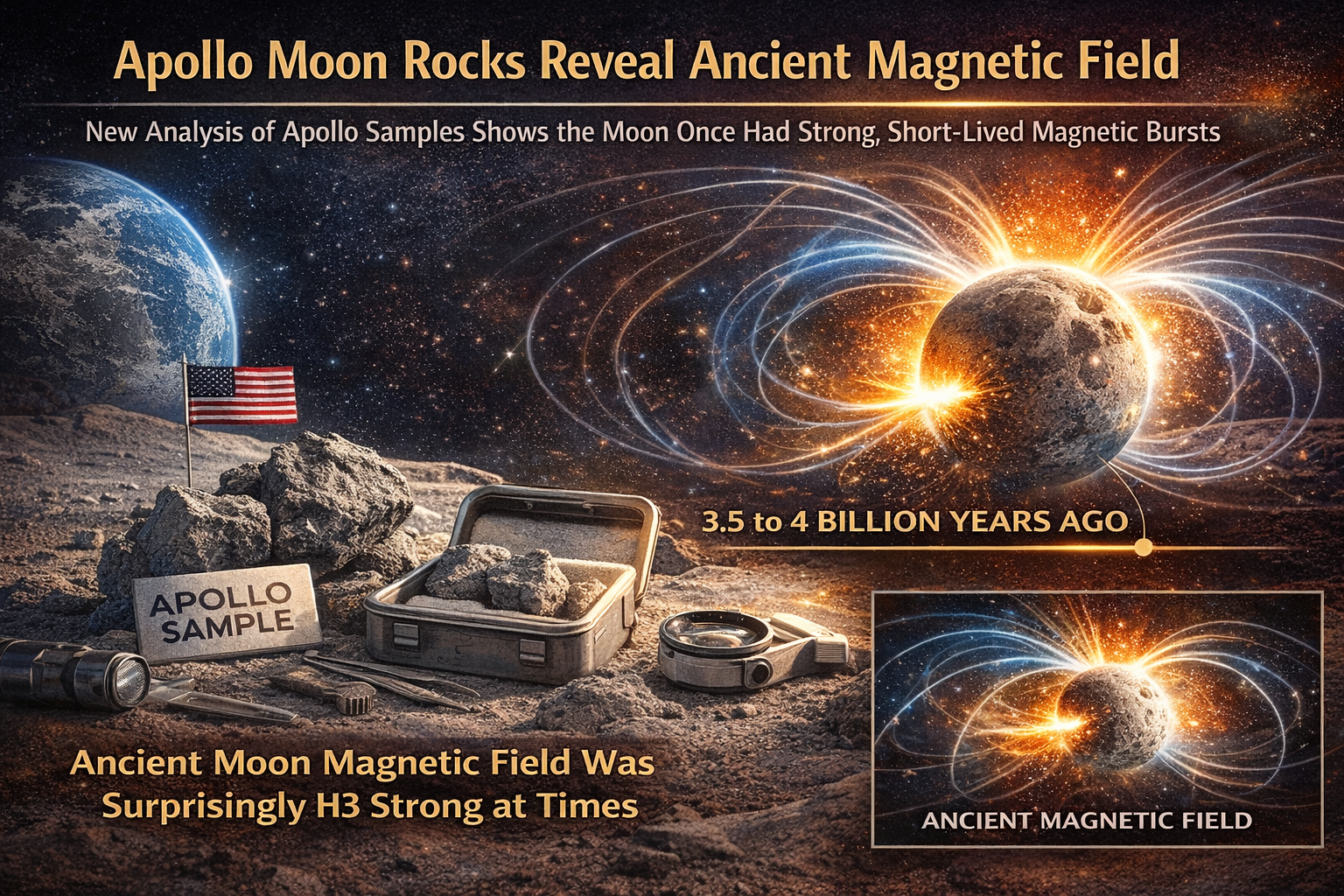
New compelling evidence has been discovered by the scientists crunching through moon rocks gathered more than 50 years ago by the astronauts on the Apollo missions, and new facts have been discovered that have disproved the ancient-held beliefs about the old state of the lunar environment. This week, the journal Nature Geoscience published research indicating that, despite having a weak magnetic field during its whole history, in bursts of activity, the magnetic field of the moon was strong several billion years ago. So it once again cast fresh light on the events that shaped our closest star and the early solar system. This discovery highlights the timeless worth of the Apollo samples and a bright scientific future as the Artemis program of NASA is gearing up to send people back to the moon.
Between 1969 and 1972, hundreds of pounds of lunar rocks were brought back by Apollo astronauts. Since then, this collection of samples has continued to yield important information about lunar geology, planetary evolution, and Solar System history. A team of scientists at the University of Oxford, led by Claire Nichols, reworked the Apollo samples using the latest analysis methods in their recent study. They find that the magnetic field of the Moon, which has long been viewed as either consistently strong in its early life or steadily weaker, actually had sudden peaks of strong activity between some 3.5 and 4 billion years ago. These mag bolts could even have been stronger than the magnetic field of the Earth on some occasions.
Revisiting Old Samples with New Technology
Scientific debate over the moon’s magnetic field has been going on for decades. Past analyses of lunar rocks had indicated that the Moon might have possessed a powerful magnetic field in the past over a long period of time. The paleomagnetic readings of rocks collected at Apollo landing sites partially supported this concept. Nevertheless, the sampling localities were restricted, and those initial analyses were confined to the extent of the technology available at the time. The rocks gathered by the Apollo missions were mostly in the low-latitude lava plains that were rich in titanium, which, as scientists know, can selectively retain magnetic signals.
In the new work, the Oxford team reassessed these Apollo rocks and discovered that high titanium contents are associated with unusually intense preserved magnetic indications. This indicates that the observed magnetic signals do not necessarily indicate that there is an existing global lunar magnetic field. Still, they do indicate brief episodes of dynamo activity within the depths of the Moon’s interior. These periods or bursts can last up to about 5,000 years or even less than a couple of decades, indicating the dynamic processes within that were never realized before in such ancient times.
It is suggested by the researchers that these intermittent magnetic spikes could have been caused by melting titanium-rich rocks in the area near the lunar core-mantle boundary. And as this kind of dynamo engine rose and fell, it left traces of recorded magnetism in some of these rocks. The Apollo samples are mostly volcanic samples, which means that they may not represent a global magnetic history of the Moon, and this makes it harder to interpret them as before.
What These Findings Mean for Lunar History
Lead author Claire Nichols cites the study as an imperative gap in the knowledge of the magnetic development of the Moon. Instead of an ancient and long-standing discipline, the Moon appears to have had short and intense magnetic bursts that could have had critical consequences for the lunar surface and possibly for the early Earth, too. The results contradict straightforward theories of lunar magnetism and provide impetus to reevaluate the manner in which planetary dynamos are capable of functioning in small rocky objects.
The role of magnetic fields in protecting the planetary bodies against solar and cosmic radiation is very important. On the surface, our magnetic field plays a role in shielding the atmosphere and the surface against the inflow of charged particles, which are emitted by the Sun. The current magnetic field of the moon is practically negligible. Yet, the lunar field peaks are higher than Earth’s, hinting at ancient magnetism and raising questions about the moon’s interaction with solar wind and early Earth. Research indicates that a magnetic Moon might have helped to protect the early atmosphere and conditions of the surface of the Earth billions of years ago and that it may have had substantial effects on habitation.
The ramifications are greater than lunar science. Knowledge of the behavior of the magnetic field of the Moon assists scientists in improving their models of the magnetic evolution of the planet. They can also comprehend the mechanisms that activate and deactivate dynamos in small bodies. The Moon is not as large or endowed with heat processes as the Earth, and thus its dynamo behavior is more sporadic than continuous. The intermittent dynamo model has become one through which magnetic signatures on other airless objects in the solar system may now be interpreted.
Looking Ahead to Artemis and New Discoveries
The relationship to the NASA Artemis program, which seeks to bring humans back to the Moon for longer exploration, is one of the most thrilling elements of this research. The Artemis missions intend to provide a landing ground to astronauts in the lunar south pole, which is filled with permanently shadowed craters and even water ice. The retrieval of new samples in these untouched landscapes will enable scientists to gain more insight into the history of the moon, such as the history of the magnetic field across more geographic regions.
The Apollo samples have so far been of invaluable value, though they are the product of a very limited area of the lunar surface. The rocks that will be collected by Artemis in the future will show whether the sporadic magnetic spikes that were detected in the Oxford research were local incidents or elements of the global procedure. This would open up avenues to the understanding of the process of cooling and evolution of the moon’s interior and would allow the models of solar system evolution to be calibrated.
Moreover, the results might have an impact on the plans of safeguarding space radiation for future astronauts. In case the ancient Moon had periods of high magnetic shielding, the mechanisms of the spikes can enlighten the plan of human exploration and long-term residence on the lunar surface, where radiation is a serious issue. Although the existing magnetic shield on the Moon is very poorly covered, understanding how it worked in the distant past may provide some hints on how future explorers may address the risk of radiation.
This research also underscores the interconnectedness of space exploration programs across generations. Apollo missions laid the foundation for lunar science, and Artemis aims to extend it with fresh data and broader exploration. As scientists piece together the Moon’s complex magnetic history, public interest and engagement with lunar science will likely grow. These narratives enrich our collective view of humanity’s place in the cosmos, reminding us that exploration—whether robotic or human—continues to expand our scientific horizons.
The Moon’s Magnetic Legacy
In conclusion, the latest analysis of Apollo lunar rocks offers an intriguing and nuanced picture of the Moon’s ancient magnetic field. Instead of a long-sustained magnetic dynamo early in its history, the Moon appears to have experienced intermittent but powerful spikes of magnetic activity driven by internal processes billions of years ago. These findings reshape scientific understanding of lunar magnetism and provide a compelling case for continued study through future Artemis missions. As humanity prepares to return to the Moon, the lessons drawn from these old rocks will guide new explorations and deepen our understanding of the Moon and the early solar system.