
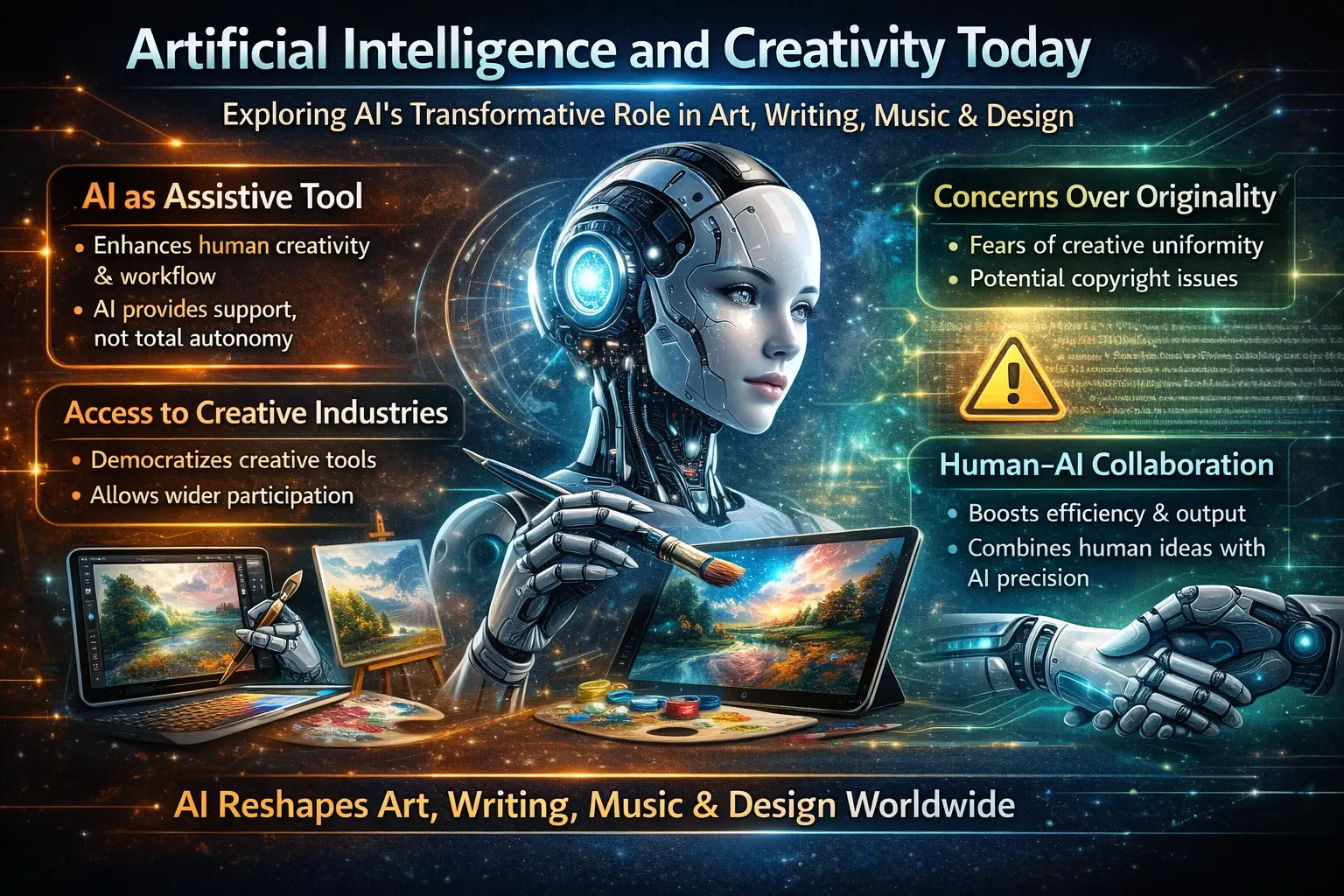
The emergence of Artificial Intelligence (AI) is affecting creative sectors more and more, as it is proving wrong a long-standing assumption that creativity is a purely human ability. Since writing and painting can now be enhanced by AI that composes music and even designs something digital, AI tools are now elements of daily creative processes anywhere in the world. What was considered experimental technology has quickly become popular, and creators, institutions, and audiences are all reevaluating the ways in which creative work is created and appreciated.
The rise of AI adoption has paralleled significant transformations in the nature of digital consumption, speed, volume and accessibility are starting to become central to creative success. Because of this, AI-driven tools are no longer exclusive to tech-savvy people and huge companies. These tools now support independent creators, freelancers and small studios to keep up with the demand of the high-paced digital platforms.
According to The Guardian Nigeria, creativity is not always being reduced by the ever-increasing presence of AI, but rather being transformed into some basic forms. Instead of overtaking the human imagination, AI finds itself in a growing role as a support tool that improves efficiency and workflow and opens a larger creative gateway. This change has elicited controversy on whether it should be the process, the product or the purpose of the process that should determine creativity.
AI as an Assistive Tool, Not an Independent Creator
Creative people in different fields claim that AI is not intentional, emotional, or lived-in, which are the qualities of a true creative person. According to writer Matthew Simpa, AI can only create meaning when it is guided by human instruction and thus cannot create meaning on its own. In his opinion, it is the human idea, emotion, or story that is the first step in creativity, and AI only assists in making an idea, emotion, or story more refined, structured, or expressed.
This opinion is quite common in the field of the creative industry, which is more often called an assistant of AI than a creator. According to artists and writers, AI-created content is not always deep and original without human guidance. Although AI can copy styles and patterns, it lacks awareness and cultural knowledge, which is a fundamental part of being creative.
Another point that is stressed by numerous creatives is that AI lacks creative risks. Rather, it is based on previous data, which supports the notion of human judgment as the key to innovation. Consequently, AI is considered to be an assistance to creativity and not a replacement of imagination of human beings.
Expanding Access to Creative Industries
Among the most important effects of AI, there has been the democratisation of creative tools. People who used to not have technical abilities, formal training, or even financial means are now able to produce content of professional quality on AI-based platforms. This has paved the way for new voices and new perspectives, especially in those areas where the traditional creative infrastructure is not readily available.
Authors are becoming more and more active in writing by use of AI to write, edit, and formulate content, and musicians are creating music with little equipment or software. Designers are able to produce images, logos and illustrations without any technical preparation. This availability has enlarged access to the creative sectors and minimized the use of costly tools and huge production groups.
Meanwhile, the content production has increased because of the ease of creation. The quality control, originality, and oversaturation of AI-assisted content are under question because now digital platforms are flooded with it. According to industry observers, the fact that AI has boosted output has also heightened competition for the attention of the audience.
Human–AI Collaboration and Creative Efficiency
Studies on human-AI partnership indicate that creatives collaborating with AI tend to take shorter periods of time to accomplish tasks and have higher technical accuracy. The AI systems are good at recognizing patterns, quick iteration, and the automation of repetitive tasks, including editing, formatting, and simple composition. This enables creators to concentrate more on idea thoughts and narrative.
Professionally, AI is becoming popular to facilitate brainstorming, generating ideas and drafting. The advertising agencies, content studios, and digital media companies are using AI to optimize production schedules and fulfill commercial requirements.
But scholars warn that AI systems are extremely dependent on the existing datasets. Consequently, blind trust in AI might insidiously affect the creative focus and restrain experimentation. Unless human attentiveness is given to the creative products, they can start to have similarities, making the results less varied in terms of style and confidence.
Concerns Over Originality and Creative Uniformity
The issue of originality is on the rise as AIs gain more and more popularity in content generation. Critics state that it is likely that due to the many AI models being trained on similar data, they reproduce common patterns and styles, common narratives, and common visual patterns. This has created concerns that creativity is likely to get homogenized with time.
Such anxieties are especially intense in the business fields of marketing, digital media and online publishing, where efficacy frequently prevails over artistic daring. There is also the fear that the use of AI tools can lead to a lack of experimentation and a decline in the desire to pursue an unconventional idea.
Some say that originality is increasingly becoming more human. Within a world inundated with AI-created content, the unique voices of creators can gain increased importance, making creators focus on being authentic and having a personal experience.
Entertainment Industry Pushback
The entertainment industry is one that has reacted with stiff opposition to the increased role of AI. Actors, writers, and performer unions have sounded the alarm concerning AI-written scripts, AI-created characters and digital performances. They claim that these practices are dangerous to employment and the worth of human narration.
It has been questioned how AI can be used to duplicate voices, faces, and performances without permission. The entertainment industry has been hit hard by these developments, raising more debates on the limits of ethical concerns, labour rights, and ownership.
Creative professionals have urged industry bodies to come up with more explicit guidelines that will help prevent the irresponsible use of AI. Contracts between labour unions and manufacturing organisations now include provisions in dealings about the use of AI and the protection of human employees.
Copyright and Legal Uncertainty
Copyright and intellectual property issues remain unresolved as AI adoption accelerates. Many artists and writers have questioned whether their work has been used without permission to train AI systems. The lack of transparency around training data has fuelled mistrust between creators and technology companies.
Legal cases in several countries are examining whether AI-generated content violates existing copyright laws. Courts and policymakers are struggling to determine who owns AI-created material and how credit and compensation should be assigned.
As AI-generated content becomes more prevalent, governments are under pressure to modernise regulations. These efforts aim to balance technological innovation with the protection of creative labour and intellectual property rights.
Technology Companies Defend AI Use
The technology companies that have created AI tools argue that they are created to empower creators and not to substitute them. According to them, AI has led to lower technical barriers, and more individuals can be involved in creative industries.
AI also allows creators to devote their time to storytelling, emotional richness, and idea creation by automating repetitive and time-consuming processes. One more point that companies focus on is that AI promotes experimentation because it enables creators to pilot ideas fast and at volume, which in the past was costly and time-intensive.
Numerous companies emphasize the significance of ethical AI development and point to the continuous work on the enhancement of transparency and accountability.
Education and Cultural Adaptation
Schools are starting to accommodate the rising AI creative role. Models. The introduction of AI literacy is being made through art, design, and writing programmes to allow students to be familiar with the potential as well as the limitations of these tools.
The educators prioritize critical thinking, originality, and ethical awareness so that the students can use AI in a responsible way. Cultural observers observe that, despite the changes in the production approaches due to AI, audience expectations are still based on authenticity and connection.
AI’s Growing Role in Global Creative Economies
AI-powered technologies have allowed independent creators to access global audiences with small budgets and without institutional help in emerging markets. This has helped to increase the diversity of culture and representation in the world media.
With the further development of AI, the topic of ethics, regulation, and responsible use is not closed yet. Governments, creators, and technology companies are trying to establish the limits that safeguard human creativity and still accommodate technological development.