
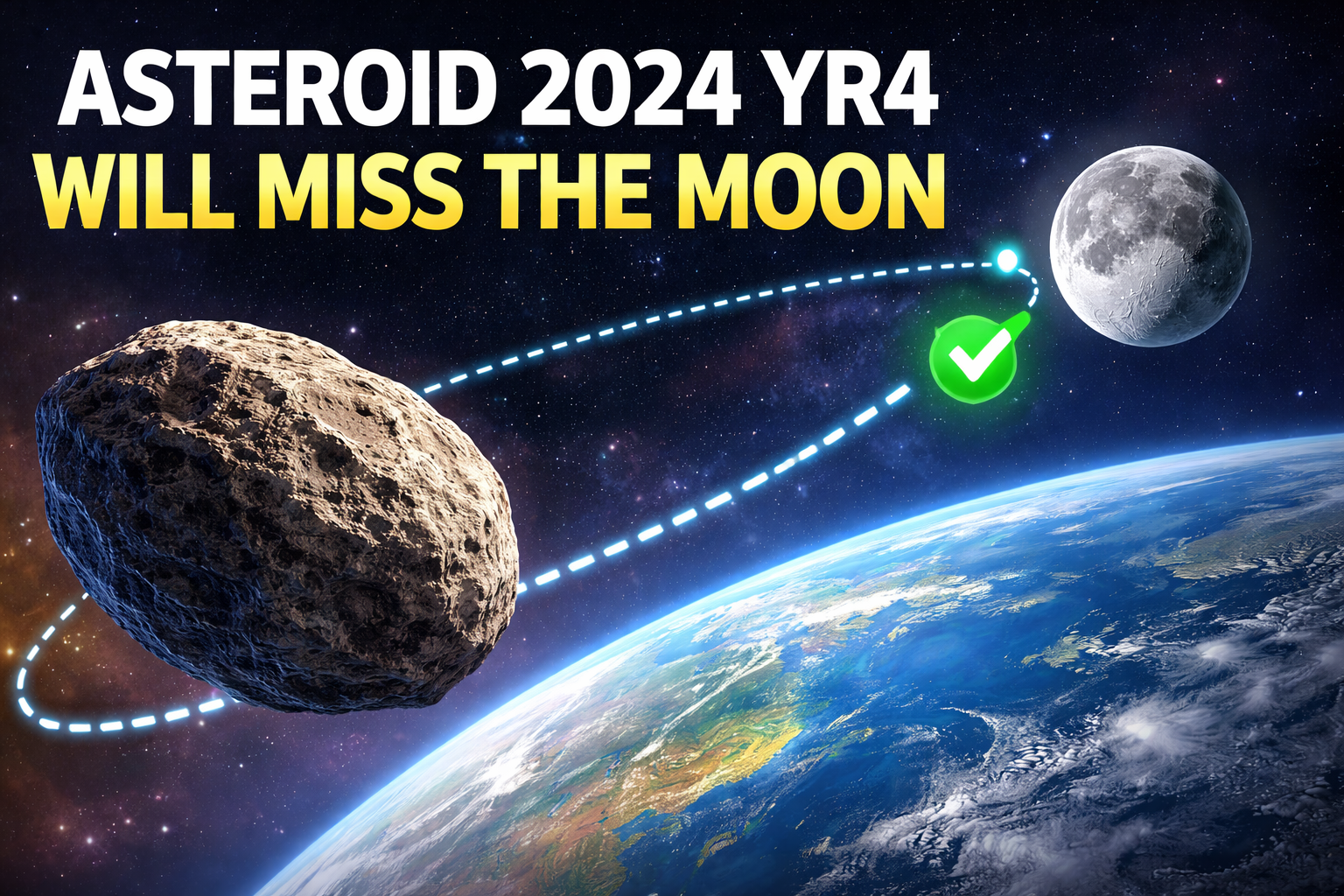
NASA confirms asteroid 2024 YR4 will not strike the Moon in 2032 after new telescope data refined its trajectory.
Over a few months, the world’s astronomers were very alert to a near-Earth asteroid by the name 2024 YR4, which was a rocky body around 60 meters (approximately 200 feet) in diameter and initially caused speculations of an impact with the Moon. Early orbital estimates indicated that the asteroid was not a threat to the earth. Still, there was a low probability (approximately four percent) that it would hit the surface of the moon in December 2032. This would have caused a dramatic flash that would have been seen on Earth and a larger crater on the Moon.
But there is good news which was brought by new observations by the strong telescopes: the asteroid will not run into the Moon at all. Recalculations indicate that the space rock will safely moan around both the earth and its natural satellite. Scientists believe that the updated information eliminates the remaining vestige danger and proves that the asteroid will entirely miss hitting Earth in the year 2032 and will not cause any harm.
Planetary defense research can be dynamic and full of uncertainty as seen in the case of asteroid 2024 YR4. It also shows how novel observations can significantly enhance the knowledge of scientists on the dangers that may happen in the universe.
Discovery of a “City-Killer” Asteroid
The Asteroid Terrestrial-impact Last Alert System (ATLAS), a survey located in Chile, initially discovered asteroid 2024 YR4 in December 2024. This chain of telescopes can scan the sky of near-Earth objects that can be dangerous to our planet. The asteroid was detected soon after it had already swept quite near to the earth, at a distance of approximately 828,800 kilometers or a little more than the distance between the earth and the moon.
Despite the fact that such approach was safe, first calculations brought up concerns as to its future path. Having an estimated diameter of about 53 67 meters, the asteroid is classified in a category that is sometimes colloquially referred to as city-killer objects at that size, it would be capable of causing severe local damage should it ever be drawn to Earth. Luckily, additional observations soon eliminated the risk of an impact of the Earth on its next close approach in 2032.
However, astronomers found something interesting: whereas the Earth seemed to be safe, the Moon could be not. Initial orbital calculations suggested an approximation of 4 percent probability of a collision with the surface of the moon, which is a fairly large possibility by astronomical standards.
This was an opportunity that attracted the mind of people. Such a collision would have formed a crater some one kilometer across and would have released an energy equivalent to a large nuclear explosion.
How the Moon Became the Target
Due to the anomalous orbit of the asteroid, the body came into the close vicinity of the earth and the moon on its estimated flyby on December 22, 2032. Since the gravitational attraction of both objects affects any objects in the surrounding, slight errors in the orbit of the asteroid would alter forecasts regarding the direction.
With the continued gathering of data, these astronomers noticed that although the asteroid was approaching Earth safely, its trajectory in a few of the simulations overlapped the Moon. The estimate changed when scientists refined their estimations and finally settled on four percent.
This possible lunar influence was of interest due to the fact that this would have offered a scientific rare occasion. Provided that the asteroid had hit the dark side of the Moon, the explosion may give a bright flash that can be seen on the Earth with the help of telescopes- and, probably, with the naked eye. Scientists estimated that the flash could be very bright and could shed light on planet Venus, several minutes.
Other scientists even proposed that the collision would spew huge masses of lunar debris into space, and this would result in a distinctive meteor shower on Earth days later. Most fragments would burn harmlessly in the atmosphere, but the occurrence would provide useful information on the physics of asteroid impacts.
New Telescope Data Changes the Picture
The turning point came when astronomers used the James Webb Space Telescope (JWST) to observe asteroid 2024 YR4 in February 2026. These observations allowed scientists to measure the asteroid’s position and motion with far greater precision than earlier ground-based observations.
Using the new data, NASA’s Center for Near-Earth Object Studies (CNEOS) recalculated the asteroid’s orbit. The results showed that the asteroid would miss the Moon by about 13,200 miles (21,200 kilometers) during its 2032 flyby.
This refined trajectory effectively eliminated the possibility of a lunar impact. NASA scientists announced that the probability of a collision is now zero, meaning that both Earth and the Moon are completely safe from asteroid 2024 YR4.
The asteroid will still pass through the Earth-Moon system, but at a distance that poses no risk.
Why Predictions Change Over Time
The evolving story of asteroid 2024 YR4 illustrates an important aspect of astronomy: predictions about asteroid paths improve as scientists gather more data.
When an asteroid is first discovered, astronomers often have only a short observational record—sometimes just a few days of measurements. With limited information, predictions about its future path can contain significant uncertainties.
Over time, additional observations allow researchers to refine their calculations. Each new measurement narrows the range of possible trajectories until the asteroid’s orbit becomes well understood. In many cases, potential threats are eventually ruled out as scientists collect more data.
This process is a normal part of planetary defense science and does not mean that earlier warnings were mistaken. Instead, it reflects the careful and cautious approach scientists take when assessing potential hazards.
The Role of Planetary Defense
Asteroid 2024 YR4 briefly achieved a Torino Scale rating of 3, making it one of the most closely watched near-Earth objects in recent years. The Torino Scale measures the potential hazard posed by asteroids on a scale from 0 to 10. A rating of 3 indicates a close encounter that merits attention from astronomers but does not represent an immediate threat.
When the asteroid’s probability of impact exceeded one percent, international planetary defense organizations began coordinating observations. This included telescopes operated by NASA, the European Space Agency, and other institutions around the world.
Such efforts are part of a global strategy to detect and track potentially hazardous asteroids long before they could pose a real danger. Early detection provides valuable time to plan possible deflection missions if necessary.